
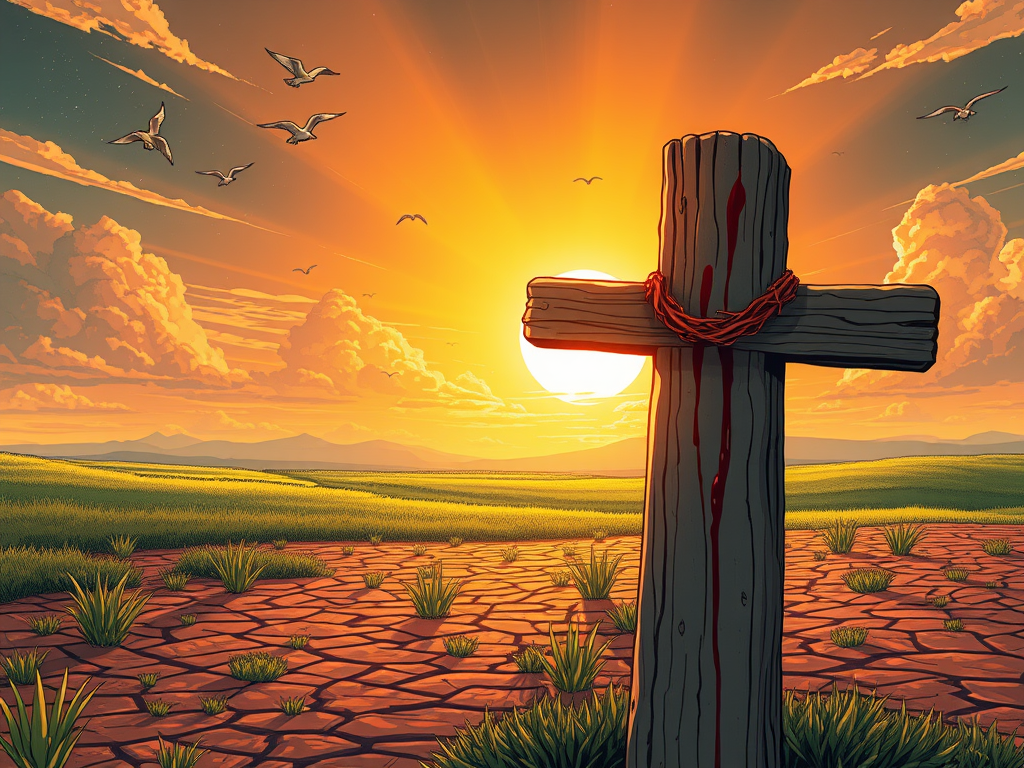
Humanity, Christ, and the Answer That Existed Before the Question
There is a strange problem hidden inside every intelligent mind.
How does a thing know what it is?
A tree does not know it is a tree. A rock does not know it is a rock. A bird does not know it is a bird. They simply exist. Yet humanity possesses a unique ability. We can step back and ask questions about ourselves. We can wonder who we are, why we are here, and what purpose our lives serve. We can examine our own existence.
But even here a problem appears.
Can a thing fully know itself from within itself?
Imagine a box. A box cannot know it is a box. It cannot step outside itself and observe itself. It cannot compare itself to something greater. It cannot define itself because it has no perspective outside itself. The box requires something beyond itself to reveal what it truly is.
Perhaps humanity faces the same dilemma.
If humanity is the highest thing that exists, then humanity becomes its own ruler, its own judge, and its own measuring stick. Humanity decides what is good. Humanity decides what is evil. Humanity decides what is truth. Humanity becomes both the examiner and the thing being examined.
But can anything truly measure itself?
This question is older than Christianity. Plato wrestled with it. Augustine wrestled with it. Centuries later, C. S. Lewis wrestled with it in Mere Christianity, particularly in Book One, Chapters One through Five, where he discusses what he calls the Moral Law. Lewis observed that human beings constantly appeal to standards they did not create. People argue about fairness, justice, honesty, and right behavior as though such things actually exist.
Why?
Because deep down humanity seems to recognize that any true standard must exist beyond the reach of the thing being judged. If humanity creates the standard, humanity can change the standard. If humanity becomes the judge, humanity can excuse itself. But a genuine standard must stand above humanity, outside humanity, and beyond humanity’s authority to alter it. Otherwise there is no judgment at all—only self-approval disguised as wisdom.
The Moral Law and the Mirror
One of the most profound realizations in life is that morality functions much like a mirror. A mirror does not create a flaw on a person’s face. It simply reveals what is already there. If a person discovers dirt on his face after looking into a mirror, the mirror did not cause the problem. The mirror merely exposed a reality that already existed. In a similar way, moral standards do not create human failures. They reveal them.
The Apostle Paul expresses a similar idea when discussing God’s law. Writing to the Romans, he explains:
“Through the law comes the knowledge of sin.”
— Romans 3:20 (NET)
Paul’s point is not that the law creates sin. Rather, the law reveals it. The law functions as a moral mirror. It shows humanity what is present but often hidden. Without a standard, people may convince themselves that everything is fine. Once the standard is revealed, however, shortcomings become impossible to ignore.
This observation helps explain an example discussed by C. S. Lewis in Mere Christianity (Book One, Chapters One through Three). Lewis asks readers to consider situations that appear similar on the surface but feel completely different when examined morally. Imagine boarding a crowded bus and finding every seat already occupied. You remain standing throughout the journey. Although this may be inconvenient, no one has wronged you. The situation is simply an ordinary part of life.
Now imagine a different situation. You are already seated and stand briefly to stretch your legs. While you are away from your seat, another passenger pushes your belongings aside and takes your place. Once again, you are standing. The outcome is exactly the same as before. Yet nearly everyone immediately senses that something different has occurred.
The difference is not found in the result. In both cases you are standing rather than sitting. The difference lies in the moral reality of the situation. In the second example, something deeper has been violated. Fairness has been violated. Respect has been violated. Common decency has been violated. Justice has been violated. The inconvenience may be identical, but the moral weight is not.
Lewis uses examples such as these to demonstrate what he calls the Moral Law. Human beings instinctively appeal to standards such as fairness, honesty, and justice. Even people who break these standards often attempt to justify themselves by arguing that they had a good reason. They rarely deny that the standard exists. Instead, they try to explain why their actions should be treated as an exception to it.
This realization is crucial to understanding the argument of this article. The Moral Law acts like a mirror because it reveals more than the actions of others. It reveals something about ourselves. When we recognize injustice, we are also acknowledging a standard by which we ourselves may be judged. The mirror is not merely showing us what other people are. The mirror is showing us what we are.
And once humanity discovers the existence of the mirror, a deeper question emerges. If the mirror reveals a standard, where did that standard originate? Did humanity create it, or does it exist beyond humanity itself? That question ultimately leads us back to the central problem of the box. A box cannot define itself. A standard cannot originate from the thing being measured. If the mirror reveals a reality beyond ourselves, then perhaps the source of that reality also lies beyond ourselves.
Humanity’s Greatest Problem
One of the observations that struck me while listening to C. S. Lewis is that intelligence and goodness are not the same thing. Humanity often assumes that increased knowledge will naturally produce a better world. If we become smarter, more educated, more technologically advanced, and more capable, then surely we will become more moral as well. History, however, tells a different story.
The same species that composes symphonies also wages war. The same minds that discover medicine also devise new methods of destruction. Humanity has learned to fly through the skies, cross oceans, split atoms, and send machines into space, yet these achievements have not removed greed, hatred, envy, pride, violence, or cruelty. Every generation celebrates its own wisdom while looking back at previous generations and wondering how they could have been so blind. Yet the next generation often says the same thing about us.
Throughout history civilizations have risen with confidence in their own intelligence. Kings have declared themselves divine. Empires have proclaimed their rule would never end. Nations have trusted in military strength, economic power, and human ingenuity. Yet one after another they eventually fade into history. Their monuments crumble, their rulers die, and their achievements become chapters in books. Humanity repeatedly demonstrates that possessing knowledge is not the same as possessing wisdom.
The Moral Law discussed in the previous section reveals something important. Humanity is capable of recognizing fairness, justice, and goodness, yet humanity repeatedly fails to live according to those standards.
The Bible presents this same conclusion repeatedly. Isaiah stood before the holiness of God and did not proclaim the failures of others. Instead he cried out:
“Woe to me! I am destroyed!”
— Isaiah 6:5 (WEB)
The closer humanity comes to a perfect standard, the more clearly humanity sees its own imperfections. Intelligence can reveal the problem, but intelligence alone cannot solve it. Humanity possesses knowledge, yet humanity lacks perfection. The mirror continues to reveal what we are, but it cannot make us what we ought to be.
The Problem of Self-Measurement
The moment humanity becomes its own standard, every measurement begins to shift. One person compares himself to another and finds comfort in the comparison. A nation compares itself to another nation and concludes that its own faults are smaller. One generation looks back at previous generations and declares itself wiser, more enlightened, and more moral. Yet each generation is judged by those that follow. The measuring stick continually changes because the people holding it continually change.
This creates a serious problem. If humanity is the highest authority, then there is no fixed standard by which humanity can be measured. The thief compares himself to the murderer and concludes he is a good man. The liar compares himself to the thief and concludes he is honest. The proud compare themselves to the wicked and conclude they are righteous. In every case the comparison is made against another imperfect person. The result is that everyone can eventually find someone worse than themselves and use that comparison as proof of their own goodness.
History demonstrates this problem repeatedly. Entire civilizations have justified practices that later generations would condemn. Powerful rulers have declared themselves wise while leading nations into ruin. Whole societies have accepted injustice because everyone around them accepted it as normal. When humanity measures itself by humanity alone, the standard becomes unstable. What one century praises, another century condemns. What one culture celebrates, another culture rejects. The result is not certainty but confusion.
Scripture approaches the question differently. Rather than presenting God as merely a more intelligent version of humanity, the Bible presents God as existing beyond humanity altogether. Through the prophet Isaiah, God declares:
“Indeed, my plans are not like your plans, and my deeds are not like your deeds,” says the LORD.
— Isaiah 55:8 (NET)
This statement reaches beyond the idea of greater intelligence. The claim is not merely that God knows more facts than human beings. The claim is that God’s perspective exists above and beyond the limitations of human understanding. The Creator is not simply another voice among many voices. The Creator stands outside the system itself.
This realization brings us back to the problem of the box. A box cannot fully define what a box is because it cannot step outside itself. In the same way, humanity cannot ultimately define goodness, justice, or truth by appealing only to humanity. If the standard originates within mankind, mankind can alter it whenever convenient. A true standard must stand above the thing it measures. Humanity does not invent goodness; humanity discovers goodness. Humanity does not create justice; humanity discovers justice. Humanity does not define truth; humanity discovers truth. The standard remains beyond our reach because it must remain beyond our authority.
This is why the search for truth eventually leads beyond humanity itself. If there is a fixed standard, it must exist outside the object being measured. The box cannot define the box. Only something beyond the box can reveal what the box truly is.
Humanity’s Ultimate Defense
Perhaps the most remarkable thing about humanity is not our intelligence, our technology, or even our creativity. Perhaps the most remarkable thing is that humanity can question its own Creator. A mountain cannot protest its existence. An ocean cannot challenge the purpose for which it was made. Animals live according to their nature without asking why they exist. Humanity alone seems capable of standing beneath the heavens and asking questions about life, suffering, justice, and even God Himself.
This ability appears throughout Scripture. Job questioned his suffering. The Psalms contain cries of confusion, grief, and frustration. The prophets often asked why judgment came in one generation and mercy in another. Human beings possess reason, imagination, self-awareness, and free will. These gifts allow us to ask questions that no other known creature can ask. Why do we suffer? Why do we die? Why is there injustice? Why does God permit evil? Does the Creator truly understand what it means to live as one of His creatures?
Whether these questions are ultimately right or wrong is not the point. The point is that humanity can ask them. We are capable of constructing arguments, defenses, and objections. We can examine our own existence and challenge the very circumstances of our creation. In doing so, humanity arrives at a fascinating possibility. A person might eventually stand before God and argue:
“Only a human truly knows what it means to be human.”
The statement may or may not be correct, but it is a defense that humanity is capable of making. It is an argument born from suffering, limitation, and experience. A person who has known hunger, grief, betrayal, fear, temptation, and death may wonder whether anyone who has not experienced such things can fully understand them. Throughout history, countless people have wrestled with this question in one form or another.
This is where the discussion becomes especially interesting. If God is truly all-knowing, then God would not merely know humanity’s actions. God would know humanity’s thoughts. God would know humanity’s questions. God would know every argument humanity would eventually construct against Him. Before Adam walked in Eden, before Noah entered the ark, before Abraham left his homeland, before Moses climbed Sinai, before Job suffered, before Isaiah saw the throne room, God would already know every objection humanity would someday raise.
Before the first tear was shed, God would know the question. Before the first grave was dug, God would know the question. Before the first cry of injustice rose from the earth, God would know the question. If God truly knows the end from the beginning, then humanity’s greatest argument could never take Him by surprise.
And if God knew the question before humanity ever asked it, then it is possible that God also prepared the answer before humanity ever needed it. The answer would not come in the form of a philosophical argument or a heavenly explanation. The answer would come in the form of a person. Long before humanity asked whether God understood what it meant to be human, the answer already existed in the purpose and person of Christ.
The Failed Union of Genesis 6
Genesis 6 contains one of the most mysterious and debated passages in all of Scripture. Before the account of the flood, the text records an unusual event involving the “sons of God” and the “daughters of humankind.” The passage states:
“The sons of God saw that the daughters of humankind were beautiful. Thus they took wives for themselves from any they chose.”
— Genesis 6:2 (NET)
The biblical account is brief and leaves many questions unanswered. For centuries, readers have debated who these beings were and what exactly occurred. Yet the passage clearly serves as part of the introduction to the corruption that eventually led to the judgment of the flood.
The Book of Enoch, a respected ancient Jewish work known and discussed during the Second Temple period, expands this story dramatically. According to Enoch, heavenly beings descended to earth, took human wives, taught forbidden knowledge, and produced a corruption that spread throughout the world. While Enoch is not part of the biblical canon, its interpretation of Genesis 6 was influential among many ancient readers and provides insight into how this mysterious passage was understood in the centuries before Christ.
Whether one accepts every detail found in Enoch or not, a common theme emerges from both accounts. An attempt was made to unite heaven and earth in a manner that was not part of God’s design. Instead of producing harmony, the result was disorder. Instead of producing righteousness, the result was corruption. Violence increased throughout the earth. Wickedness multiplied among mankind. Human civilization moved further from God rather than closer to Him.
The biblical record describes the condition of humanity before the flood in sobering terms:
“But the LORD saw that the wickedness of humankind had become great on the earth. Every inclination of the thoughts of their minds was only evil all the time.”
— Genesis 6:5 (NET)
The result was not redemption. The result was judgment. The flood came as a response to a world that had become thoroughly corrupt. From this perspective, Genesis 6 presents a failed bridge between heaven and humanity. A union was attempted, but it did not restore creation. Instead, it contributed to its destruction.
This becomes an important contrast for the rest of the article. Humanity could not become God. Heavenly beings could not properly unite themselves with humanity. The bridge remained broken. Every attempt from below ended in failure. Yet the longing for a connection between heaven and earth remained. The question was not whether a bridge would exist, but who alone possessed the authority and holiness to build it.
Humanity’s Attempt to Become God
The pattern that appears in Genesis 6 does not end with the flood. In many ways, the same desire continues throughout the biblical story. Humanity repeatedly seeks to reach beyond the limits of its created nature. From the beginning, mankind has wrestled with the temptation to obtain what belongs to God alone. The desire is not merely to know more, achieve more, or possess more. At its deepest level, the temptation is to become something greater than what humanity was created to be.
The first example appears in Eden. The serpent’s temptation was not simply about eating fruit from a forbidden tree. The temptation centered upon becoming like God. The promise offered to Eve was that her eyes would be opened and that she would possess knowledge reserved for God Himself. Humanity reached upward, seeking wisdom apart from obedience, and the result was separation rather than elevation. Instead of becoming divine, mankind became estranged from the Creator and subject to death.
The same pattern appears again at Babel. Humanity gathered together and declared:
“Come, let’s build ourselves a city and a tower with its top in the heavens…”
— Genesis 11:4 (NET)
The tower represented more than architecture. It symbolized mankind’s attempt to establish its own greatness and secure its own place among the heavens. Once again, humanity sought elevation through its own efforts. Once again, the result was not unity but division. The project ended in confusion, and the people were scattered across the earth.
As history unfolds, the pattern continues. Kings claim divine authority. Pharaohs present themselves as gods. Emperors demand worship. Nations boast of their power and permanence. Civilizations proclaim that their wisdom, strength, and achievements will endure forever. Yet every empire eventually declines. Every ruler eventually dies. Every kingdom eventually passes into history. Humanity repeatedly attempts to exalt itself, and history repeatedly demonstrates the limits of human greatness.
From the perspective developed throughout this article, these events reveal a common truth. Humanity cannot become God. Creation cannot elevate itself into the place of its Creator. The bridge between heaven and earth cannot be constructed from below. Even the account of Genesis 6, as understood through the lens of Enoch, presents a failed attempt at union between heavenly beings and humanity. Neither mankind reaching upward nor other created beings reaching downward succeeded in restoring what had been lost.
The gap therefore remains. Humanity continues searching for meaning, righteousness, and reconciliation, yet the distance between Creator and creation cannot be crossed by human effort alone. The box remains trapped within itself, unable to step outside its own limitations. If a true bridge is ever to exist, it must come from the One who stands beyond the box and beyond creation itself..
The Answer Was Christ
Christianity presents one of the most astonishing claims ever made. Throughout history, humanity has wrestled with questions concerning suffering, justice, mortality, and the nature of God. Philosophers have debated them. Prophets have cried out over them. Entire civilizations have sought answers through religion, reason, and human wisdom. Yet Christianity declares that God’s answer to humanity’s deepest questions was not merely an argument, a philosophy, or a set of commandments. God’s answer was a person.
The Gospel of John introduces this claim in extraordinary language:
“Now the Word became flesh and took up residence among us. We saw his glory—the glory of the one and only, full of grace and truth, who came from the Father.”
— John 1:14 (NET)
This statement represents a dramatic reversal of every failed attempt discussed earlier. Humanity was unable to ascend to God through its own efforts. Empires could not build a tower high enough. Kings could not elevate themselves into divinity. The corruption associated with Genesis 6 and the traditions preserved in Enoch did not restore the relationship between heaven and earth. Every bridge built from below ultimately failed. Christianity proclaims that the solution would not come from creation reaching upward but from the Creator reaching downward.
This is the significance of the Incarnation. The Word did not merely appear among humanity. The Word became flesh. God did not simply observe humanity from a distance. God entered the human condition. The Creator stepped into creation. The Author entered His own story. The One who fashioned humanity from the dust chose to experience life as one of the people He created.
This realization connects directly to the question developed throughout this article. Humanity possesses the ability to ask whether God truly understands what it means to be human. Humanity can construct the argument that only a human being fully understands human suffering, human weakness, human temptation, human grief, and human mortality. Whether that argument is ultimately correct is not the point. The remarkable truth is that humanity is capable of asking it.
Yet Christianity claims that God anticipated the question before it was ever spoken. If God is truly all-knowing, then God knew humanity would one day struggle with suffering, question divine justice, and wonder whether heaven truly understood life on earth. Before the first cry of pain, before the first funeral, before the first act of rebellion, God already knew the questions humanity would ask.
The Incarnation therefore appears not as God’s reaction to humanity’s objections but as God’s provision for them. Christ experienced hunger. Christ experienced exhaustion. Christ experienced rejection by His own people. Christ knew grief at the tomb of Lazarus. Christ endured betrayal by a friend, abandonment by followers, suffering, humiliation, and death. The answer to humanity’s deepest question was not a philosophical explanation but a life lived among us.
From this perspective, Christ becomes more than a teacher or a prophet. Christ becomes the bridge that every previous attempt failed to create. Humanity could not become God. Angels could not properly unite themselves with humanity. Creation could not heal itself. The bridge remained broken until the Creator Himself crossed it. In Christ, heaven and earth meet not through corruption, pride, or rebellion, but through the holy purpose of God.
The most profound implication may be this: the answer existed before the question. Before humanity ever wondered whether God understood what it meant to be human, the answer already existed in the purpose of Christ. The Incarnation was not an emergency measure. It was not a divine adjustment to unforeseen events. It was the answer prepared before the foundation of the world, the moment when the Creator entered the box so that the box could finally understand both its Maker and itself.
The Way, The Truth, and The Life
Shortly before His crucifixion, Jesus made one of the most famous and controversial statements recorded in the New Testament. Speaking to His disciples, He declared:
“I am the way, and the truth, and the life. No one comes to the Father except through me.”
— John 14:6 (WEB)
For centuries Christians have understood this statement as a declaration concerning salvation, and rightly so. Jesus presents Himself as the means by which humanity is reconciled to God. The passage speaks of access to the Father, forgiveness, redemption, and eternal life. Yet when considered alongside the themes developed throughout this article, the statement may reveal an additional dimension that is often overlooked.
Throughout history, humanity has attempted to understand itself by comparing itself to other human beings. One generation measures itself against the failures of a previous generation. One nation compares itself to another nation. One individual compares himself to those he considers worse than himself. The result is an endless cycle of shifting standards. Humanity becomes both the judge and the thing being judged. The box attempts to define the box.
The Incarnation changes this entirely. For the first time, humanity is presented with a perfect reference point that is not merely another human opinion or another human achievement. In Christ, humanity encounters a life fully aligned with the will of God. The standard is no longer measured against kings, philosophers, religious leaders, or cultural expectations. The standard is measured against the One who perfectly fulfilled the purpose for which humanity was originally created.
This helps explain why the Gospels repeatedly present Jesus as both the revelation of God and the revelation of true humanity. When people encountered Christ, they did not merely learn something about heaven. They learned something about themselves. His compassion revealed what love was intended to look like. His humility revealed what greatness was intended to look like. His obedience revealed what faithfulness was intended to look like. His life became a living demonstration of humanity as it was meant to exist in relationship with its Creator.
The Apostle Paul develops a similar idea when he refers to Christ as the “last Adam” (1 Corinthians 15:45). Adam represents humanity as it became after the fall. Christ represents humanity as God intended it to be. In Christ, mankind is given more than an example. Mankind is given a revelation of its original purpose and design. The perfect human life becomes visible for the first time.
This brings us back to the central question of the article. How can a box truly know what a box is? It cannot discover its identity by endlessly comparing itself to other boxes. It requires a reference point beyond itself. In the same way, humanity cannot fully understand humanity by comparing itself only to humanity. A higher standard must reveal what humanity was created to be.
This is why Christ occupies such a unique place within Christian thought. He does not merely reveal God to mankind. He reveals mankind to mankind. He shows what righteousness looks like. He shows what obedience looks like. He shows what love, justice, mercy, humility, and holiness look like when lived in human flesh. The Creator enters creation and, in doing so, provides humanity with the very standard by which it can finally understand itself.
The box finally sees itself because its Maker entered the box.
The Advocate
The story of Christ does not end with the resurrection or the ascension. If the Incarnation represents God entering creation, another question immediately follows. What happens after Christ returns to the Father? Does humanity once again find itself separated from God’s presence? Does the bridge between heaven and earth close after it has finally been opened?
The New Testament answers these questions with the promise of the Holy Spirit. Before His departure, Jesus assured His followers that they would not be left alone. He promised another Helper, another Comforter, and another Advocate who would remain with them. In John’s Gospel, Jesus declares:
“And I will ask the Father, and he will give you another Counselor to be with you forever—the Spirit of truth.”
— John 14:16–17 (NET)
This promise reveals that the work of God among humanity did not end with Christ’s earthly ministry. The Creator who entered creation did not simply visit His people for a brief moment in history and then withdraw. Instead, God’s presence would continue through the Holy Spirit dwelling among and within those who follow Him.
C. S. Lewis reflects on this mystery in Mere Christianity, particularly in Book Four, where he explores the doctrine of the Trinity. Lewis emphasizes that the Holy Spirit is not merely a force, energy, or influence. The Spirit is not an impersonal power flowing through the universe. Rather, the Holy Spirit is fully personal and fully divine, sharing in the very life and nature of God. Readers interested in Lewis’s full treatment of this subject should consult Mere Christianity, Book Four, especially the chapters dealing with the Trinity and the nature of God’s life.
This idea carries profound implications for the argument developed throughout this article. If Christ is the bridge between God and humanity, then the Holy Spirit represents the ongoing reality of that bridge. The Incarnation demonstrates that God is willing to enter the human condition. The Spirit demonstrates that God is willing to remain present with humanity. The Creator is not merely observed in history; the Creator continues to work within creation.
The progression is remarkable. In Christ, God is with us. Through the Spirit, God is in us. The relationship moves from visitation to indwelling. The Creator who stepped into the box does not simply depart and leave the box unchanged. Instead, the Creator continues His work within the lives of those He has created, guiding, teaching, convicting, and transforming them from within.
This brings the article’s central theme full circle. Humanity searched for a standard beyond itself. Humanity longed for a bridge to the Creator. Humanity questioned whether God understood what it meant to be human. In Christ, God answered those questions by entering creation. In the Holy Spirit, God continues that answer by remaining present within creation. The bridge is not temporary. The bridge remains open.
The Box Finally Sees Itself
The greatest mystery of humanity may not be that we search for God. Human beings have always searched for something beyond themselves. Every civilization, every generation, and every culture has wrestled with questions of purpose, truth, justice, life, and death. The greater mystery may be that before humanity ever began searching for God, God had already prepared the answer humanity would eventually need.
Throughout this article, we have followed a simple question: Is a box really a box? A box cannot fully know what it is because it cannot step outside itself and observe itself. It cannot become its own standard. It cannot define itself from within itself. Something beyond the box must reveal the truth about the box. In the same way, humanity cannot fully understand humanity by comparing itself only to humanity. Every human standard eventually shifts. Every civilization changes its definitions. Every generation rewrites its assumptions. The measuring stick moves because the thing being measured is holding the ruler.
The Moral Law points beyond us. The prophets point beyond us. The longing for justice points beyond us. Even our dissatisfaction with ourselves points beyond us. Humanity continually acts as though there is a standard higher than mankind, a truth beyond human opinion, and a goodness greater than human achievement. The mirror reveals that something is missing, but the mirror itself cannot supply what is lacking.
Yet humanity possesses another unique characteristic. Humanity can question its Creator. Humanity can ask whether God truly understands what it means to be human. Humanity can construct the argument that only a human being can fully know human weakness, human suffering, human temptation, and human mortality. Whether that argument is correct is ultimately secondary. The remarkable fact is that humanity is capable of making it.
If God is truly all-knowing, then God knew humanity would eventually ask such questions. Before the first sin, before the flood, before Babel, before Abraham, before Moses, before the prophets, before the first grave was dug into the earth, God already knew every objection humanity would raise. The question was never hidden from Him. The answer was never absent.
The history of Scripture reveals repeated attempts to bridge the distance between heaven and earth. Humanity sought to become like God in Eden. Humanity sought to reach heaven at Babel. Kings and empires claimed divine authority. According to the traditions preserved in Enoch, even heavenly beings attempted an unlawful union with humanity. Yet every bridge constructed by creation ultimately failed. Humanity could not become God. Angels could not redeem mankind. Creation could not heal itself.
Then Christianity presents its astonishing claim. God did not answer humanity’s deepest question with a philosophy. God answered with a person. The Word became flesh and dwelt among us. The Creator entered creation. The One who stood outside the box stepped inside the box. Christ did not merely reveal God to humanity. Christ revealed humanity to itself. For the first time, mankind could see what humanity was intended to be. The standard was no longer an abstract principle. The standard walked among us.
The story does not end there. Through the Holy Spirit, the bridge remains open. God is not merely a distant Creator, nor merely a visitor in history. The same God who entered creation continues to call, teach, guide, and transform His people. The answer continues to reach into the lives of those willing to receive it.
And so we arrive at the final realization. Humanity cannot fully know itself from within itself. The box cannot define the box. The measuring stick must always stand above the thing being measured. The standard must always exist beyond the thing being judged. If humanity is ever to understand itself, the revelation must come from beyond humanity.
Perhaps this is why Christ stands at the center of the Christian story. Not merely because He reveals the way to God, but because He reveals the truth about man. The Creator became one of us so that we might finally understand both Him and ourselves. The answer existed before the question was asked. The bridge existed before the gap was recognized. The light existed before the darkness understood its need.
And in Christ, the box finally sees itself.



Leave a comment