

Looking Back
Now that I can see more of my life behind me than ahead of me, I often find myself reflecting upon the themes that dominated the culture during my lifetime.
Men worried about the size of their manhood. Women were measured by physical attractiveness and bodily proportions. Entire industries profited from these insecurities, convincing people that their value could be found in physical desirability.
The subject appeared so frequently and so persistently that it became part of the background noise of society, a constant stream flowing beneath nearly every form of popular culture.
The Ancient Beauty Industry
Many modern people imagine cultures of the past were less concerned with beauty, appearance, and desirability than our own. Yet Esther reveals an elaborate system devoted entirely to preparing women for presentation before the king. The young women selected for the royal harem underwent an astonishing twelve months of beauty treatments before they were even permitted to appear in his presence. Scripture records,
“Now when every maid’s turn was come to go in to king Ahasuerus, after that she had been twelve months, according to the manner of the women, (for so were the days of their purifications accomplished, to wit, six months with oil of myrrh, and six months with sweet odours, and with other things for the purifying of the women)” (Esther 2:12).
An entire system of cosmetics, fragrances, oils, and beautification existed to enhance physical appearance and increase desirability. Esther herself is introduced as one who was
“fair and beautiful” (Esther 2:7),
and among all the women she “obtained favour in the sight of all them that looked upon her” (Esther 2:15).
Her beauty eventually led to her selection as queen, for
“the king loved Esther above all the women, and she obtained grace and favour in his sight more than all the virgins” (Esther 2:17).
Long before magazines, movies, social media, and advertising campaigns, entire institutions existed that elevated physical appearance as a matter of extraordinary importance. Human nature has always placed tremendous value upon outward beauty, even while Scripture repeatedly reminds us that God looks beyond the outward appearance and examines the heart.
“… for man looketh on the outward appearance, but the LORD looketh on the heart.”
— 1 Samuel 16:7 (KJV)
Don’t let your beauty be external, with braided hair and wearing gold jewelry or fine clothes; but let it be the hidden person of the heart, in the incorruptible adornment of a gentle and quiet spirit, which is very precious in God’s sight.
— 1 Peter 3:3–4 (WEB)
Discovering an Ancient Problem
When I was younger, I assumed this obsession was unique to the modern world. I believed perhaps television, magazines, movies, and later the internet had created a culture unlike any that had existed before it. Yet as I devoted myself to studying the Scriptures, I discovered that humanity’s fascination with sexual behavior is far older than modern civilization.
In fact, the biblical record presents examples of sexual immorality that far exceed anything commonly discussed in ordinary society today. Adultery, fornication, prostitution, temple prostitution, incest, homosexuality, sexual violence, and countless other corruptions appear throughout the biblical narrative.
One reason every generation believes itself to be unique is because it gradually forgets the generations that came before it. Solomon observed this when he wrote,
“There is no memory of the former generations; neither will there be any memory of the latter generations that are to come among those that will come after”
Ecclesiastes 1:11, WEB.
As the wisdom, failures, and experiences of earlier ages fade from memory, each new generation begins to mistake old struggles for new discoveries. What was once recognized as folly is often repackaged as progress, and what previous civilizations learned through painful experience is frequently rediscovered as though it had never been known before. Later Solomon adds,
“That which is has been long ago, and that which is to be has long ago been”
Ecclesiastes 3:15, WEB,
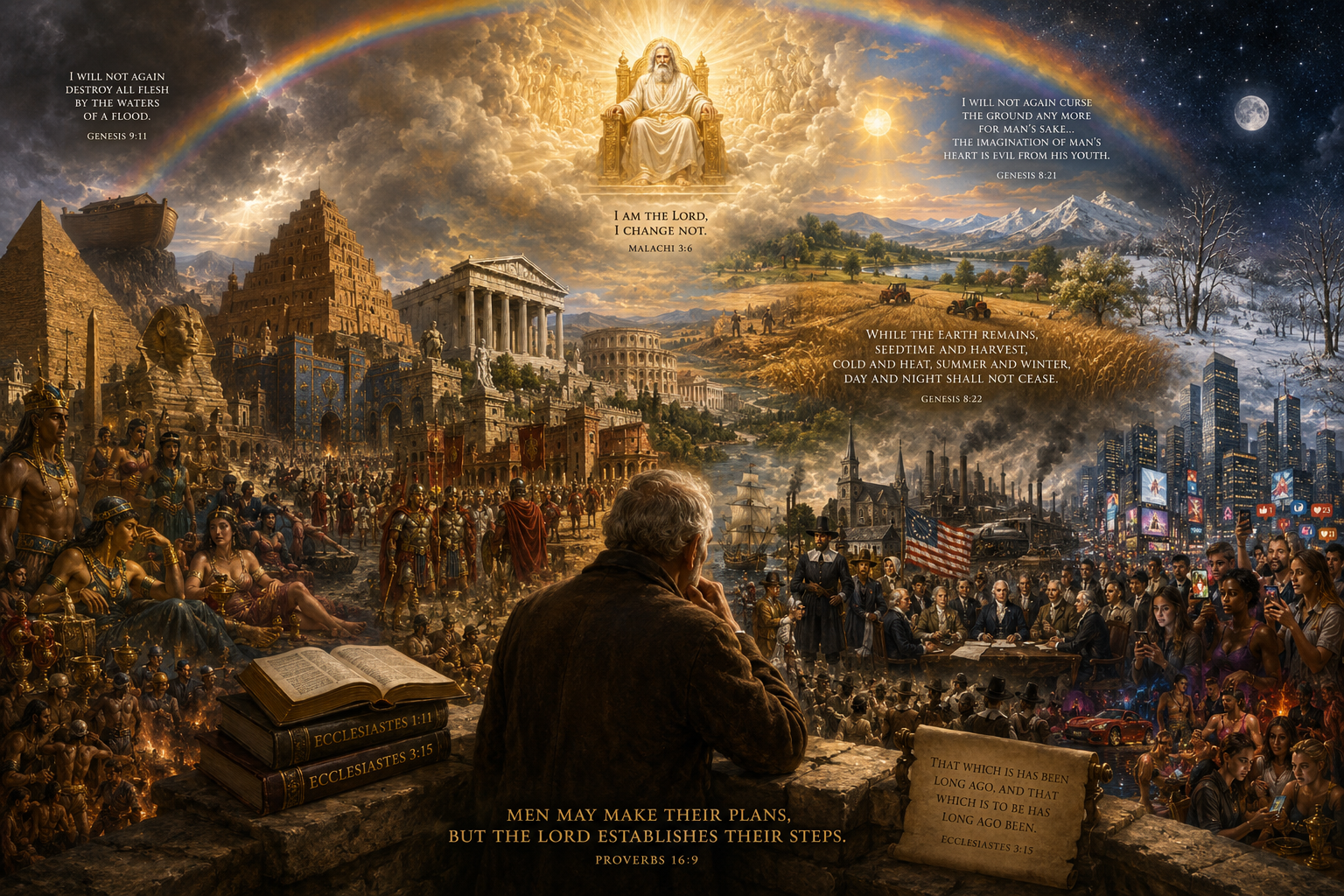
reminding us that beneath the changing names, technologies, fashions, and political movements, the fundamental patterns of human behavior remain remarkably consistent. The more I studied the ancient world, the more I realized that modern man has invented very little.
The forms may differ, but the impulses remain remarkably familiar, for the same desires, ambitions, temptations, and justifications that moved the hearts of men thousands of years ago continue to move them today.
The Covenant After the Flood
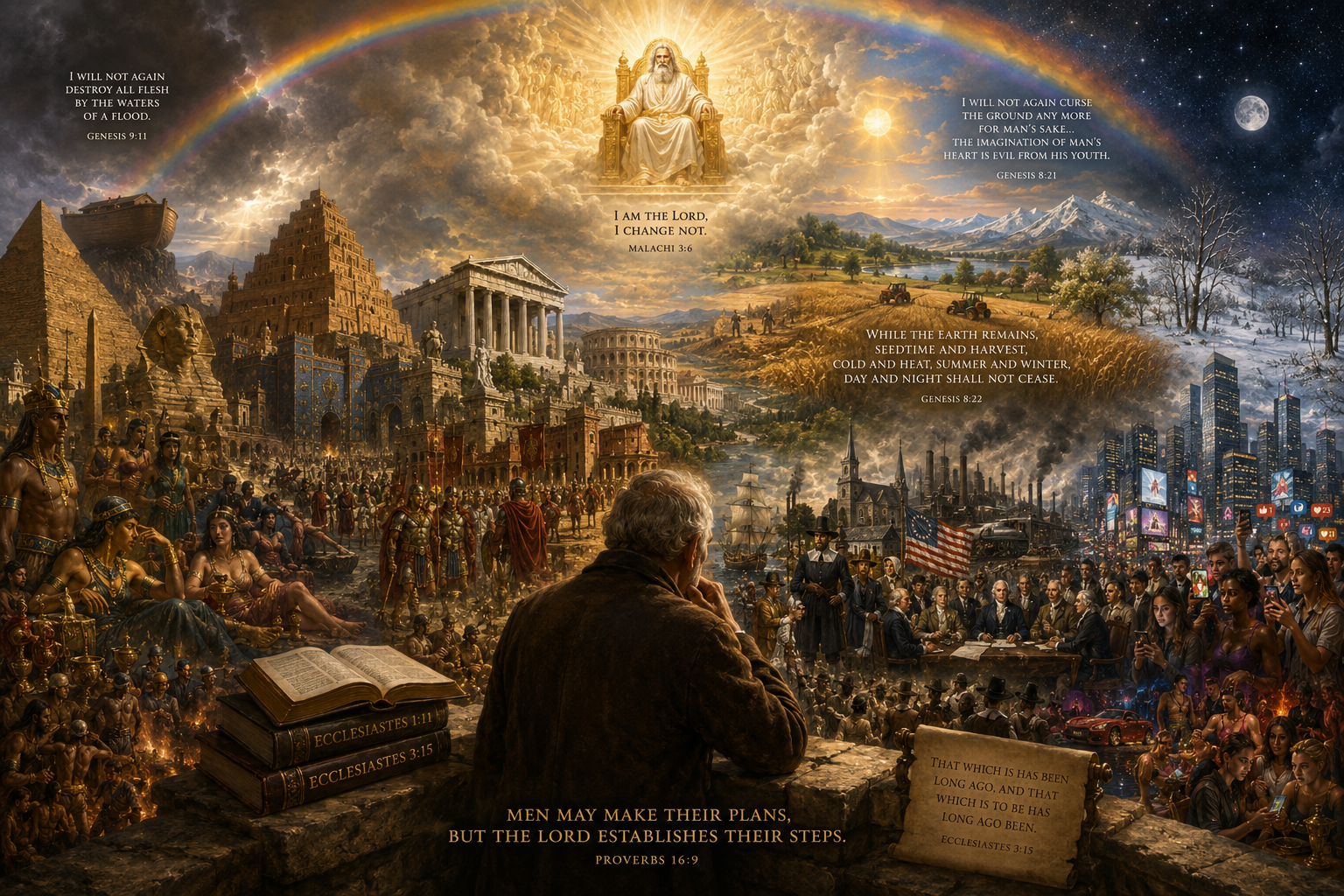
This realization brought me back to the covenant God made with Noah after the Flood. Following the destruction of the world, God declared that He would never again destroy all living creatures by a flood. At the same time, Scripture acknowledges a profound truth concerning mankind. The inclination of man’s heart remains what it has always been.
Yahweh smelled the pleasant aroma. Yahweh said in his heart, “I will not again curse the ground any more for man’s sake, because the imagination of man’s heart is evil from his youth; neither will I ever again strike everything living, as I have done.
While the earth remains, seed time and harvest, cold and heat, summer and winter, day and night shall not cease.”
— Genesis 8:21-22 (WEB)
Humanity survived the judgment, but humanity’s nature did not fundamentally change. The Flood washed away a generation, but it did not wash away the condition of the human heart. The imagination of man would continue to produce both great beauty and great corruption, and God would permit history to unfold according to His sovereign purposes.
Reflecting upon thousands of years of recorded history, I find it difficult to escape the conclusion that human freedom consistently reveals what already exists within mankind. Civilization may restrain certain behaviors for a season through law, custom, religion, or social pressure, but given sufficient freedom, the desires of the human heart eventually make themselves known.
The issue is not technology, education, wealth, or political structure. The issue is humanity itself. Every generation inherits the same passions, the same temptations, and the same capacity to justify its own behavior. What changes is merely the manner in which those desires are expressed.
America’s Experiment
America provides a fascinating example of this principle. The nation emerged from foundations heavily influenced by Christian and Puritan thought. Early generations viewed sexual conduct through the lens of biblical morality and generally regarded self-restraint as a virtue. Public standards reflected a belief that individuals were accountable not only to society but ultimately to God.
America’s earliest foundations were deeply intertwined with Christian belief and the conviction that society itself existed under the authority of God. The Mayflower Compact of 1620 declared that the settlers had undertaken their journey
“for the Glory of God, and Advancement of the Christian Faith,”
establishing from the outset that faith was not merely a private matter but a guiding purpose of the community. Less than two decades later, the Connecticut Fundamental Orders of 1639 spoke of governing in a manner intended
“…to maintain and preserve the liberty and purity of the gospel of our Lord Jesus…”
reflecting a belief that civil government and Christian morality were closely connected. This mindset extended beyond statements of faith into the laws themselves. The Massachusetts Body of Liberties of 1641 declared,
“If any person commit Adultery with a married or espoused wife, the Adulterer and Adulteress shall surely be put to death,”
demonstrating the seriousness with which sexual conduct was viewed and the degree to which biblical morality influenced public standards.
As the colonies matured and eventually moved toward independence, the connection between liberty and morality continued to be emphasized by many of America’s leading voices. Samuel Adams argued that
“Religion and good morals are the only solid foundation of public liberty and happiness,”
expressing the belief that freedom could not survive apart from virtue. This principle was echoed after the founding of the nation by President John Adams, who wrote in 1798,
“Our Constitution was made only for a moral and religious people. It is wholly inadequate to the government of any other.”
These statements reveal a consistent thread running from the earliest settlements through the founding generation: the conviction that self-government depended upon self-restraint, and that liberty could endure only among a people who recognized a moral authority higher than themselves.
These standards were imperfectly practiced, as all standards are, yet they established boundaries that shaped the culture for generations. Over time, however, those boundaries weakened. Behaviors once regarded as sinful became tolerated, then normalized, then celebrated. What previous generations considered moral restraints came to be viewed as obstacles to personal freedom and self-expression.
To me, this transformation does not demonstrate that mankind has become more enlightened. Rather, it demonstrates what mankind naturally gravitates toward when traditional restraints are removed. The democratic experiment has revealed many noble qualities of humanity, but it has also revealed humanity’s persistent attraction to indulgence.
Adultery, fornication, pornography, sexual promiscuity, homosexuality, vulgarity, and countless other expressions of sexual desire increasingly moved from the margins of society into the mainstream. This should not surprise anyone who takes the biblical view of human nature seriously. Scripture consistently portrays mankind as possessing a tendency to pursue his own desires while convincing himself that those desires are righteous.
Sovereignty of God
Yet despite all of this, history remains neither random nor uncontrolled.
The same Scriptures that describe the corruption of mankind also describe the sovereignty of God. Nations rise and fall according to His purposes. Kingdoms appear powerful for a season and then vanish into the pages of history. Cultures embrace virtue and later descend into decadence. Generations convince themselves that they have escaped the moral lessons of the past only to repeat them once again.
Through it all, God remains sovereign. Humanity may exercise its freedom, but it does not escape His authority. Men may imagine themselves masters of their own destiny, yet they continue to live, move, and build their civilizations beneath the government of the Creator who judges both nations and individuals.
Nebuchadnezzar’s confession:
“His dominion is an everlasting dominion, and his kingdom from generation to generation. All the inhabitants of the earth are regarded as nothing; and he does according to his will in the army of heaven, and among the inhabitants of the earth. No one can stop his hand, or ask him, ‘What are you doing?’”
Daniel 4:34-35 (WEB)
“I will magnify myself, sanctify myself, and make myself known in the eyes of many nations.”
Ezekiel 38:23 (WEB)
History is ultimately about God revealing Himself.
“I will set my glory among the nations, and all the nations shall see my judgment that I have executed…”
Ezekiel 39:21-23 (WEB)
So the older I became, the less I saw history as a story of progress and the more I see it as a story of recurring human nature. The names change. The technologies change. The fashions change. The political movements change. Yet the imagination of man remains remarkably consistent. The same struggles recorded in the earliest pages of Scripture continue to unfold before our eyes today.
For all of our advancements, we remain what we have always been: creatures capable of tremendous good, tremendous evil, and an endless ability to convince ourselves that our own desires should sit upon the throne.
– Silent Truths




Leave a comment