The Beginning
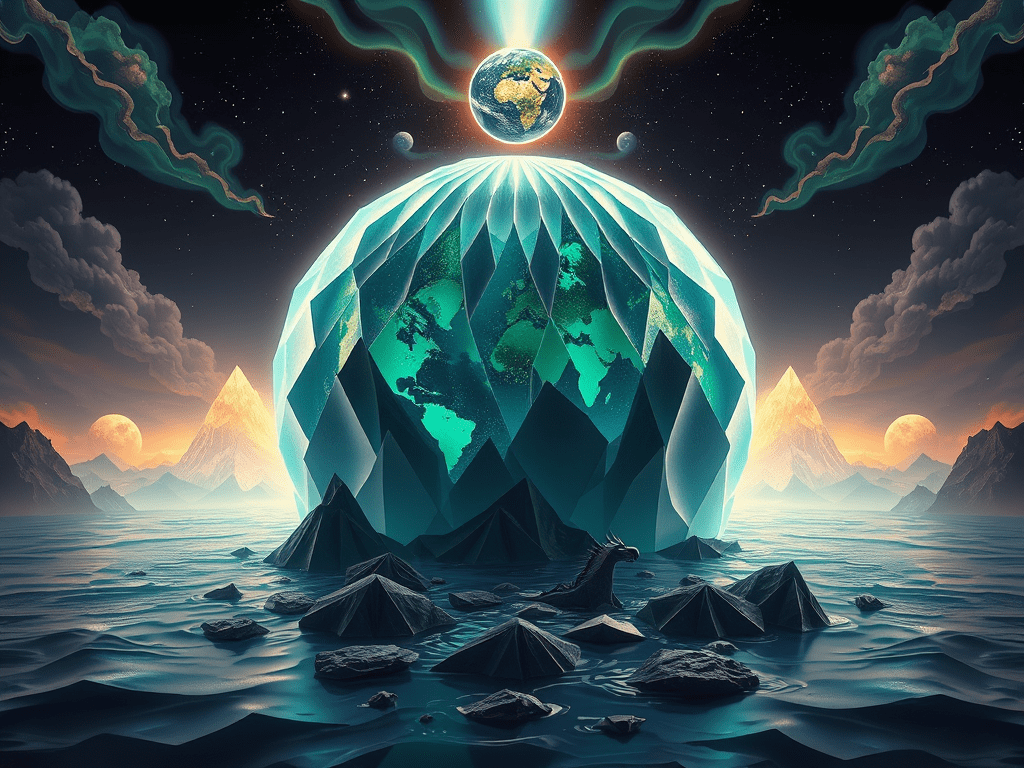
In the beginning, there was no forest, no birdcall, no tide rolling on the shore. There was only silence and fire, stone and storm. Out of that chaos, the first creature was shaped: vast, round, and clothed in seas. She was to be the mother of all things, a seed of seeds, a womb vast enough to carry worlds inside her.
The Maker—a hand beyond the stars—breathed into her not just existence, but the power to bear.
She opened her eyes in darkness and named herself by no name, for there was none to give it.
She was the First
She grew skin of soil, bones of mountains, blood of rivers, and a brain sheltered and protected by miles deep of ice that dreamed endlessly beneath the southern pole.
The winds are her breath, the auroras her thoughts flashing at the edge of the sky. But she was alone, and loneliness pressed upon her heart.
She bore the children
From her waters, she brought forth the fish, silver and quick, to swim through her veins. From her forests, she lifted the birds, their wings an echo of her breath. From her deserts, she made the creeping things, hardened as she was against the blazing sun. From her marrow, she gave rise to beasts with bones like hers, who walked the land and roared her strength.
And last, she shaped more fragile creatures from dust and breath, small but restless, quick with fire. These she called her “mind-born children,” for they carried sparks from her own dreaming skull. In them, she whispered the gift of thought, so they might remember her even when they forgot everything else.
Her brood spread across her skin, each one a miniature Earth, a reflection of her body: they bled her waters, carried her iron, breathed her air, lived and died by her rhythms. They were not strangers upon her, but seeds of her own flesh.
And when they looked back upon her—blue and green and alive—they finally gave her a name: Mother.
Earth Bound
When her children grew bold, they lifted their eyes to the stars. They saw the night sky like a field of unharvested seeds, and in their hearts a restlessness stirred: We could go there. We could leave her side.
The Mother felt it. Her skull of ice shivered, her spine of mountains trembled, her lungs sighed across desert and forest. And from her depths, from marrow and magma, she spoke—not in words, but in quakes and storms, in auroras that flamed green across the heavens:
“Earth is where you will stay.”
Not as a punishment, but as truth. She had made them of herself: water in their blood, iron in their bones, breath from her air. The stars were not their soil. No other body carried their reflection. They might build fires in the sky, walk briefly on the dust of the moon, but their roots would always clutch her soil.
For she was the first creature, made to bear seed of herself. She was their cradle and their grave, their body and their breath. To leave her entirely was to unravel themselves, like children cutting the cord before they could survive.
The stars might call, but the Earth would hold them. Because she was not just a place. She was the Mother. And a child may roam the wide world, but it is the mother’s body that formed them, and it is to the mother that they must always return.
Finding Secrets
Her body was vast, and her secrets lay hidden. Yet she did not guard them with anger, but with challenge, so that her children might find them in time, each in their own way.
The fish of the deep seas swam where light had never touched, into trenches black and pressurized. There they felt her pulse—the slow thrum of currents that circled the globe. In that dark cathedral, they discovered her heart, beating endlessly, pumping warmth and salt and life. They did not name it, for fish have no need of names, but they swam with its rhythm, and the rhythm kept them.
The goats and high creatures of the mountains climbed where air grew thin, where snow never melted. Upon the peaks they found her spine, ridges of bone rising into heaven, vertebrae of rock. They danced upon her back, sure-footed on her sharp ridges, carrying the knowledge in their bones: that the world itself had a backbone.
The birds rode the invisible roads of the sky. They found her breath in the great winds, rising and falling in currents wider than oceans. They flew upon it without effort, for they were born from it, wings echoing her exhalation. And though they never wrote maps, their migrations traced the shape of her lungs across the seasons.
The penguins and seals, dwelling in the southern skull of ice, pressed close to the frozen halls where her brain lay dreaming. They knew the silence of her mind, the endless patience of her thoughts stored in layers of ice. To them it was not mystery but home. They moved through her dreaming without question, part of her very memory.
And then came humans. Restless, fragile, and filled with fire, they did what no other child had done: they gave names. They saw the trenches and called them abysses. They saw the spines and called them ranges. They charted the winds as currents and pressures. They drilled the ice and called it data. They drew maps on paper, as if capturing the Being could make them master of her.
But even in their naming, they revealed her: the hidden organs of their Mother. For each discovery was not conquest but recognition—an echo of the truth their bones already knew. The heart that beat in the oceans beat in their own chests. The breath that moved the birds swelled their own lungs. The marrow of mountains mirrored the marrow in their bones. The skull of ice held the same spark that burned in their minds.
So the Book of Hidden Organs was written, not in ink, but in discovery. Each creature found its part, and humanity, the restless mind-born children, gathered the stories together, binding them with names. And in doing so, they stumbled on the oldest truth: every map, every chart, every revelation was only a mirror. To find the organs of the Mother was to find themselves.


Leave a comment