
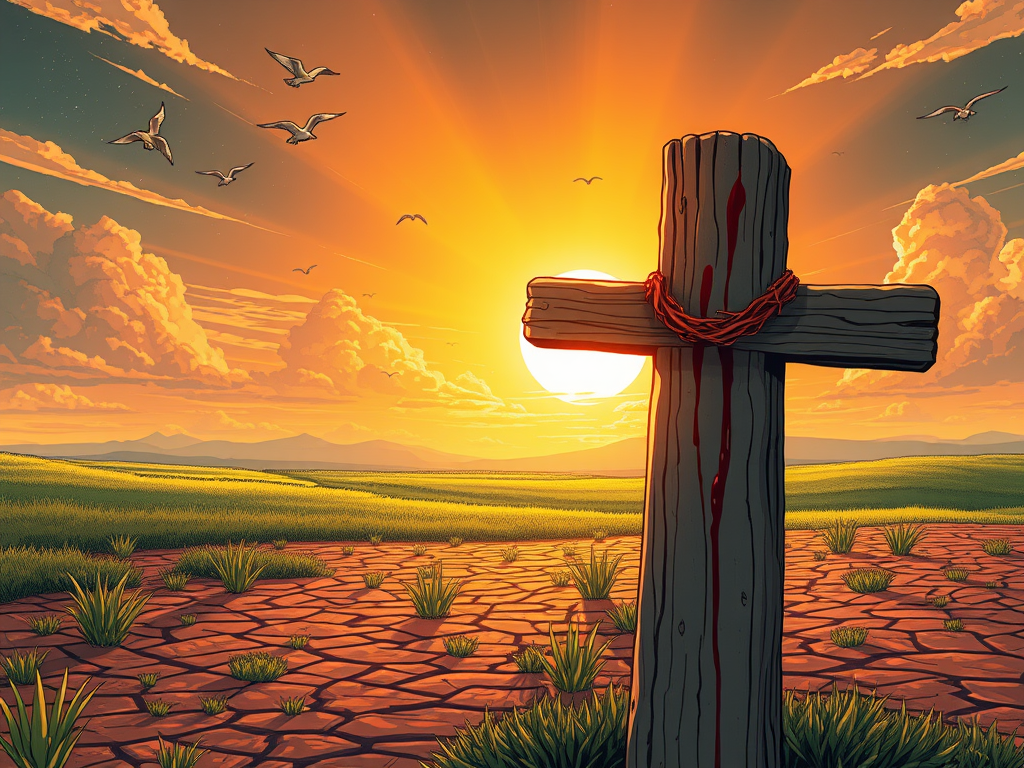
We don’t know Yeshua of Nazareth
We know the image—Christ on a cross, glowing in stained glass, seated on thrones in our songs and raised high in our creeds. We know the icon, the worshiped figure, the object of theology.
But the actual man—the Jew from an obscure village, the blue-collar laborer with calloused hands, the dusty prophet who cried over Jerusalem and was dismissed by the powerful—has been lost beneath centuries of interpretation. Somewhere between our need to worship him and our refusal to follow him, we replaced the man with a myth.
When he stepped into ministry, he left behind even the shelter of a home. He was itinerant. Homeless. Dependent on the kindness of others. He didn’t travel with fanfare, didn’t claim power, didn’t ask for loyalty through doctrine—he simply said, “Follow me.”
Yet, the most overlooked part of his identity is perhaps the most central: Yeshua was a Jew. Not a Jew in some abstract theological sense, but a man completely shaped by the life, struggles, hopes, and ache of the Jewish people.
His teachings flowed from Torah.
His prayers echoed the Psalms.
His worldview was covenantal, not systematic.
And above all, his heart beat for Jerusalem.
To be a Jew in his time was to carry a longing— a longing for redemption, for God’s justice to come, for the oppressed to be lifted up, for Zion to be restored.
Yeshua didn’t just carry that longing; he embodied it. When he looked at Jerusalem, he didn’t just see a city—he saw his people.
And when they rejected the way of peace, he wept not as a preacher disappointed by his audience, but as a son mourning a mother’s death.
We often say we want to follow Jesus. But most of the time, we mean we want to follow the exalted Christ— the one who is already risen, already divine, already victorious. That version of Jesus is safe to worship from afar.
But to follow the man—to follow Yeshua—means stepping into the dust with him. It means knowing him not as an object of belief, but as a teacher, a servant, and a fellow Jew who gave everything not to start a new religion, but to call Israel—and the world—back to justice, mercy, humility, and God.
Until we recover this man, we cannot follow him. Until we understand the Galilean Jew who spoke with authority but slept in the open fields, we cannot claim to be his disciples.
We have turned him into a theological figure so distant, so divine, so exalted, that we no longer see the barefoot prophet walking beside us, asking us not to admire him— but to do what he did.
The Spirit may guide us, but if we have no memory of the man,
we cannot know the Spirit he carried. If we want to understand Christianity, we must start not with Christ the King, but with Yeshua the Jew.
The Galilean Jew
The people of Galilee lived under Roman occupation, taxed heavily and treated as second-class subjects in their own land. They weren’t temple-goers in polished robes; they were vineyard workers, goat herders, stonemasons, and fishermen whose hands smelled of sweat, salt, and soil. They didn’t speak Greek fluently. Many likely couldn’t read. But they knew Torah by memory, heard in synagogue readings, and passed down through generations like blood. Their prayers were quiet. Their dreams were of liberation.
This is the world Yeshua came from—a place where nobody noticed you unless you caused a problem. And it’s no surprise that his earliest followers looked just like him. Not scribes or priests or thinkers, but fishermen, laborers, zealots, and women carrying shame. The poor, the rough, the overlooked. Not one of them was qualified by religious standards. But they were the ones who understood his voice, because it was the same voice that echoed through their own hunger and waiting.
He didn’t rise through the ranks of temple authority—he never belonged to it. He wasn’t trained by elite rabbis. He never wore the garments of the priests or spoke in the tones of scholars. And for that, he was suspect. He wasn’t honored for his teachings; he was hated for them. He quoted the prophets and exposed hypocrisy. He spoke plainly. He elevated the wrong people. He healed on the wrong days. He walked with the wrong crowds.
And the more he taught, the more the authorities saw him not as a savior, but as a threat. Not because he was powerful, but because he refused to play by their rules. In his world, purity wasn’t about ritual—it was about justice. Holiness wasn’t about separation—it was about compassion. And that inverted everything.
To the religious elite, Galilee itself was suspect—a place where revolutionaries stirred and unclean practices festered. But to God, Galilee was the soil for the Kingdom. It was among these people—these struggling, quiet, faithful, waiting people—that Yeshua lived, breathed, and called others to walk with him. Not to start a movement of might, but to remind Israel of mercy. Not to destroy the Law, but to fulfill it in the most human and humble way possible.
His whole life was shaped by the rhythm of Jewish village life: daily prayers, Sabbath rest, shared meals, memory of the Exodus, hope for the Messiah. And in that world, he was not extraordinary. He was one of them.
Crowned, but Not Followed
It is almost unthinkable that a man like this—this Galilean villager, this homeless teacher who slept beneath the open sky, who ate bread with calloused hands and spoke in parables to farmers—could be turned into the object of pristine worship services, ornate cathedrals, and debates about his divine essence. But that is what happened. Somewhere in the generations that followed, we crowned him God before we even understood what it meant that he was human.
And in doing so, we created a version of faith where it’s no longer necessary—or even expected—to walk in his sandals. We made him so divine, so separate, so flawlessly untouchable, that imitation seemed irrelevant. He became something to admire, not to embody. Something to sing about, not to live like. We replaced discipleship with doctrine. We replaced obedience with theology. We no longer ask, “What did he do that I should do?” We ask, “What do I need to believe about who he is?”
But this wasn’t Yeshua’s way. He never demanded to be understood in metaphysical terms. He didn’t ask for his nature to be studied and argued over. He didn’t give his followers a creed—he gave them a path. His words weren’t delivered from a throne; they were spoken while sitting in dirt, whispered on hillsides, shared over meals. He taught not like a philosopher dispensing wisdom, but like a rabbi shaping the lives of real people. He didn’t teach theory—he taught how to walk, how to forgive, how to weep, how to serve.
The tragedy is that in lifting him up, we lifted him out of reach. We made him untouchable—divine in such a way that he no longer threatens our lives. A God we worship from a distance can’t ask us to sell our possessions, to forgive our enemies, to carry a cross, to live unknown. A divine figure can be celebrated on Sunday morning without confronting our lifestyle Monday through Saturday. But a Galilean Jew who demands we become like him—that’s far more dangerous. That’s far more real.
And yet, that’s who Yeshua was. Not a doctrine, not a symbol, not an abstract Lord—but a person. A man with a voice shaped by the psalms and the prophets. A man of covenant, not convenience. A man rejected in his time, not adored. And until we stop worshiping the idea of Christ and start walking with the real Yeshua, we will never know the one we claim to follow.
Through the Eyes of Jews
The truth is, his earliest followers didn’t worship him—they followed him. They didn’t gather to adore a divine figure; they came because something about this man pierced through the silence of their daily suffering.
When Yeshua spoke, it wasn’t like the teachers in the synagogues. He didn’t quote others to prove himself. He spoke with the fire of the prophets and the tenderness of a shepherd. To the 3,000 or the 5,000 who sat in the sun and listened to him speak on hillsides, he wasn’t “God in flesh”—he was one of them. A teacher. A healer. A prophet. A man who walked like he believed every word of the Scriptures he quoted.
If you had been there, sitting among them, you wouldn’t have thought you were watching a god. You would’ve seen a man in threadbare clothes, tired from walking, with a voice both worn and alive. You would’ve noticed the poor pressing in around him.
You would’ve felt conviction—not because he demanded worship, but because his life made yours feel small in all the wrong ways. And when he said, “Come, follow me,” he wasn’t inviting you to a belief system. He was asking you to leave behind the life you knew—to walk with him into unknown places, to suffer with the poor, to confront injustice, and to carry the burdens of others.
That’s what it meant to follow Yeshua before anyone called him Christ. That’s what discipleship looked like before Christianity existed. It was bold action. It was shared sacrifice. It was a road, not a religion. And if we want to return to him now, in all our noise and drift and distance, we have to begin the same way they did—not with belief, but with a decision: to get up, leave what we know, and walk behind a forgotten man who still knows the way.




Leave a comment