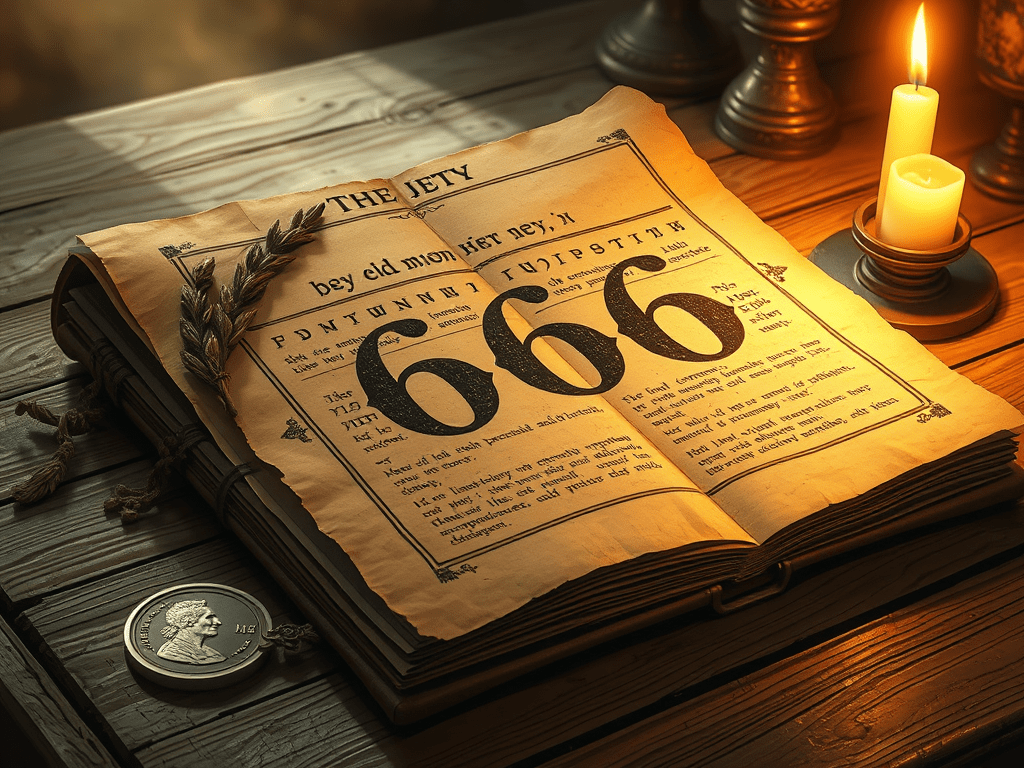

The Number of the Beast
A First-Century Cipher Unveiled
When the Book of Revelation describes the enigmatic “number of the beast” as six hundred sixty-six (Revelation 13:18), it does not present the figure as a free-floating, mystical symbol. Instead, the text itself issues an invitation — and a challenge:
“Let the one who has understanding calculate the number of the beast, for it is the number of a man.”
This call to “calculate” (Greek: ψηφισάτω, psēphisatō) reveals that the number is not a mystical talisman, but the sum of a coded name, accessible through the ancient practice of gematria.
Gematria, used widely in Jewish and Greco-Roman culture, assigns numerical values to letters. By adding the values of each letter in a name, one arrives at a total number.
This means 666 is not an independent, universal constant; it is the result of a sum, one that requires both the correct language and the correct spelling to decode. Without those inputs, the number remains opaque — a deliberate safeguard for politically dangerous information.
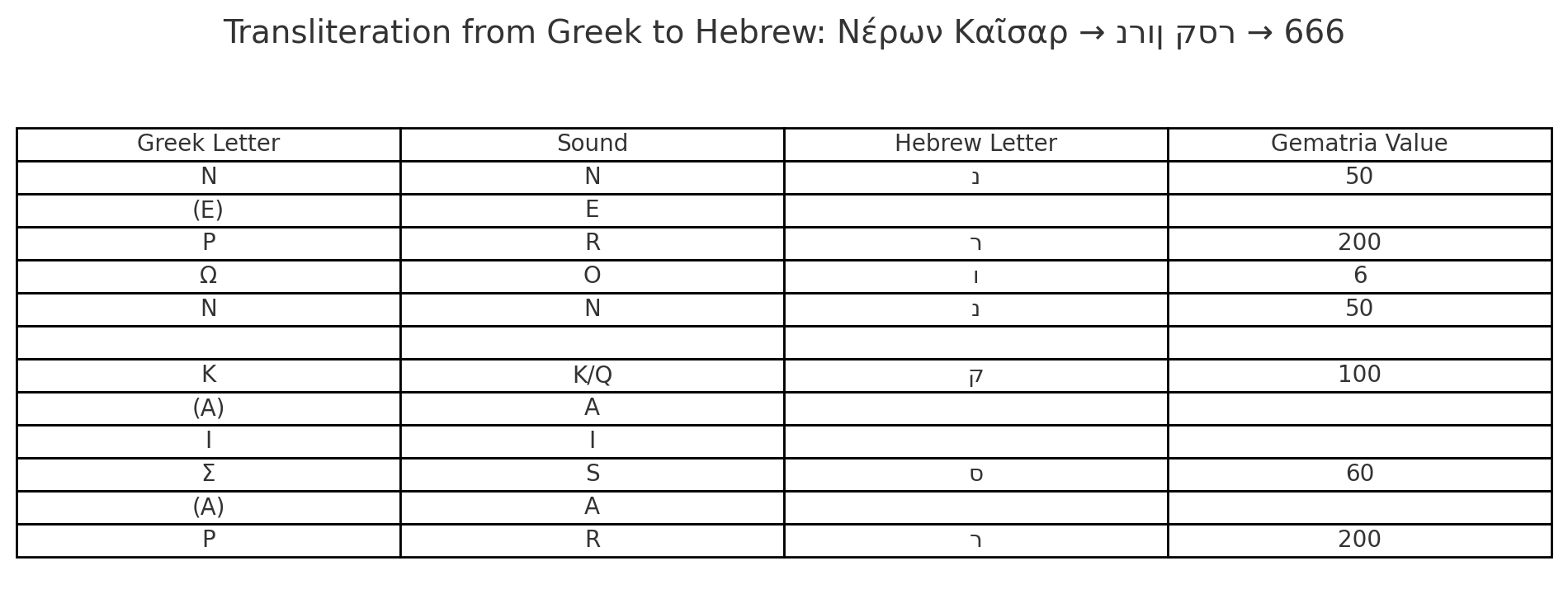
The prevailing scholarly consensus, supported by works such as Bruce Metzger’s Breaking the Code and Richard Bauckham’s The Climax of Prophecy, is that the most likely referent is the Roman emperor Nero. In Greek, his name and title were written as Νέρων Καῖσαρ (Neron Kaisar).
When transliterated into Hebrew script, this becomes נרון קסר (Neron Qesar). Applying standard Hebrew gematria:
- נ (Nun) = 50
- ר (Resh) = 200
- ו (Vav) = 6
- נ (Nun) = 50
- ק (Qof) = 100
- ס (Samekh) = 60
- ר (Resh) = 200
The total: 50 + 200 + 6 + 50 + 100 + 60 + 200 = 666.
This translation-and-sum process is the “understanding” the author expects from the readers. These readers — the seven churches in Asia Minor — lived under Roman imperial rule and would have been familiar with Hebrew or Aramaic, or at least with the Jewish-Christian interpretive methods that used gematria.
For them, 666 would have been a barely veiled but plausibly deniable reference to the emperor who had brutally persecuted Christians and Jews.
The subtlety was necessary. Directly naming Nero as the beast would have been an act of sedition. But by encoding his name through a linguistic bridge from Greek to Hebrew, the author could communicate a dangerous truth in public without inviting immediate reprisal. Outsiders would hear only an ominous number; insiders would see the emperor’s shadow in every digit.
Even more telling is the well-documented manuscript variant that gives the number as 616 instead of 666. This is easily explained: if the Greek “Νέρων” (Neron) is rendered in Hebrew without the final “n” (matching the Latin “Nero”), the spelling becomes נרו קסר (Nero Qesar), whose gematria sums to 616. This variant confirms that early Christians knew the cipher’s target and adjusted the math depending on the spelling in circulation.
Historically, this understanding fits the late first century perfectly. Whether Revelation was written during Nero’s reign (mid-60s CE) or under Domitian (mid-90s CE), the memory of Nero’s persecution was vivid, and the “Nero redivivus” myth — the belief that Nero would return — was widespread (cf. Suetonius, Nero 57; Sibylline Oracles 4.119–124).
The economic element in Revelation 13, where no one can buy or sell without the “mark,” aligns with the realities of imperial cult enforcement and trade-guild participation. Refusing to honor the emperor could mean exclusion from markets — literally the loss of bread.
The phrase “let the reader understand” takes on fresh significance in this light. In the ancient world, public reading was the primary mode of reception for such letters. The “reader” was the designated lector in a house-church meeting, speaking to a mixed audience of insiders and possible informants. This aside functions as a knowing wink: calculate the number quietly, connect the dots, but do not speak the name aloud.
In short, the “mark of the beast” in its original context is not a futuristic microchip, nor a mystical brand. It is a first-century code for a first-century emperor, cloaked in the numbers of a language-shifting cipher that only the intended audience could fully decode. Revelation’s genius lies not in inventing a mysterious number, but in disguising a very specific, very dangerous name in plain sight.
References
- Bauckham, Richard. The Climax of Prophecy: Studies on the Book of Revelation. T&T Clark, 1993.
- Metzger, Bruce M. Breaking the Code: Understanding the Book of Revelation. Abingdon Press, 1993.
- Suetonius. The Twelve Caesars: Nero. Trans. Robert Graves.
- Collins, Adela Yarbro. Crisis and Catharsis: The Power of the Apocalypse. Westminster Press, 1984.
Addendum
The Anti-Christ Spirit
It is astonishing — and frankly disturbing — how many believers persist in speaking of the “anti-Christ” as a mysterious end-time figure lurking in some yet-to-arrive chapter of history, when the Scriptures themselves could not be plainer: the opposition to Christ is already here.
The epistles speak with unsettling clarity.
John writes,
“This is the spirit of the antichrist, which you heard was coming and now is in the world already” (1 John 4:3).
Peter warns of false teachers among you, not “one day,” but now (2 Peter 2:1). Paul declares that the “mystery of lawlessness is already at work” (2 Thessalonians 2:7).
Yet, in spite of this, countless pulpits and best-selling prophecy books keep pushing the danger conveniently into the future — a “watch out, the world will get bad soon” mentality. Soon?
- As if injustice, idolatry, deception, and blasphemy have been patiently waiting their turn for two thousand years.
- As if Rome was not already the beast to the seven churches.
- As if the same corrosive spirit has not animated every empire, cult, and counterfeit faith since.
This is not a call to paranoia — it is a call to perception. The mark of the false, John tells us, is not in political charisma or technological novelty, but in this: it cannot confess that Jesus Christ is the Son of the Most High God (1 John 4:2–3). That test is immediate. It is not for a far-off hour; it is for this breath, this conversation, this confession. The “anti-Christ spirit” is any power, teaching, or influence that dodges, denies, or dilutes that truth — and it is here, always here, until the last day.
The tragedy is that by shoving the danger into the future, we excuse ourselves from vigilance in the present. We fail to see the beast in systems that demand allegiance now. We ignore the subtle pressures that demand we bow, not before a statue in a forum, but before the idols of our own age.
The readers of John’s Revelation did not have the luxury of thinking, “Maybe one day this will matter.” Their bread, their livelihoods, their lives were already on the line.
So hear it again, as it was first written: “Let the one who has understanding calculate.” Let the one with ears hear. Quit staring down the road for a villain while shaking hands with him in the marketplace. The test of truth is in your mouth — and in the world — already.




Leave a comment