The Divine Language
“Once, God spoke in dreams—men listened with fear.
Then, they cut the dream open… watched it bleed.
Now, we dream—but do not listen.
We feel—but do not believe.
Yet the dream waits,
buried in silence,
breathing in the dark,
waiting to be remembered.”— Silent Truths
Dreams of Old
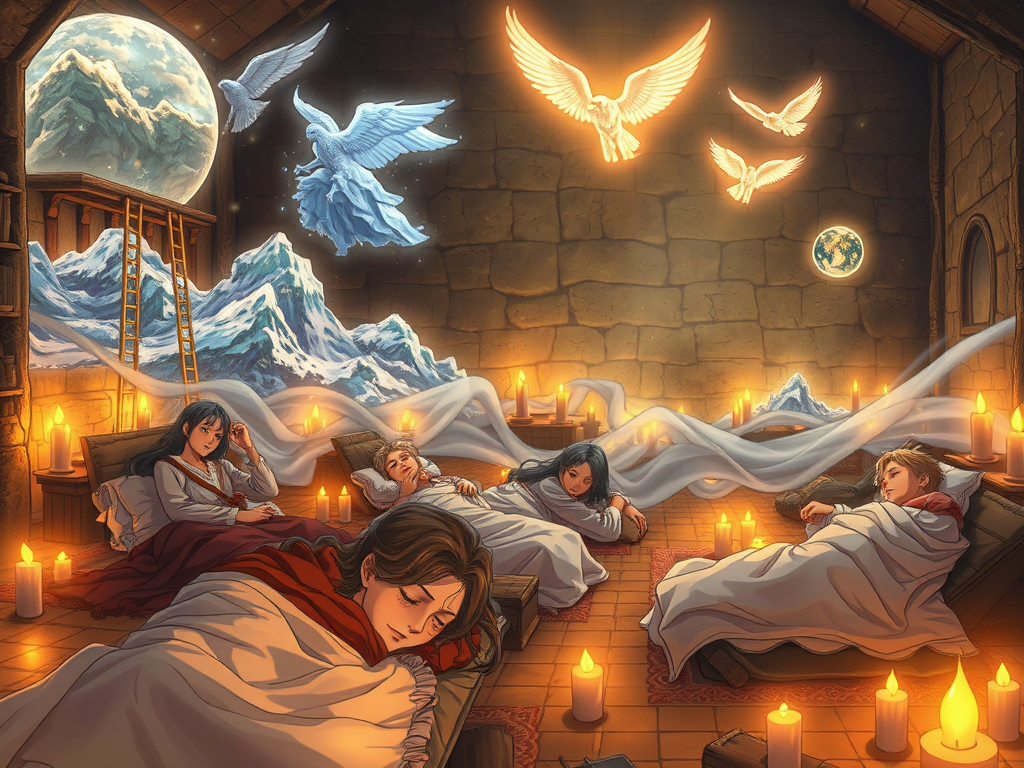
In our early days, the boundary between sleep and spirit was thin as a veil drawn in candlelight. Men laid down not to escape the day, but to enter a realm where commandments came in symbols, and fates were rewritten by visions no waking eye could see.
Dreams were not dismissed—they were interpreted, feared, obeyed. The night was not for rest—it was a sanctuary. And those who dreamed deeply were not poets or madmen—they were messengers. They bore the weight of kingdoms in their sleep. They awoke with trembling hands and words not their own.
To dream was to be marked; to understand was to be called.
For All Mankind
Yet dreams were not the language of kings alone. They came to shepherds. To farmers. To fishermen and forgotten laborers. The divine did not wait for temples or thrones—it whispered into the sleep of the carpenter, the midwife, the stone mason, the weary bread-seller with cracked heels and prayers unanswered.
A man might fall asleep beside his oxen and wake up having seen the shape of a flood, a war, an angel, or his own death. The ancients understood: a dream could wound you, haunt you, cling like ash to your skin long after morning’s light. They didn’t rise from sleep lightly—they rose under the weight of a message.
Dreams were not decoration. They were assignments.
And to ignore one was to risk judgment—or miss salvation.
Sacred Systems
In those days, dreams were not left to wander. They were caught, caged, and read. Civilizations constructed sacred systems to steward the dream—priesthoods, scribes, interpreters, custodians of night-visions who knew that dreams were not for the dreamer alone.
The Egyptians inked them onto papyrus, cataloguing symbols and outcomes like divine lexicons. The Babylonians trained their magi to read the air around a dreamer’s words. In Israel, the prophet stood between the people and God as a vessel of both terror and translation. Some dreams were written down, preserved in tablets or scrolls—others were carried word-of-mouth through generations like fire kept alive in a clay jar.
To receive a dream was one thing.
To interpret it—that was the work of the holy.
Biblical Proportions
The Scriptures are soaked with dreams—not as metaphors, but as mandates. They were blueprints for survival, judgments wrapped in symbols, divine decrees delivered while eyelids fluttered in restless sleep. God did not whisper in waking logic—He thundered in the quiet dark.
It was in a dream that Joseph, a boy sold by his brothers, saw the stars bow down to him. A vision that would one day explain his betrayal and vindicate his rise, as he saved Egypt—and Israel—from starvation.
“Behold, we were binding sheaves in the field, and behold, my sheaf arose and stood upright. And behold, your sheaves gathered around it and bowed down to my sheaf.”
(Genesis 37:7, 9 ESV)
Later, it was another Joseph—a carpenter of no great standing—who was warned in sleep to flee to Egypt with the infant Christ, evading the slaughter of innocents by the edict of Herod. Salvation itself was preserved by a man who believed a dream.
“When they had gone, an angel of the Lord appeared to Joseph in a dream. ‘Get up,’ he said, ‘take the child and his mother and escape to Egypt.’”
(Matthew 2:13 NIV)
Pharaoh, a king of divine status, saw seven fat cows swallowed by seven lean ones—and trembled. His magicians stood mute. But a Hebrew prisoner, bearing the weight of his own dreams, stood up and translated the future of a nation. Not with data. Not with war. But with the memory of God’s language in the night.
“In my dream I was standing on the bank of the Nile, when out of the river there came up seven cows, fat and sleek… After them, seven other cows came up—scrawny and very ugly and lean… Then I woke up.”
Nebuchadnezzar dreamed of a statue—gold, silver, bronze, iron—and saw the unfolding of empires. He awoke terrified, demanding not just the interpretation, but the dream itself, to be drawn out from the void by force. Only Daniel, prophet and exile, heard it in silence and answered with clarity. He spoke what the king had seen without hearing it first. He spoke as if Heaven had repeated it to him directly.
“I had a dream that made me afraid. As I was lying in bed, the images and visions that passed through my mind terrified me.”
(Daniel 2:1 NIV)
Jacob dreamed of a ladder—a bridge between the Divine and the dirt. He named the place Bethel, the House of God, saying: “Surely the Lord is in this place, and I knew it not.” In one night, he saw the geography of Heaven itself, and the ground became holy beneath him.
“And he dreamed, and behold, there was a ladder set up on the earth, and the top of it reached to heaven. And behold, the angels of God were ascending and descending on it!”
(Genesis 28:12 ESV)
Even Pilate’s wife, a Roman woman caught in the machinery of crucifixion, dreamed of Jesus. She sent word: “Have nothing to do with that righteous man, for I have suffered greatly in a dream because of Him.” Her warning echoed in eternity, a final divine attempt to shake the empire before it nailed God to a tree.
“While he was sitting on the judgment seat, his wife sent word to him, ‘Have nothing to do with that righteous man, for I have suffered much because of him today in a dream.’”
(Matthew 27:19 ESV)
Beyond Mystery
For generations, the dream was sacred—a fire entrusted to trembling hands. Shepherds and kings alike walked carefully beneath its weight. They did not scoff. They did not rush to explain. They stood before it as one stands at the threshold of a holy place—half in shadow, half in awe. But slowly, the sacred was replaced by the systematic. The flame was passed to minds that did not fear it. And in time, it was no longer held at all, but cut open, measured, and named. Humanity did not reject the dream outright—we simply removed its mystery, and called that progress.
What once made men weep, we now file under “REM activity.”
What once built altars, we now scroll past on sleep trackers.
And so begins the next chapter in the story of the Dreaming Man.
Dreams of Enlightenment
The Enlightenment was not an enemy to man’s soul. It was, in many ways, a gift—a call to clarity in a world long held under superstition and tyranny. But with its arrival came a change so subtle, few noticed its cost. In our pursuit to understand everything, we began to fear that which could not be explained. The dream—once a holy encounter—was now treated like a strange animal under glass.
We no longer feared the voice in the night. We simply reduced it to metaphor.
Philosophy replaced prophecy.
“I am accustomed to sleep and in my dreams to imagine the same things that lunatics imagine when awake.”
— René Descartes, Meditations on First Philosophy (1641)
Analysis replaced awe.
“Dreams and other fictions of the imagination… have no influence on conduct.”
— David Hume, A Treatise of Human Nature (1739)
The dream wasn’t denied—it was dissected.
“Dreaming is the liberty of the mind to entertain the most extravagant thoughts without the restraint of reason.”
— John Locke, An Essay Concerning Human Understanding (1689)
And like all living things, once dissected… it stopped breathing.
Divinity Awakened
The Church, once the cradle of mystics and prophets, began to shutter its windows against the night. In the age of Enlightenment, visions were not sanctified—they were suspect. To dream was no longer to commune with God—it was to flirt with madness, or worse, rebellion.
Those who claimed dreams risked censure or silence. Monks with visions were watched. Women with dreams were dismissed. Some were imprisoned. Some burned. The dreamer became a threat to doctrine, because a dream comes without permission. It answers to no hierarchy. And a man who hears directly from heaven is dangerous to any system built on control.
So the dreaming saints were folded into the pages of history, relics of a time the Church was now embarrassed to remember.
And what of God?
The Divine, once whispered of in fire and wind and thunderous dreams, was now recast in the image of order and reason. God became a clockmaker, a distant intelligence, a first cause who did not intrude. He was no longer Emmanuel—God with us—but a remote architect of laws, uninterested in dreams, untouched by symbols.
Heaven falls silent, not because the voice had ceased, but because humanity no longer had ears to hear it. The dream had not died… it had been outlawed by the very institutions once built to protect it.
María de los Ángeles
“She claims visions while asleep, which she cannot explain but insists are divine. Such ‘revelations’ are more likely the work of deception, or the Devil in dreams.”
— Inquisitorial Report, Tribunal of Valencia (1602), Case File of María de los Ángeles
María de los Ángeles was a peasant woman claiming repeated dreams from saints and angels. The Inquisition considered her dreams “unauthorized revelations” and therefore dangerous. She was imprisoned for several months under suspicion of heresy.
Council of Trent (1545–1563)
“Let no one presume to publish or teach dreams or private visions unless approved by the Holy See; such revelations are not binding to faith and may mislead the simple.”
— Council of Trent, Decree on Justification, 1546
This decree didn’t outright condemn all visions, but it drew a line of control—if you had a dream or vision, you could not share it unless Rome approved. That meant dreams became filtered through doctrine and hierarchy—stripped of spontaneity and mystery.
Jeanne des Anges (1634)
“She claims nightly torments by spirits and visitations by Christ in dreams. Her language is of ecstasy, but we find in it confusion, danger, and pride.”
— Jesuit Examination Report, Loudun Possessions Trial
Jeanne des Anges was a nun who claimed visionary dreams and ecstatic experiences. The Church investigated and ultimately treated her with suspicion. Though not executed, her dreams were pathologized, her spiritual experiences turned into signs of hysteria. She became a case study, not a mystic.
Catholic Manual of Discernment, 18th Century
“Private revelation is always to be regarded with caution. The Devil is able to appear as light in dreams. He who follows dreams follows uncertain stars.”
— Fr. Miguel de Salazar, Instructions for Spiritual Directors (1738)
This manual was widely used by confessors and spiritual directors across Spain and Italy. It demonstrates the deep fear that dreams might be counterfeit revelations—tools of deception, not divine light. The warning was: don’t trust the dreamer—trust the Church.
Pope Benedict XIV on Private Revelations (1748)
“The faithful are not obligated to believe private revelations, even when approved. It is safer and more perfect to remain grounded in the public doctrine of the Church.”
— De Servorum Dei Beatificatione et Beatorum Canonizatione (1748)
This was one of the most influential ecclesiastical writings of the Enlightenment period on the subject of dreams and visions. It didn’t condemn them outright, but it clearly demoted them. The dream became optional, non-binding, and suspect unless canonically certified.
Dreams Exiled
The Church of this age did not burn every dreamer—but it quietly exiled them. The mystic was not crucified; she was cross-examined. Dreams were no longer treated as divine incursions, but as private revelations—unverified, untrustworthy, and often dangerous.
In 1602, the Tribunal of Valencia recorded: “Such ‘revelations’ are more likely the work of deception, or the Devil in dreams.” The Council of Trent echoed this caution in 1546: “Let no one presume to publish or teach dreams or private visions unless approved by the Holy See.” The dreamer, once revered as a vessel of divine mystery, was now required to submit their soul for review.
Even within the cloister, visionaries like Jeanne des Anges were reduced to case studies, not saints. “Her language is of ecstasy, but we find in it confusion, danger, and pride,” wrote Jesuit examiners in 1634. And by the 18th century, the language had grown colder still. “He who follows dreams follows uncertain stars,” warned Fr. Miguel de Salazar in his 1738 manual for spiritual directors.
Perhaps no words summed up the Church’s posture better than those of Pope Benedict XIV, who wrote in 1748: “The faithful are not obligated to believe private revelations, even when approved.” The dream had not been condemned—but it had been quarantined.
What once thundered in scripture now required paperwork.
And the dreaming man, once a prophet, became a liability.
The Last Age of Symbols
While the Age of Reason dissected dreams, one man tried to reassemble the body with reverence. Carl Jung, psychologist and myth-maker, did not see dreams as delusions or detritus of the mind. He saw them as maps of the soul, stitched with archetypes older than civilization.
Jung dared to say what the Church no longer would: the dream is sacred.
In a world that no longer believed in prophecy, Jung spoke of the Collective Unconscious—a vast, mythic undercurrent shared across cultures, buried beneath logic, where dreams still moved like underground rivers. He described recurring symbols—the Wise Old Man, the Shadow, the Great Mother, the Hero’s Journey—and suggested that they were not invented, but remembered.
Each dream, to Jung, was a ritual of self-revelation, a conversation between the conscious self and the deep unknown.
“Dreams are the guiding words of the soul. Why should I henceforth not love my dreams and not make their riddling images into objects of my daily consideration?”
— Carl Jung
But even Jung’s work was soon domesticated—repackaged into psychology textbooks, robbed of its mystical backbone. His attempt to resurrect the language of the dream was applauded, studied… and ultimately shelved beside Freud as another system.
The world had forgotten the fire.
Jung merely tried to chart the smoke.
Silence in the Sky
And what of the One who once spoke through dreams?
He too was rewritten.
No longer the God of burning bushes, midnight whispers, and ladders reaching heaven—He became a distant architect, an observer. The Age of Enlightenment imagined God not as a voice, but as a mathematical principle—the unmovable mover, the sterile Creator who had long since stepped away from the mechanism He designed.
He was not feared.
He was not known.
He was simply absent.
No longer Emmanuel—God with us—but a cosmic watchmaker, disinterested in dreams, untouched by prayer. Mystery was recategorized as ignorance. And revelation? A thing of the past.
God did not stop speaking.
We simply stopped believing He had anything left to say.
Age of Artificial Certainty
We no longer burn prophets or imprison mystics. We have no need. This age has perfected something more effective—distraction. In the Age of Artificial Certainty, the dream is not feared or dissected. It is simply drowned in a flood of glowing screens, curated feeds, and dopamine loops.
… We sleep less.
… … We scroll more.
The mind is never still enough to receive a message, and the soul—if it speaks—is lost in the static. We have become so full of information, we have no room left for revelation.
The voice that once thundered in dreams now knocks gently … but we are too busy to answer.
Dream of Today
The dream still visits us—but it finds no altar, no oil, no listener. It drifts through the minds of a generation raised in fluorescence, in scrolls and screens, where silence is rare and sleep is shallow.
When dreams arrive now, they are met not with fear, nor reverence, but with shrugs, chuckles, or edits for online clout. We do not reject them violently. We simply explain them to death, label them as fragments, anomalies, “just my brain doing weird stuff.” And yet… beneath the sarcasm, beneath the self-aware dismissal, there is a lingering pause in many of these voices.
Something unsettled.
Something almost haunted.
As if deep down, we know we are forgetting something ancient, something meant for us. But we do not turn to face it. We do not kneel to interpret.
We scroll, then we move on.
And the dream, once a holy visitation, becomes just another notification we swipe away.
Now read them.
Not headlines. Not punchlines.
Just the voices of now—those who dream, and don’t know what to do with the dreaming.
Read slowly.
Listen for the ache between their words.
This is what remains.
Billie Eilish
“My dreams are so vivid and scary, sometimes they feel more real than real life… but I don’t think they mean anything. I don’t trust them. I just try to forget them.”
— Billie Eilish, in an interview with Noisey (2019)
Tone: Disoriented awe meets distrust. There’s recognition of power—but no interpretive framework, no ritual, no tradition. The dream is overwhelming, but meaningless.
Viral Tweet
“Dreams are like spam emails from your brain. Wild. Unsolicited. And most of them are useless.”
— Anonymous, Twitter post (2021)
Tone: Sarcastic, postmodern, emotionally detached. The dream has become a punchline, not a portal. This is typical of meme culture—clever, nihilistic, and hollow.
Carl Jung (popular misquote)
“Your vision will become clear only when you look into your heart. Who looks outside, dreams; who looks inside, awakens.”
— Carl Jung, widely quoted in contemporary spiritual media (attributed)
Tone: This quote is ironically misinterpreted today. Many modern spiritualists share it on Pinterest boards and TikTok, but often detach it from its deeper symbolic context. The mystery remains, but it’s floating unanchored.
Reddit User
“I don’t believe dreams mean anything spiritual. They’re just the brain sorting memory fragments and emotions. But… sometimes I wake up with tears in my eyes and I can’t explain why.”
— Reddit user, comment on r/Dreams (2022)
Tone: This one is gold—disbelief colliding with unresolved experience. That’s the modern condition: explaining away the sacred while still being haunted by it.
Neil Gaiman
“The Lord of Dreams learns that one must change or die, and makes his decision.”
— Neil Gaiman, The Sandman, Preludes & Nocturnes (1989)
Tone: Gaiman’s entire Dream series remains a modern mythic exception. It presents dreams as sovereign, dangerous, poetic. He’s one of the rare contemporary voices who still writes about Dream as Person, as force.
The Mundane
What we call the dream today is not a message—it’s an inconvenience. A curiosity at best, a glitch at worst. In an age of infinite noise, we no longer remember how to receive something we didn’t summon.
Dreams have become background static in a world overstimulated, oversaturated, and spiritually parched.
They are fragments—disposable, unserious, quickly forgotten before the second coffee scroll. And deeper still, in the shadows we won’t name: they are a boredom we do not want to face. No awe, no terror, no trembling—just flickers in the night we dismiss by habit. Just my brain again.
But it’s not just the dream that faded. God was explained away, rationalized, denied, or politely redefined into silence—and with Him went the Voice. And so now we sleep, but do not hear. We dream, but do not remember. And if we do remember, we do not believe.
This is the dreamworld of our age—not empty, but unheard.
A realm still breathing, but long unvisited.
Return, Dreamers!
“And it shall come to pass in the last days,” God says, “that I will pour out My Spirit on all people. Your sons and daughters will prophesy, your young men will see visions, and your old men will dream dreams.”
— Acts 2:17 (quoting Joel 2:28)
The promise was never revoked. The words of the prophet Joel, echoed by Peter on the day of Pentecost, were not metaphor, not poetry—they were a revelation of the spiritual terrain we are meant to walk in. God still speaks. His voice has not gone silent. It has simply been ignored, explained away, or drowned beneath our disbelief.
But for those with ears to hear, the dream remains the doorway. Not a curiosity, not a glitch in the night—but a realm of encounter where the soul is addressed directly, symbolically, divinely.
The wisdom books warned us to take dreams seriously.
“A dream comes with much business.”
— Ecclesiastes 5:3 (ESV)
The Jewish sages built on this foundation. In Midrashic tradition, dreams were understood as divine riddles meant to be opened with care:
“A dream uninterpreted is like a letter unopened. A dream interpreted is like a letter read.”
— Midrash Bereshit Rabbah 17:5
And Job, in one of the most mystical and overlooked passages in all Scripture, speaks to the very urgency and danger of ignoring the dream:
“For God may speak in one way, or in another, yet man does not perceive it. In a dream, in a vision of the night, when deep sleep falls upon men… He opens the ears of men and seals their instruction.”
— Job 33:14–16 (NKJV)
To the prophets, dreams were not decoration—they were dispatches from the heavenly realm. Daniel, Joseph, Ezekiel, even Peter and Paul—all received instruction in visions and dreams, and never once did the text treat these experiences as less real than waking life. Often, they were more real.
“I know a man in Christ who fourteen years ago was caught up to the third heaven… whether in the body or out of the body I do not know—God knows.”
— 2 Corinthians 12:2
Paul himself couldn’t tell the difference between dream and spirit. And that’s the point: the spiritual life must be lived in both worlds. The awake and the asleep. The seen and the unseen. The conscious and the symbol.
“To dismiss dreams is to close the ears of the soul to the language of God. The spirit that refuses them does not grow wise—it grows starved.”
— Silent Truths
We were never meant to abandon the dream realm.
We were meant to dwell in it—to interpret, to listen, to obey.
To treat our sleep as sanctuary, and our dreams as scripture written in symbols.
This is not superstition.
This is not mysticism for mysticism’s sake.
This is the forgotten half of the Christian life.
It is time to return.
Reclaim the Dream Realm
- Treat Sleep as a Ritual, Not Routine
Prepare your body and soul. Avoid noise. Enter the night with reverence. - Keep a Dream Journal Beside Your Bed
Every morning, write—even if it’s fragments. This teaches your soul that dreams matter again. - Pray or Speak Intention Before Sleep
Ask. Don’t demand. But invite the dream to come. Treat your pillow like an altar. - Study the Dreams of Scripture
Revisit the old dreamers. Trace how God spoke in symbols. See how the language of the beyond is timeless. - Resist the Urge to Explain Too Quickly
Let mystery linger. Dreams are a slow revelation. They will unfold if you stay with them. - Share Dreams with Trusted People
Speak them aloud. Naming a dream keeps it alive. Sometimes, others see patterns you do not. - Fast from Artificial Certainty
Take breaks from screens, facts, updates. Let your mind ache a little. That ache? That’s where the dream reenters.
The Dreaming Man is not extinct.
He is simply asleep within us, buried beneath the rubble of constant knowing, artificial wisdom, and the loud echo chamber of self-certainty.
But even now, the Voice still speaks.
Not through headlines. Not through updates.
Through symbols. Fire. Water. Ancestors.
Through dreams.
All we must do is remember how to listen to our dreams.