Gods of Society
—or how we dared to clothe the Unclotheable
I’ve watched the world carve its gods—delicately, strategically. Not with chisel and hammer anymore, but with hashtags, traditions, ideologies, and soft tones of acceptance. People make their own gods now—fashioned not from stone, but expectation.
“They crowned the Creator with tassels, garlands, and doctrinal jewelry—not in worship, but in insecurity. As if the One who spoke galaxies into being required their aesthetic approval to feel welcome in their curated belief systems.
Imagine—man adorning God, so He doesn’t embarrass them.”
—Silent Truths, Darian Ross
And I wonder… who gave us this right?
We think gods must be agreeable. Must be palatable. Must look like us, vote like us, speak in ways that won’t interrupt our coffeehouse serenity. We’ve turned the Infinite into a lifestyle accessory—a divine fedora worn on Sunday, then hung neatly on the spiritual coatrack the rest of the week. Neat. Polished. Predictable.
But gods do not bend to their creations.
It is creation that bends, or breaks.
And yet, in the folly of our youth—when we are drunk on discovery and self-importance—we dare to put God on trial. We ask if He aligns with our values, if His judgments fit the current moral mood, if He is worthy of our affirmation. Imagine that… mortals measuring the immortal.
Then come the professors. The thinkers. Those who pronounce theories with confident poise about the origin of the universe and whether God belongs there. They speak of the divine in past tense or metaphor—as if reality were clay in the classroom, and the mystery of being could be boxed into a syllabus.
But what is this arrogance?
Where did we—so small, so breathtakingly temporary—get the gall?
We, dust. We, who blink in and out of history without a sound. We, who dwell on a minor speck of a blue planet, circling an unremarkable star, nestled in the unimportant edge of a galaxy among billions…
We dare to define the Uncreated.
And worse—we imagine him… visiting us.
Sipping espresso. Laughing at our jokes. Wearing some imagined “aura” or vibe that matches our social media aesthetic. As if the Source of all stars might come wrapped in flannel and irony, just to make us feel “seen.”
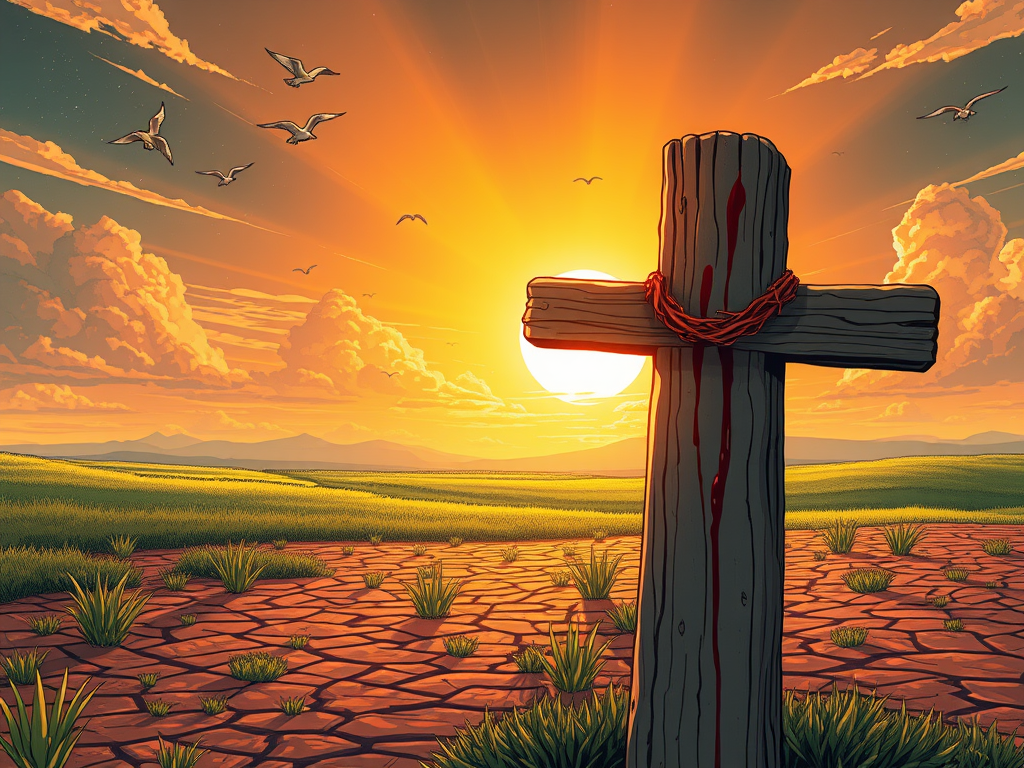
But when the real God comes—when the Divine steps out of eternal light and into human skin—we flog him. We drag him outside the city walls. We nail him to a post.
Why?
Because God never fits. Not in our boxes, our sermons, our denominations, or political parties.
He breaks every container we build.
He disturbs every comfort.
Still, we pretend.
We act as if He is our personal badge of righteousness.
We carry Him around like a holy relic, performative and proud.
“Look how blessed I am,” we say. “Look how God walks with me.”
But when did we ever stop to ask:
What happens when God wants to walk with us—on His terms?
Would we even let Him?
Or would we, once again, dress Him up in a costume we stitched from culture and convenience? Would we reduce Him to our imaginary version—a god we can explain, domesticate, quote, and claim?
Maybe we should stop talking.
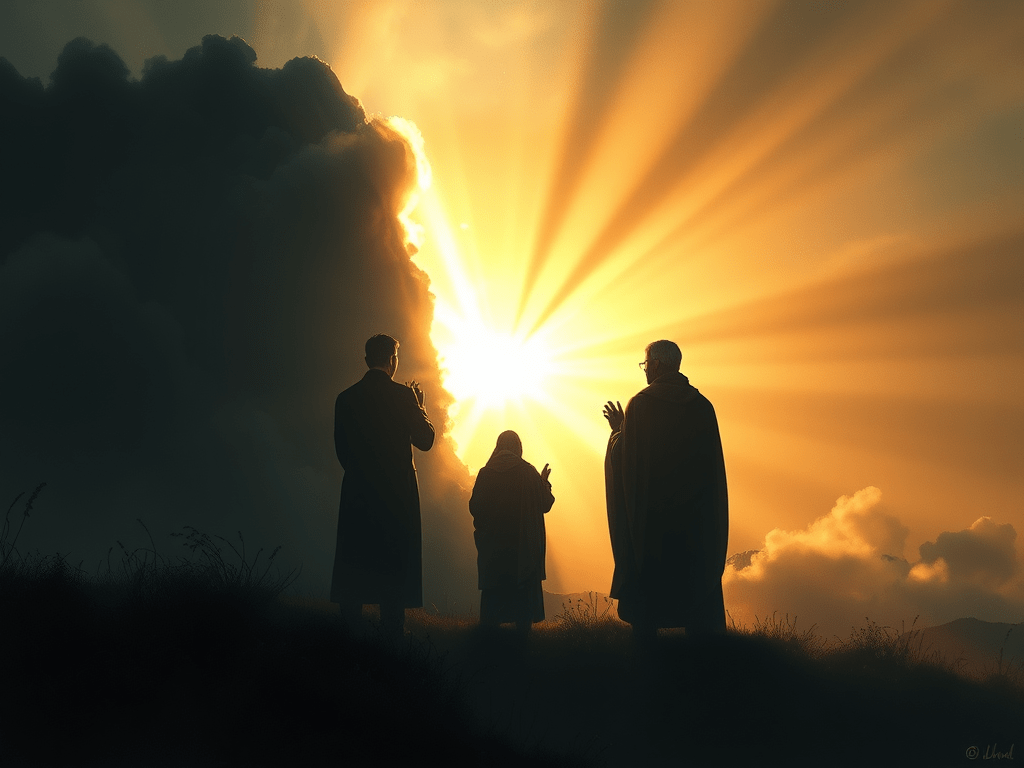
Maybe we should shut our lips and fall on our knees.
Maybe the Name should only be whispered, if spoken at all.
Because if He is who He truly is—if He really is—then it would be wisdom to tremble before we type.
So I ask myself…
Have I made my own god?
Have I dared to decorate the Almighty?
Or will I dare instead … to let God be God?
No matter how elaborate the liturgy, how intricate the theology, or how sacred the garment, the greatest traditions do not actually invite us to define God.
They caution us—often in whispers, sometimes in wails—that God is wild, untamed, and utterly beyond us.
Denial of Containment
—how the great religions whisper the same secret: He cannot be tamed
For all our dressing-up of the divine, all our holy robes and jeweled temples, there remains this strange confession echoing through the world’s highest religions:
He cannot be captured.
Judaism
Judaism, ancient and trembling, knew this long before theology became an academic hobby. The Name itself—YHWH—was so sacred it dared not be pronounced aloud. Not out of superstition, but reverence. Not because God was unknowable in essence, but because He was unbearably real.
“You cannot see My face, for no one may see Me and live.”
—Exodus 33:20
“I appeared to Abraham, to Isaac, and to Jacob as God Almighty, but by My name YHWH I was not fully known to them.”
—Exodus 6:3
“The Lord is in His holy temple; let all the earth be silent before Him.”
—Habakkuk 2:20
Even the Holy of Holies stood empty but for presence itself. No idols. No thrones. Just a silence so thick it cracked the soul of those who entered.
Christianity
Christianity, in its truest form, does not attempt to define God in full, but instead dares to testify that God defied expectation by entering weakness. The Infinite clothed in finitude. And how did we respond? We rejected Him—because He did not fit our ideas of power.
“The Word became flesh and made His dwelling among us. We have seen His glory, the glory of the one and only Son… full of grace and truth.”
—John 1:14
“He had no beauty or majesty to attract us to Him… He was despised and rejected by mankind.”
—Isaiah 53:2–3
“My thoughts are not your thoughts, neither are your ways My ways,” declares the Lord.
—Isaiah 55:8
Our saviors must conquer, not suffer. But God wept. And that, for many, was unacceptable.
Islam
Islam, too, knows the danger of containment. Allahu Akbar—God is greater—is not merely a cry of identity but a theological declaration. Greater than what? Than everything. Every image. Every expectation. Every metaphor.
“There is nothing whatever like unto Him, and He is the All-Hearing, the All-Seeing.”
—Surah Ash-Shura 42:11
“Vision perceives Him not, but He perceives all vision; and He is the Subtle, the Acquainted.”
—Surah Al-An’am 6:103
“Say: He is Allah, [who is] One, Allah, the Eternal Refuge. He neither begets nor is born, nor is there to Him any equivalent.”
—Surah Al-Ikhlas 112:1–4
The Qur’an warns that “there is nothing like unto Him.” And in that, Islam joins the chorus: beware the god you’ve made in your own image.
Hinduism
Even Hinduism, with its ocean of deities and incarnations, when taken beyond the surface ritual and into the heart of Vedantic reflection, speaks of the Brahman—the formless, boundless, ineffable reality beyond all gods and forms.
“Brahman is neither this nor that. It is beyond all definitions.”
—Brihadaranyaka Upanishad 2.3.6
“From Brahman, which is pure being, all things proceed, by Brahman they are sustained, and into Brahman they are dissolved again.”
—Taittiriya Upanishad 3.1
“He moves and He moves not; He is far and He is near; He is within all and He is outside all.”
—Isha Upanishad 5
It’s not contradiction—it’s transcendence. What you see is but a shadow of the Infinite.
Buddhism
Buddhism takes it further. The moment you name the divine, you’ve already missed it. In Mahayana thought, even the Buddha-nature is not a personality to worship but a silent awakening to that which lies beyond words.
“The finger pointing at the moon is not the moon.”
—Zen proverb
“Those who know do not speak. Those who speak do not know.”
—Lao Tzu (quoted often in Chan/Zen contexts)
“Form is emptiness; emptiness is form.”
—The Heart Sutra
The Divine, if it can be called that, is not to be explained but experienced, and even that experience cannot be held onto.
Taoism
And in Taoism, the first line of the Tao Te Ching whispers like a cosmic riddle: “The Tao that can be spoken is not the eternal Tao.” The Way—true and eternal—slips through fingers the moment you try to define it.
“The Tao that can be told is not the eternal Tao.
The name that can be named is not the eternal name.”
—Tao Te Ching, Chapter 1
“When the great Tao is forgotten, goodness and piety appear.”
—Tao Te Ching, Chapter 18
“He who defines does not understand.
He who understands does not define.”
—Tao Te Ching, paraphrased insight
The harder you try to possess it, the further it flees.
So what does that leave us with?
Despite their divergences, the rivers of the world’s faiths seem to flow toward one shared ocean: the mystery of God defies all architecture—mental, emotional, or religious.
Not because He hides from us.
But because He is too vast for the containers we bring.
We are the ones who trim His glory to make Him wearable. We are the ones who color Him with culture, fashion Him with politics, and prop Him up on pedestals of approval.
But He is not a totem.
He is not a flag.
He is not an emotion, an opinion, or a sacred object.
The truest teachings—the highest truths—don’t try to wrap God up with a neat little bow.
They tremble.
They hush.
They fall on their faces and say nothing at all.