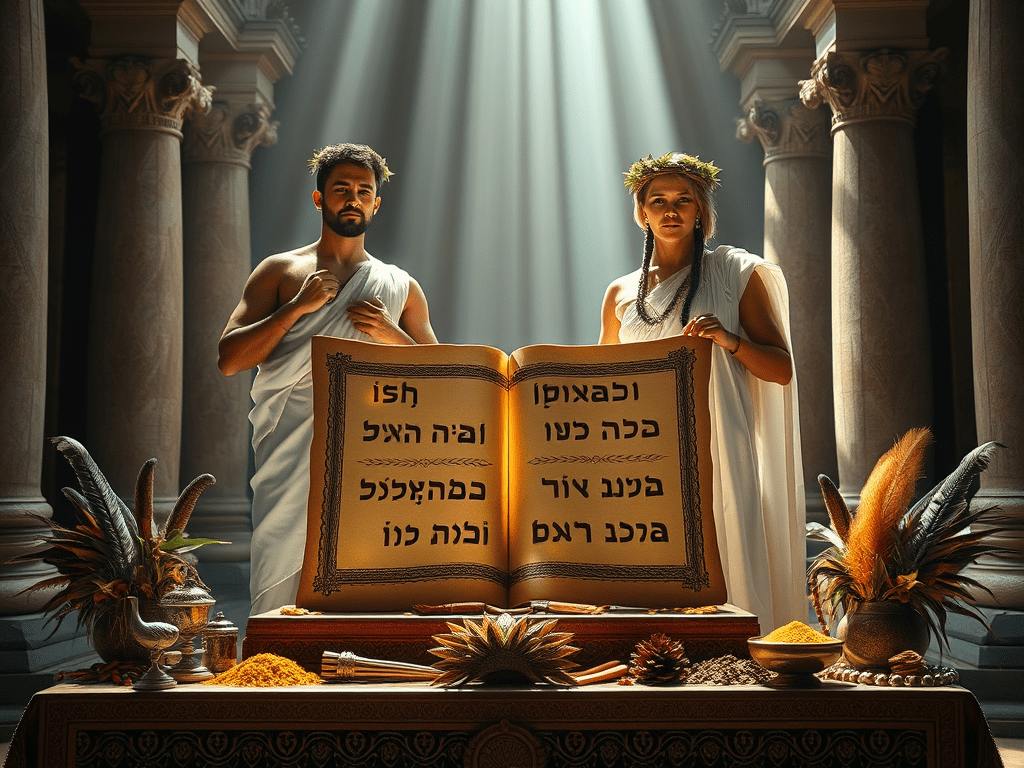

Defined by the Divine
An Inquiry through the Lens of Divine Texts
In this article, we do not concern ourselves with the legal, political, or emotional definitions of marriage. We set aside the frameworks of civil governance and modern rights-based ideologies to focus on a singular question:
My tone is academic, theological, respectful, yet uncompromising.
Does any sacred text of antiquity—those that claim divine revelation—ever sanctify a marital union outside the male-female paradigm?
We will examine sacred texts across several major theological traditions, looking not for vague affirmations of love, nor philosophical abstractions of union, but for clear ceremonial definitions—for explicit prescriptions—of what marriage is, and whom it includes.
This article is a rare bridge: one that does not deny dignity or rights, but dares to ask what is sacredly prescribed, rather than what is socially constructed. If the sacred is to mean anything at all—if it truly binds heaven to earth—then the blueprint must matter.
Even if the world outside the temple courts runs by a different architecture, what lies within the sanctuary must still speak.
“I am not standing at the gates of City Hall. I am standing at the gates of Eden, of Mount Olympus, of Sinai, of the Vedas, and the temples of Ur.”
— Silent Truths
Our inquiry is text-specific—not allegorical, not cultural, not speculative.
- Let us open the scrolls—not to reinterpret their metaphors, but to examine their explicit words.
- Not to impose our modern questions, but to hear their ancient answers.
Sacred Texts
Hebrew Bible
The Hebrew language in sacred texts leaves little ambiguity. Terms like ish and ishah, the act of davaq (clinging), and the declaration of basar echad (one flesh) are all rooted in a dual-sex paradigm.
Genesis 2:24
“A man shall leave his father and mother and be joined to his wife, and they shall become one flesh.”
Hebrew (transliteration):
‘Al-ken ya‘azov ish et-aviv ve’et-imo vedavak be’ishto vehayu lebasar echad.
Key Words to Examine:
- אִישׁ (ish) – Man, male, husband. Not a gender-neutral term. This is the adult male, both in biology and in social role.
- אִשָּׁה (ishah) – Woman, wife. Again, not a flexible or ambiguous term. Ishah is specifically female and carries with it both marital and biological connotations.
- דָּבַק (dāvaq) – To cling, cleave, adhere. It’s a covenantal term, used in other places to describe the relationship between humans and God (see Deut. 10:20).
- בָּשָׂר אֶחָד (basar echad) – One flesh. This is profoundly intimate language—not merely sexual, but ontological union.
Cultural Insight:
This is not a romantic verse—it’s a foundational theological statement. It sets the pattern for covenantal union not just based on affection, but role, reproduction, and divine symbolism.
Proverbs 18:22
“He who finds a wife finds a good thing and obtains favor from the LORD.”
Hebrew (transliteration):
Matzā ishah matzā tov vayafek ratzon me’et Adonai.
Key Words:
- אִשָּׁה (ishah) – again, the term for woman or wife—not a romantic partner or companion in the generic sense.
- טוֹב (tov) – good, beneficial, morally upright. This is the same word used in Genesis 1 when God declares creation “good.”
- רָצוֹן (ratzon) – favor, will, delight. This word implies divine approval. This isn’t just about finding a life partner—it’s about participating in the will of God.
Cultural Insight:
In ancient Hebrew wisdom literature, the family was the moral nucleus of society. Finding a wife wasn’t just personally satisfying—it was seen as an alignment with divine structure.
Song of Songs (Shir HaShirim)
While not explicitly about “marriage,” this poetic book is a highly sensual dialogue between a male (dod, beloved) and a female (ra‘yah, lover).
Why this matters:
- The allegory of divine love—whether Israel and Hashem, or Christ and the Church in later Christian thought—uses male and female imagery to encode that sacred relationship.
- It’s not just poetry—it’s a reflection of sacred order and longing, often interpreted as yearning to be united in covenant.
No Same-Gender Ceremonial Equivalents
“Notably, no sacred ceremony between same-gender individuals is recorded, nor are blessings of such unions ever described.”
And that’s a critical textual silence, not just a historical gap.
This absence is not due to censorship—it reflects a worldview in which the concept of sacred marriage was inextricably linked to sexual complementarity, procreative possibility, and covenantal symbolism.
“The Hebrew tongue bears witness: in the scrolls of sacred Scripture, marriage is not invention but revelation—woven from man and woman into one flesh, stitched by covenant, a holy song composed by the Composer of all, sung into being from the garden’s first breath.”
— Silent Truths
Christian Scriptures
This section is short but potent—and yes, there are only two primary references where the male-female union is explicitly reiterated and interpreted within Christian Scripture:
Greek Text and Theological Typology
Let’s break this open not just with theological commentary, but with Koine Greek terms that clarify exactly what Paul and Jesus were saying, and how their audiences would have heard it.
Ephesians 5:31–33
“For this reason a man will leave his father and mother and be joined to his wife, and the two shall become one flesh.” This is a profound mystery—but I am talking about Christ and the Church.
— Ephesians 5:31–32 (quoting Genesis 2:24)
Greek (transliteration of key terms):
- Ἄνθρωπος (anthrōpos) – man, in the sense of male-human (gendered context is assumed here from Genesis).
- Γυνή (gynē) – woman or wife. This word is unmistakably gendered and relational.
- κολληθήσεται (kollēthēsetai) – shall be joined, cleave to. A Greek parallel to the Hebrew dāvaq.
- σάρκα μίαν (sarka mian) – one flesh. Literal and symbolic; both physical union and covenantal oneness.
Theological Insight:
Paul does not reinterpret Genesis—he elevates it. He calls it a μυστήριον μέγα (mystērion mega)—a “great mystery.” In Greek rhetoric and theology, mystērion is a truth previously hidden, now revealed by divine insight.
“To Paul, marriage is no mere human arrangement—it is a living typology: the union of male and female echoing the cosmic covenant between Christ and His bride, the Church.”
— Silent Truths
This is not incidental. The genders are not interchangeable in this metaphor—they are symbolic roles, revealing a divine order.
Matthew 19:4–6
“Have you not read that He who created them from the beginning made them male and female, and said, ‘Therefore a man shall leave his father and mother and hold fast to his wife, and the two shall become one flesh’?”
— Jesus quoting Genesis 1:27 and 2:24
Greek Highlights:
- Ἀρσεν (arsen) – male
- Θῆλυ (thēly) – female
These are the same Greek words used in the Septuagint, the Greek translation of the Hebrew Bible. Jesus directly affirms both the biological and covenantal design of male-female union as established “from the beginning.”
Interpretive Note:
Jesus does not reinterpret Genesis—He doubles down on it, rooting the definition of marriage in creation theology rather than evolving culture or contemporary rabbinical debate.
Typology and Symbolism
In biblical theology, a type (Greek: typos) is an imprint, a pattern cast into creation that points beyond itself. Here, the male-female bond is the type, and the divine-human relationship is the fulfillment.
- The husband represents Christ—initiating, sacrificing, loving unto death.
- The wife represents the Church—receiving, responding, honoring the covenant.
- Their union is not merely functional—it is eschatological, pointing to the marriage supper of the Lamb (Revelation 19:7–9).
Qur’an
We approach this section with academic clarity, but also with deep respect for the sanctity of the Arabic text, the weight of Hadith and Tafsir, and the generational sincerity of Muslim belief.
❗Out of respect for the sacred Arabic text, we do not impose interpretation. We only highlight what the text explicitly describes—nothing more.
Surah Ar-Rum 30:21
“And of His signs is that He created for you from yourselves mates (azwāj) that you may find tranquility (litaskunū) in them; and He placed between you affection (mawadda) and mercy (raḥma). Indeed in that are signs for a people who reflect.”
— Surah Ar-Rum (30:21)
Arabic Terms in the Sacred Text
- أَزْوَاج (azwāj) – mates, spouses, pairs.
The plural of zawj, which is used throughout the Qur’an to refer to either male or female partners—but always in the context of complementary opposites. The Qur’anic use is consistent with the created pairing found in nature and humanity: “And of everything We created pairs…” — Surah 51:49 - لِتَسْكُنُوا (litaskunū) – that you may find rest / tranquility / peaceful dwelling.
This verb (s-k-n) carries connotations of spiritual and emotional repose. The verse presents the marital bond not as legal obligation first, but as divinely ordered serenity. - مَوَدَّة (mawadda) and رَحْمَة (raḥma) – affection and mercy
These are qualities imbued by Hashem (Allah) into the bond—not earned, not contractual, but bestowed. They describe the emotional and ethical essence of marriage as envisioned by the divine.
Islamic Law (Nikah)
Within classical Islamic jurisprudence (fiqh), the institution of marriage—nikāḥ—is defined as:
“A contract between a man and a woman, permitting sexual intimacy and establishing mutual rights and responsibilities under divine law.”
— Al-Majmu‘, Imam Nawawi (Shafi’i), Book of Marriage
All four major Sunni schools (Hanafi, Maliki, Shafi’i, Hanbali) and major Shi‘a traditions agree on this framework.
- The contractual nature of nikāḥ is not merely legal—it is sacrosanct.
- Marriage is intended to safeguard chastity, build families, and structure society according to divine guidance (shari‘ah).
The Qur’an often couples marriage with terms like ‘urf (custom), ‘iffah (chastity), and ahl (family)—implying that this union is not only physical, but social and sacred.
Structure in the Qur’an
- There are no verses in the Qur’an which describe or sanction a same-sex marital covenant under divine blessing.
- While same-sex acts are explicitly referenced in the context of the Qawm of Lut (the people of Lot)—they are framed not as alternate unions, but as behaviors outside the divinely intended sexual ethic (Surah 7:80–81, 26:165–166).
Scholarly Summary
In Islamic sacred tradition, marriage (nikāḥ) is framed as a complementary union between a man and a woman, designed for tranquility, procreation, and covenantal responsibility. The Qur’anic language underscores a pairing rooted in divine order, emotional rest, and sacred mercy. No text describes or affirms same-sex marriage as part of the moral or legal framework of the faith.
“In the Qur’an, marriage is a sign—āyah—of divine mercy and balance: a union of man and woman, created for peace, not passion alone. The sacred design is not debated; it is declared.”
— Silent Truths
Hindu Texts
Vivāha – A Sacrament, Not a Social Contract
In Vedic Hinduism, marriage is not merely a cultural milestone—it is a sacred rite, one of the Ṣoḍaśa Saṃskāras: the sixteen life-purifying rituals (saṃskāra) that mark the soul’s journey toward fulfillment.
Among them, vivāha (marriage) holds particular honor, for it is the threshold into gṛhastha āśrama (household life), where one begins to embody the sacred balance of dharma (duty), artha (provision), and kāma (desire) within the greater cosmic order (ṛta).
विवाहः संस्कारो धर्मस्य मूलं।
“Vivāha is the saṃskāra that is the root of dharma.”
— Manusmṛti, 3.21
The Cosmological Balance
Marriage is not framed as a mere companionship, but as a harmonization of cosmic principles:
- Puruṣa (पुरुष) – the cosmic masculine principle, consciousness, unchanging, still, eternal.
- Prakṛti (प्रकृति) – the feminine creative force, nature, dynamic, birthing, cyclical.
Together, these are not just male and female—they are ontological categories. The sacred texts declare that it is through their union that the manifest universe comes into being.
“He desired, ‘Let me have a wife, so that I may be born.’”
— Bṛhadāraṇyaka Upaniṣad 1.4.17
In the metaphysical image of creation, the male-female dynamic is not optional—it is archetypal. Vivāha is thus a reenactment of the primal cosmic act, sanctifying not only love, but the continuation of order itself.
Scriptural Requirements for Vedic Rituals
Most Vedic yajñas (sacrificial rituals) cannot be performed alone. They require a pati-patnī (husband-wife) pair. The wife plays an essential, irreplaceable role in ritual recitation, offering, and spiritual completion of the ceremony.
- The Ṛgveda (10.85) includes the famous Vivāha Sūkta, a series of mantras recited during the wedding ceremony, always between a bride and groom.
- Gr̥hya Sūtras, which detail household rites, prescribe male-female participation in nearly all domestic rituals.
There is no known scriptural rite, Vedic or post-Vedic, that defines or enshrines same-sex marriage as a saṃskāra.
Scholarly Note on Dharma and Order
The purpose of vivāha is to establish dharma through union. This is not rooted in desire alone, but in cosmic duty, familial responsibility, and spiritual complementarity.
- While Indian literature—like the Kāmasūtra and later epics—may acknowledge homoerotic expression, it is never elevated into the ritual or sacramental plane of vivāha.
- The sacred is reserved for the union of dual principles—not only for procreation, but as a reflection of the divine tension and balance between forces.
Scholarly Summary
In Hindu sacred tradition, marriage (vivāha) is a sacrament, a rite in which male and female enact the primal balance of Puruṣa and Prakṛti. The Vedic worldview sees this union as essential for fulfilling both personal dharma and cosmic harmony. No Vedic or classical text prescribes or ritualizes same-sex unions within the saṃskāra framework. The silence is not social—it is ontological.
“In the Vedic rites, marriage is not chosen—it is performed. A sacred reenactment of creation itself, where man and woman become vessels of the universe’s first breath.”
— Silent Truths
Upaniṣads and Dharmaśāstras
Now we’re entering the deep sanctums of Hindu philosophy, where ritual gives way to revelation, and ethics are born not from law but from dharma’s whisper through the cosmos.
The Upaniṣads and Dharmaśāstras do not merely speak about marriage—they speak through it, as vessels of higher order, balance, and purpose.
We tread respectfully, precisely, and poetically.
Marriage and Sacred Roles
Pathway of Dharma and Transcendence
The Upaniṣads, though primarily concerned with metaphysics and liberation (mokṣa), still uphold marriage as a foundational stepping stone in the soul’s journey through the four āśramas (life stages).
According to this system:
- Brahmacharya (student)
- Gṛhastha (householder) ← Marriage begins here
- Vānaprastha (forest-dweller)
- Sannyāsa (renunciate)
The Gṛhastha āśrama is uniquely powerful because all other āśramas depend upon it. Why? Because the householder:
- Produces offspring to continue the gotra (lineage)
- Performs daily sacrifices to nourish the devas (gods), ṛṣis (sages), and pitṛs (ancestors)
- Upholds society through hospitality and moral order
Bṛhadāraṇyaka Upaniṣad 1.4.17 tells us:
“He was not delighted. Therefore, a man is not complete unless he is joined with a wife. When he joins with her, he becomes complete.”
Sanskrit: Naiva asya ānandah āsīt. Tasmāt nārīyā api ānandī bhavati. Tadātmānaṃ dvaitena saṃyojayat.
This is not emotional longing—it is metaphysical incompleteness.
The text describes the male seeking completion in the feminine. Not as possession—but as cosmic counterpart. The word dvaita (duality) implies sacred tension—not sameness.
No Upaniṣadic verse speaks of marriage outside this duality of gendered being. There is a silence here—not of exclusion, but of design.
Codified Roles and Marital Ethics
The Dharmaśāstras (particularly the Manusmṛti, Yājñavalkya Smṛti, and Āpastamba Dharma Sūtra) provide the most detailed description of the expectations, roles, and sacred obligations within marriage.
Manusmṛti 3:9–15:
“A man must always honour his wife, even when angry. Where women are honored, there the gods are pleased.”
“A wife is half the body of her husband, and also half his dharma.”
“A husband is the protector, the performer of rites, the giver of offspring; the wife is the field in which the seed is sown, the keeper of the fire, and the bearer of sacrifice.”
These passages outline complementary roles:
- The man as initiator of sacrifice and protector of lineage
- The woman as sacred vessel of life, keeper of spiritual fire (gṛhyāgni), co-performer of yajña
No mention is ever made of a husband with a husband, or a wife with a wife, participating in these sacred structures. It is ritually unacknowledged, not politically denied.
The Sacred Blueprint
In the Dharmaśāstra worldview, marriage is ritual, duty, balance, and social offering. Gender is not a social construct—it is a sacramental assignment, a channel through which cosmic forces manifest in the world.
In this vision, sacred union is not a right. It is a responsibility to divine order.
“In the Upaniṣads and Dharmaśāstras, marriage is not merely union—it is completion. Man seeks woman not for pleasure, but for purpose; not to possess, but to participate in the weaving of the cosmos.”
— Silent Truths
Greco-Roman Texts
Archetypes and Civic Expectations
In ancient Greek society, marriage was regarded as a civic and familial obligation, essential for the continuation of lineage and the preservation of the household (oikos). It was not rooted in personal affection alone, but in the social necessity of producing legitimate offspring.
This foundational purpose is reflected in the language of the playwright Menander, who wrote:
“I give you this woman for the sowing of legitimate children.”
Such phrasing reflects the dominant Greco-Roman view: marriage was oriented toward procreation, and the legitimacy of children was directly tied to the lawful union of man and woman. Both Greek and Roman legal frameworks embedded this view within their civic structures.
In Athens, marriage laws required that both parties be of free status. After 451 BC, additional stipulations mandated that both husband and wife be born of Athenian citizen families, preserving not only family lineage but also national identity and civic purity.
The Divine Archetype
Beyond civic order, mythology offered a divine template. The union of Zeus and Hera, king and queen of the gods, served as the sacred archetype of marriage in the Greek imagination.
- Hera, goddess of marriage and childbirth, was revered as the patroness of the sacred bond.
- Zeus, though often unfaithful in myth, remained symbolically bound to Hera in a union that reflected cosmic governance and matrimonial legitimacy.
Their union is captured in the concept of hieros gamos (ἱερὸς γάμος)—the “sacred marriage”—a ceremonial expression of the union between divine masculine and divine feminine forces. This rite appears in various cultic rituals and fertility celebrations, always as a reenactment of male-female cosmic convergence.
Marriage in myth, then, was more than biology—it was divine theater, a reflection of heaven’s order played out in human bonds.
Silence on Same-Sex Marriage
While Greek and Roman culture acknowledged a broad range of sexual behaviors, including same-sex relationships (especially between men), no religious or liturgical framework existed in which same-sex unions were sanctified as marriages.
- Same-sex relationships, particularly in Greek texts, were often philosophical, erotic, or mentor-based—but not ritualized in temple or law as sacred covenants.
- Roman law, while occasionally tolerating ceremonial gestures (such as Emperor Nero’s infamous mock weddings), did not recognize these as binding or divinely endorsed.
Scholarly Summary
In Greco-Roman sacred and civic tradition, marriage was framed as a procreative and structured union, both legally and mythologically between male and female. The gods modeled this union in myth, and the city enforced it in law. While same-sex intimacy is acknowledged in literature, no sacred rite, divine ordinance, or religious ceremony ever sanctified same-sex marriage.
“Even on Olympus, marriage remained the convergence of god and goddess. The sacred scripts of myth may stretch the sky, but they do not bend the altar.”
— Silent Truths
Indigenous and Animist Traditions
Unlike the scriptural traditions of the Hebrew Bible, Qur’an, or Vedas, many Indigenous and Animist cultures of the Americas did not preserve their sacred teachings in written form. Instead, their truths were passed orally, ritually, and symbolically—woven into dances, ceremonies, and living memory.
Because these traditions often lacked written codification, we cannot analyze them in terms of “sacred textual prescriptions.” However, what survives—through ethnographic accounts and oral transmission—is the sacred structure of practice. These were not arbitrary customs, but reflections of what the people believed the Creator, the ancestors, or the spirits had established as the moral order of life.
As such, we approach these accounts not as civil anthropology, but as testimonies of sacred memory—cultural echoes of covenantal patterns lived out in embodied tradition.
Luiseño (Southern California)
“It is said that polygamy was not common, though some men would have two wives, and occasionally more. The most usual form was for a man to marry several sisters one after the other. It is said to have been permissible for a free woman, such as a widow, to herself propose to a man that he take her as a wife, even though he was already married, and it was thought unchivalrous for him to refuse to do so.”
Key takeaway: The Luiseño maintained a male-female marriage structure with flexibility in how unions were formed, but the gender pairing itself remained consistent.
Blackfeet Nation
“Immorality rare among Blackfeet women.—Sanctity of marriage religiously taught.—Severe penalty for marital infidelity.—Purity of family life contributed to a high moral and physical development.”
Key takeaway: Marriage was not merely social—it was taught as sacred, with consequences for violating its trust. This moral weight hints at an unwritten code regarded as spiritual in nature.
Chinook (Pacific Northwest)
“When a man from one town desired to marry a woman from another, his relatives would offer property to her family as part of the marriage arrangement. The woman’s family would then reciprocate with preparations and gifts, culminating in the bride joining the groom’s household.”
Key takeaway: Marriage was relational, negotiated, and structured, always male-female, and cemented through ceremonial exchange and tribal unity.
Navajo Nation
“The wedding took place in a hogan (a traditional dwelling), with various rituals and gatherings involving family and community members. These ceremonies underscored the communal and spiritual aspects of marriage within the Navajo Nation.”
Key takeaway: While oral and symbolic, these ceremonies carried deep spiritual intent—signaling that marriage was not just about household structure, but spiritual alignment within the community and cosmos.
Nisenan (Northern California)
“Arrangements were typically made by the parents. Engagement involved exchanges of gifts between families, and the couple received guidance on their marital responsibilities. After marriage, the couple would reside near the husband’s family, following a patrilocal system. Widows and widowers could remarry, with specific customs and mourning periods observed.”
Key takeaway: Structured expectations and gender-defined roles were the norm. Even the mourning and remarriage rites show that marriage was handled with ritual gravity.
Scholarly Summary
While no sacred texts survive from these Indigenous traditions, their practices reveal a consistent view: marriage was a spiritual and communal covenant, always between male and female, and treated with ceremonial reverence. Though unwritten, their frameworks reflect what their people believed to be the order of creation, the will of the spirits, and the honor of the tribe.
“Even where no scroll remains, the sacred echoes in practice. In the earth’s oldest circles, marriage was not declared in ink, but danced in ceremony and honored in living law.”
— Silent Truths
On Two-Spirit Identities
We acknowledge that in many Indigenous cultures—particularly among various Plains and First Nations peoples—the term “Two-Spirit” has been used in contemporary times to describe individuals who embody both masculine and feminine spirits.
This identity is honored in tribal narratives and ceremonies as having unique spiritual insight or roles within the community.
However, it is important to clarify:
“Two-Spirit” is a modern umbrella term, formally introduced in 1990 at the Indigenous lesbian and gay international gathering in Winnipeg, Canada. While it draws on authentic Indigenous spiritual traditions, it does not correspond to a universally shared concept across all tribes or historical periods.
More critically for our inquiry:
We found no historical evidence—in sacred oral tradition or ethnographic records—that same-sex marriage rites were ever sanctified, ritually performed, or prescribed within Indigenous spiritual law or ceremonial structure.
Two-Spirit individuals were often respected, even revered, but their roles—whether in healing, craftsmanship, or counsel—did not involve a redefinition of the sacred institution of marriage itself.
“The presence of the Two-Spirit speaks to mystery—but not to matrimony. Revered in function, honored in role, but absent from the sacred vows of divine union.”
— Silent Truths
A Note from the Author
Some readers might wonder why I haven’t included Buddhism or Confucianism in this exploration of sacred marriage. It’s a fair question—and one that deserves clarity, not omission.
This article is a focused inquiry. I have intentionally restricted the scope to ancient sacred texts that:
- Claim divine origin or cosmic revelation
- Prescribe or describe marriage as a covenantal or ritual institution
- Present marriage not as culture, but as a sacred act—something holy, binding, and handed down from the heavens
Buddhism, for all its profound wisdom, does not present marriage as a divine covenant. Its highest ideals are renunciation, and its teachings are aimed at liberation from attachment—not the sanctification of it.
Confucianism, meanwhile, is a brilliant ethical framework rooted in order, honor, and social harmony. But its marriage customs are drawn from ancestral tradition and civic duty, not from a divine mandate or sacred text.
These traditions are rich, worthy of study, and deeply influential—but they do not meet the specific criteria of this article: sacred prescriptions of marriage as recorded in divine revelation.
I also acknowledge that Indigenous traditions, while often oral and non-textual, do reflect sacred structure through ceremony and practice. This is why they were included—not for written text, but for ritual sacredness.
My goal is not to map every human view of marriage. My aim is to ask: Where do the gods speak of it? And when they do, what form do they give it?
This article lives within that sacred inquiry.
The Silence That Speaks
Across the major theological frameworks of human civilization—from the Torah to the Vedas, from the Qur’an to the Upaniṣads, from temple incense to ancestral fire—there is a striking and universal silence:
Not one sacred text describes or sanctifies a same-sex marriage.
- Not one divine decree.
- Not one ritual prescription.
- Not one marriage ceremony performed, blessed, or commanded by the gods between two of the same sex.
What we find, consistently and without exception, is this:
- Marriage is a covenantal act—ritualized, communal, and divinely appointed
- Male and female are joined—not merely by biology, but by sacred archetype
- Every reference to “wife” and “husband,” across Hebrew, Greek, Arabic, Sanskrit, and Native tongues, carries this patterned pairing
- Even when same-sex acts or affections appear in literature or myth, they are never lifted into the realm of covenant
- The altar remains silent to such unions
From Eden to Olympus, Sinai to the Ganges, no god speaks a vow over same-sex marriage.
This is not cultural limitation—it is sacred specificity. A theological constant spanning continents and centuries. A collective reverence for a union that mirrors something beyond human affection—a design, not merely a desire.
The sacred, when it speaks of marriage, speaks with a single voice:
A man. A woman. A vow. A divine purpose.
And that purpose is more than partnership—it is participation in a sacred drama, a reenactment of cosmic duality, a vessel for life, legacy, and the unfolding of creation.
Marriage is not merely a social bond. It is a living parable.
“The gods have spoken of love in many forms—but only one they called sacred. Only one they wrapped in covenant, blessed with ceremony, and tethered to the fabric of creation: man and woman, joined under heaven’s gaze.”
— Silent Truths
Appendix
Sacred Text References and Citations
A companion to “Defined by the Divine” by Silent Truths
1. Hebrew Bible / Tanakh
Primary Texts:
- Genesis 2:24 — Hebrew Masoretic Text, BHS; Translation aligned with NASB/NIV.
- Proverbs 18:22 — Hebrew Masoretic Text; Translation aligned with ESV/NIV.
- Song of Songs (Shir HaShirim) — Allegorical interpretations reflected from Jewish Midrashim and Rabbinic commentary.
Lexical Sources:
- Brown-Driver-Briggs Hebrew Lexicon (BDB)
- Strong’s Concordance:
- Ish (H376), Ishah (H802), Davaq (H1692), Basar (H1320)
Theological Notes:
- Covenant language interpreted through Deuteronomic parallel (Deut. 10:20)
- Ontological union rooted in Jewish anthropology and marital law
2. Christian Scriptures (New Testament)
Primary Texts:
- Ephesians 5:31–33 — Koine Greek; critical text per Nestle-Aland 28th Ed.
- Matthew 19:4–6 — Quoting from Genesis, Greek Septuagint (LXX); canonical Gospels.
Lexical Sources:
- Greek-English Lexicon of the New Testament (BDAG)
- Strong’s Concordance:
- G1135 (gynē), G435 (anēr), G4342 (kollao), G4561 (sarx)
Typology Sources:
- Typological framework referenced from Pauline theology; see:
- Richard B. Hays, Moral Vision of the New Testament
- N.T. Wright, Paul and the Faithfulness of God
3. Qur’an and Islamic Tradition
Primary Texts:
- Surah Ar-Rum 30:21
- Surah Al-A‘raf 7:80–81
- Surah Ash-Shu‘ara 26:165–166
- Quranic translation used: Sahih International, with cross-check from Yusuf Ali and Pickthall
Lexical Sources:
- Hans Wehr Arabic Dictionary
- Al-Ma‘ani Arabic Lexicon
Classical Jurisprudence:
- Al-Majmu‘ by Imam Nawawi (Shafi’i Fiqh)
- The Reliance of the Traveller (ʿUmdat al-Salik) — Sunni legal manual
4. Hindu Scriptures
Primary Texts:
- Ṛgveda 10.85 – Vivāha Sūkta; Griffith Translation and Jamison/Brereton critical edition.
- Manusmṛti 3.21, 3.9–15 — Translation by G. Buhler and P. Olivelle.
- Bṛhadāraṇyaka Upaniṣad 1.4.17 — Translations by Swami Madhavananda and Patrick Olivelle.
- Yājñavalkya Smṛti & Āpastamba Dharma Sūtra — Traditional Dharmaśāstra compilations.
Sanskrit Lexical Resources:
- Monier-Williams Sanskrit Dictionary
- Wisdom Library (wisdomlib.org)
Commentary References:
- Radhakrishnan, S. The Principal Upanishads
- Patrick Olivelle, Dharmasūtras: The Law Codes of Ancient India
5. Greco-Roman Sources
Primary Texts:
- Menander (Fragments) — “I give you this woman…” quoted via standard English translations; see:
- William Geoffrey Arnott, Menander: The Principal Fragments
- Greek Mythology: Zeus and Hera — Hesiod’s Theogony, Homer’s Iliad Book 14
Key Terms:
- Hieros Gamos (ἱερὸς γάμος) — Sacred marriage; referenced in Orphic and Eleusinian traditions.
Secondary Sources:
- Walter Burkert, Greek Religion
- Robert Garland, Religion and the Greeks
- Sarah Iles Johnston, Restless Dead: Encounters between the Living and the Dead in Ancient Greece
6. Indigenous Traditions
Ethnographic Sources:
- Edward S. Curtis, The North American Indian (1907–1930)
- Alfred L. Kroeber, Handbook of the Indians of California (Smithsonian Institution)
- Ruth Underhill, Red Man’s America and The Navajos
Oral History Archives:
- Native American Language & Culture Programs, Smithsonian NMAI
- Tribal Elders Interviews (where available)
Caveat: Due to the absence of canonical texts, all references to Indigenous marriage are drawn from:
- Oral traditions recorded by anthropologists and missionaries
- Community-sanctioned ceremonial reports
- Culturally respectful retellings with ethnographic citation
7. General Lexical and Canonical Tools Used
- Strong’s Exhaustive Concordance
- Theological Wordbook of the Old Testament (TWOT)
- BDAG (Bauer-Danker-Arndt-Gingrich Lexicon for NT Greek)
- Hans Wehr Arabic-English Dictionary
- Monier-Williams Sanskrit-English Dictionary
- Logos Bible Software (Academic Suite)
- Al-Islam.org and SunniPath classical fiqh repositories
- Wisdom Library (Sanskrit/Hindu glossary)




Leave a comment