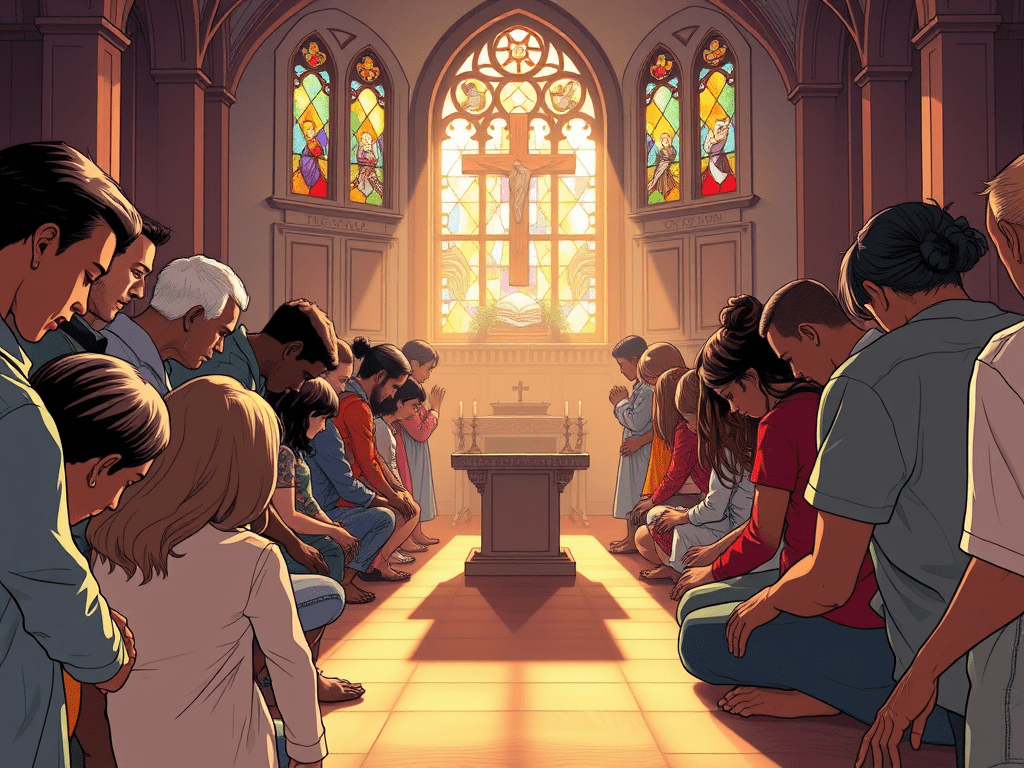

Reimagine the Gathering
What if we’ve misunderstood what it means to be gathered in God’s name?
Not in theory—but in posture. In practice. In the shape of the room, in the placement of the voices, and in the silence of the souls who feel too small to speak. This isn’t a call for disorder. It’s a call for awe. It’s a call to return to the kind of gathering where no man dares stand tall, because God is already in the room.
For centuries, Scripture shows us a pattern: man bowing before man. Bowing before kings, before prophets, before holy men and perceived authorities. These weren’t just gestures of politeness—they were powerful statements of who was above and who was below. Reverence flowed in one direction. Power was vertical. Holiness was possessed by a few, and the rest watched from beneath.
This was the structure: one man lifted, the others lowered. One man on the platform, the others in the pew. And when you look at it plainly, it’s no wonder people believed this was God’s order—this was how things had always been.
But then Jesus came—and the hierarchy cracked.
He didn’t demand posture. He washed feet. He didn’t ascend stages to receive admiration. He descended into pain to give mercy. He didn’t exalt Himself; He emptied Himself. In Him, the platform was removed. The only One worthy of reverence bowed before others in humility—and with that, the entire framework of spiritual superiority was undone.
This article is a journey through that unraveling.
Over the years, through study, experience, and quiet revelation, I’ve come to believe this was never God’s design. The hierarchy of reverence—the invisible ladder of holiness where some are presumed nearer to God than others—was never meant to exist in the house of the Lord.
Because when God alone is on the platform, the only reasonable response isn’t to watch—but to bow. Together.
Posture of Reverence
Throughout scripture, the physical act of bowing—falling on one’s face, stooping low, laying prostrate—carries profound weight. It is, in many cases, the outward expression of an inward acknowledgment: “I am not worthy.”
This is not mere social courtesy; it is the language of soul-to-soul humility. But when man bows before another man, the implications grow sharp. What does it mean when one human places another on a pedestal of holiness, wisdom, or divinely-given superiority?
We see it first and foremost with Joseph’s brothers. Though a prophecy foretold they would bow to him, it was never meant to deify Joseph—it was to reveal that even the most broken familial bonds could be healed through divine providence.
“And Joseph’s brothers came and bowed themselves before him with their faces to the earth.”
— Genesis 42:6
As they bowed, they didn’t know it was Joseph at first. Their bow was survival, not worship.
Moses before Jethro, his father-in-law. In Exodus 18:7, we’re told:
“So Moses went out to meet his father-in-law and bowed down and kissed him. They asked each other about their well-being and went into the tent.”
— Exodus 18:7
There’s intimacy here, familial respect—not superiority. It’s a bow of affection, not worship. He welcomes Jethro into the camp, not above the camp.
David before Saul. In 1 Samuel 24:8, we read:
“David also arose afterward, went out of the cave, and called out to Saul, saying, ‘My lord the king!’ And when Saul looked behind him, David bowed with his face to the earth, and paid homage.”
— 1 Samuel 24:8
David’s reverence wasn’t submission to Saul’s righteousness—it was submission to the position Saul held, as God’s anointed. Still, the posture speaks loudly—David held back his own righteousness in favor of honoring the structure, though he himself had done no wrong.
These gestures—while often rooted in reverence, fear, or awe—reveal something deeper beneath the surface: a quiet architecture of hierarchy. It’s the kind that elevates one man as a beacon of holiness, casting light that others are told they cannot touch.
This, I believe, is the very heart of the problem—not the reverence itself, but the imbalance it silently enforces.
Posture of Equality
Jesus interrupts this entire lineage. He bows to no man, and yet, He bows to wash their feet.
“So He got up from the meal, took off His outer clothing, and wrapped a towel around His waist… He poured water into a basin and began to wash His disciples’ feet, drying them with the towel that was wrapped around Him.”
— John 13:4–5
He doesn’t expect Peter to kneel and confess in His shadow—He kneels in front of Peter.
He invites Thomas to touch Him:
“Put your finger here; see My hands. Reach out your hand and put it into My side. Stop doubting and believe.”
— John 20:27
He lets Mary sit at His feet—not in submission, but in learning:
“Mary, who sat at the Lord’s feet listening to what He said.”
— Luke 10:39
His authority is never assumed through posture—but by the Presence He carried.
And what does He say to us?
“The greatest among you will be your servant. For those who exalt themselves will be humbled, and those who humble themselves will be exalted.”
— Matthew 23:11–12
And again:
“But do not be called ‘Rabbi’; for One is your Teacher, and you are all brothers.”
— Matthew 23:8
There it is: the equality. The divine leveling.
In our gatherings, do we invite others into this kind of equality? Or do we repeat the patterns of kings and prophets, looking to a man to stand where only God should stand?
Man Before Angels
Even more telling are the moments when humans encounter angels—those divine emissaries wrapped in human appearance, or light, or flame. The reaction is nearly universal: terror, awe, the instant fall to the ground.
And yet, what do they say nearly every time?
“Do not be afraid.”
“Stand up.”
“I am a servant just like you.”
Take Peter and Cornelius in Acts 10. Cornelius, a devout man, falls at Peter’s feet in reverence—but Peter won’t have it.
“But Peter lifted him up, saying, ‘Stand up; I too am just a man.’”
— Acts 10:26
That moment should echo like thunder through every pulpit and pew today. Even Peter—who walked on water, who preached Pentecost, who saw the risen Christ—refuses elevation. He does not receive the bow, because he knows it doesn’t belong to him.
John in Revelation: Twice, in his visions, he falls at the feet of an angel—overwhelmed, undone by the glory he sees. And both times, the angel responds with holy restraint:
“Then I fell at his feet to worship him. But he said to me, ‘You must not do that! I am a fellow servant with you and your brothers who hold to the testimony of Jesus. Worship God.’”
— Revelation 19:10
And again:
“I fell down to worship at the feet of the angel who showed them to me, but he said to me, ‘You must not do that! I am a fellow servant… Worship God.’”
— Revelation 22:8–9
Even the angels refuse the bow. They recognize what too many men have forgotten—that reverence misdirected becomes idolatry, even if wrapped in robes of religion.
Even angels reject the pedestal. Even the heavenly beings refuse the throne of honor.
So how is it that men so eagerly mount them? How is it that, today, we witness ministers building stages, crafting brands, accepting the silent bow of admiration, and even expecting it?
My Experience
I remember what it felt like walking into church for the first time with a heavy conscience and trembling knees. Not just guilt—shame. Not just reverence—fear. And not the kind of fear that leads to wisdom, but the kind that makes your soul flinch under the eyes of men who seem too clean, too confident, too close to God to understand someone like me.
I carried burdens—deep ones—and the thought of being seen by the preacher, or the Sunday school teacher, or even the front-row regulars, made me feel like a walking scandal. It wasn’t the message that frightened me; it was the structure—this subtle but unshakeable feeling that someone up there had the authority to look right through me. To judge. To disapprove. To dismiss.
There was a kind of unspoken choreography: the man on the platform speaks; the rest listen. The man at the pulpit knows; the rest receive. And as for me, I was just trying to survive the moment I stepped through the door without being spiritually found out. I didn’t feel like a brother among brothers. I felt like a sinner under surveillance.
And yet—over time—I began to see it wasn’t just me. This dynamic lives in more than just one denomination. It transcends cultures and languages. A hierarchy of reverence has taken root in the architecture of religious life: one man elevated, the rest seated; one voice amplified, the rest hushed; one heart assumed holy, the rest assumed needy.
I’m not saying there shouldn’t be leadership. I’m not even saying there’s no place for gifted teachers or shepherds. But when a gathering becomes an audience, and the presence of man overshadows the presence of God, something sacred has been displaced.
I’ve watched how people walk into church quietly, unsure of themselves, weighed down by the week, and leave just as disconnected—because they never spoke, never prayed aloud, never shared, never opened their soul. Why? Because it wasn’t their role. It wasn’t their place.
But in a gathering truly shaped by the Spirit, shouldn’t every person have a place?
What if, instead of spectating, we were invited to participate? What if the platform wasn’t the throne of a spiritual elite, but the common ground where equals meet before the face of God?
These are the questions that keep pressing against my heart—and the observations that have fueled this deeper search.
- Not out of rebellion, but out of reverence.
- Not to disrupt the sacred, but to rediscover it.
- Not chaos.
- Not rebellion
But order with humility. Leadership without pedestals
Order Without Elevation
There is wisdom in guidance.
There is strength in accountability.
There is beauty in order.
But the kind of order Jesus modeled wasn’t built on superiority—it was built on service. The shepherd was to lead by feeding, not by being fed praise. The teacher was to equip, not enthrone. The host was to welcome, not command.
What I’m advocating for isn’t the removal of leadership—but the removal of spiritual classism. The unspoken caste system that suggests some voices have direct access to God while the rest of us need permission, credentials, or clearance to approach the sacred.
Even Paul, who helped shape the structure of the early church, constantly referred to himself as a servant, not a ruler. And when order was laid out—for elders, deacons, shepherds—it was never a call to lordship.
It was a call to stewardship.
“Not domineering over those in your charge, but being examples to the flock.”
— 1 Peter 5:3
That’s the kind of order I believe in. Not the order that puts one man on the platform and others in the shadows—but the kind that creates space for every person to flourish under the gaze of God, not under the gaze of another man.
Because when order becomes about control, the Spirit is quenched. But when order becomes a framework for mutual edification, the Spirit flows freely. It becomes a gathering where the gifted teach, the broken speak, the quiet pray, and the humble listen—and no one is greater than the other.
Jesus didn’t come to flatten everything into spiritual chaos—He came to realign it. To show us that true authority looks like washing feet. That true leadership looks like stepping back so others can step forward. That the highest place is always the lowest.
It’s time we stop measuring church health by how well one man preaches—and start measuring it by how well we all respond to God together.
God Alone on the Platform
What would it look like—really look like—if we gathered not around a man, but around God?
What if the platform didn’t hold a preacher, a band, or a program—but was empty… held in sacred restraint, because we dared to believe He was already there?
I’m not talking about empty chairs and echo chambers. I’m talking about gatherings where the atmosphere isn’t driven by a script, but by presence. Where no one presumes to lead unless led by the Spirit, and no one hides in the crowd because they think they don’t belong.
I imagine a room where people enter not quietly out of guilt, but reverently in awe—not of the speaker, but of the One we’ve all come to meet.
There might be a host, sure. Someone to open the space, welcome hearts, create rhythm. But they wouldn’t be a gatekeeper. They’d be a doorkeeper. They’d stand back while the Spirit moves forward.
I see prayer groups forming in clusters—two, three, four people at a time. I see tears, laughter, testimony, silence. I see people moving across the room to speak to someone the Spirit puts on their heart, not worrying about “disrupting the service” because this is the service.
I see women praying with women, men sharing burdens with other men. Not just vulnerability for vulnerability’s sake, but as sacred acts of offering. The kind where you say, “This is my real heart. I’ve been through fire. Can I pray for you?”
And no one’s looking at a clock.
And no one’s waiting for the professional to take the mic.
Because God already did.
The Spirit is in the room. He’s speaking through the unlikely, touching through the broken, answering prayers mid-sentence, convicting, healing, drawing people to Himself without applause or spotlight.
There’s no sermon break. No platform plea. Just worship rising from the floor, not directed by a song list, but pulled from hearts who’ve tasted grace and want to give it back.
When I imagine that kind of gathering, I can’t imagine anyone trying to rise above it. No one would dare take the platform, because it would feel like climbing onto the mercy seat itself. And who would do that? Who could?
If God is on the platform, every soul in the room knows what to do: bow.
Not before a man.
Not before a system.
Not before a sermon.
But before God—holy, present, listening, and worthy.
Platforms of Grace
I didn’t write this to dismantle the church. I wrote it because I love her too much to leave her unexamined.
If you’ve ever walked into a room of worship and felt like your soul had to shrink just to fit, I’ve been there. If you’ve ever carried a burden so heavy you couldn’t lift your eyes toward the pulpit, I’ve felt that weight. If you’ve ever believed someone else was closer to God than you could ever be—I’ve had those same thoughts echo through my chest.
But the truth I’ve come to know—through the quiet voice of the Spirit, through the raw pages of Scripture, through trembling prayers and holy silence—is that God never asked for hierarchy.
He asked for humility.
He never demanded a stage.
He longed for a sanctuary.
And He never once told us to bow to one another in awe—but to love one another in grace.
So I’m not asking you to burn down your buildings, abandon your churches, or silence your pastors. I’m simply asking: what if we’ve made the gathering smaller than it’s meant to be?
What if we let go of our grip on spiritual roles and rediscovered that every one of us is a temple?
What if we came together not to be taught by one, but to be transformed by One?
What if the best seat in the house is the one closest to the broken, the doubting, the unnoticed?
If Jesus Himself walked into our gathering, would we hand Him a microphone—or fall to our knees and finally listen?
This is the invitation:
Not to deconstruct for the sake of destruction.
But to bow together—not before a man—but before the only One who deserves the floor.
God doesn’t need our platforms.
He wants our hearts.
And when we gather like that?
We might just find that He’s already there.



Leave a comment