
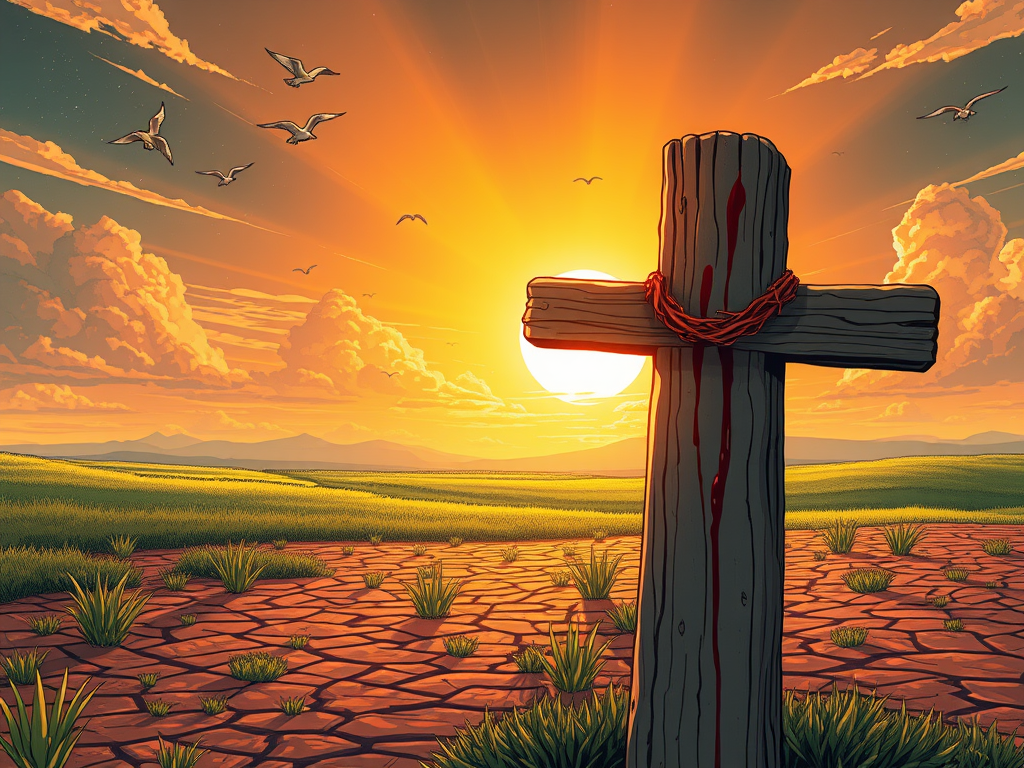
Mythological Inquiry
The ancient world moved to the rhythm of myth. Mountains breathed with the presence of gods, and the womb was a sacred altar. Myth wasn’t fantasy—it was survival. It explained the stars, the flood, the plague, the wind in the wheat. It turned chaos into cosmos.
“In a world where no telescope yet reached the stars, mankind turned the heavens inward, giving names to the thunder and calling down the gods with smoke and sacrifice.”
As writing spread and cities rose, gods stopped being distant forces and became possessions of tribes and empires. The divine was no longer just observed; it was wielded. In this world, belief wasn’t a matter of private devotion—it was a claim to reality itself. And so, with smoke and blood, sacrifice and song, mankind built a world where to name a god was to name a future.
Cultures told their stories—Ra commanded the sun’s journey across the Egyptian sky; Marduk conquered chaos to birth Babylon; Baal rode storms across the Canaanite hills. Each god ruled a domain, a people, a plot of land.
But YHWH defied containment.
The Hebrew Paradox
The Hebrew scriptures open with a God of the cosmos, not a tribal deity—but soon, in a strange narrowing of scope, this boundless Creator turns to a single man:
“Now the Lord said to Abram, ‘Go from your country and your kindred and your father’s house to the land that I will show you.’”
— Genesis 12:1
YHWH becomes intimate. Personal. He is no longer just the God of stars and atoms—He enters space and time with footsteps:
“[He] was walking in the garden in the cool of the day.”
— Genesis 3:8
He appears not in fire alone, but in friendship and fellowship:
“The Lord appeared to Abraham by the oaks of Mamre, as he sat at the door of his tent in the heat of the day. He lifted up his eyes and looked, and behold, three men were standing in front of him.”
— Genesis 18:1–2
And in one of the most intimate images, this cosmic God stays for a meal:
“He stood by them under the tree while they ate.”
— Genesis 18:8
Even as He binds Himself to a single family, this God is still named above all others:
“Blessed be Abram by God Most High, Possessor of heaven and earth.”
— Genesis 14:19
The paradox is sharp: the God who speaks galaxies into existence now dines under trees and calls a wandering shepherd His friend.
The Corners of the Earth
If the God of Genesis truly shaped the entire earth, was He only speaking to one tribe? Was the rest of creation drifting in divine silence — or worse, abandonment?
Scripture whispers a different story. Creation itself was never mute:
“The heavens declare the glory of God, and the sky above proclaims his handiwork. Day to day pours out speech, and night to night reveals knowledge.”
— Psalm 19:1–2
God embedded His voice in nature’s design. The stars sang, the rivers testified. Even without Torah, mankind was never without witness.
“For what can be known about God is plain to them, because God has shown it to them. For his invisible attributes, namely, his eternal power and divine nature, have been clearly perceived… in the things that have been made.”
— Romans 1:19–20
From the beginning, He strove not only with Israel, but with all flesh:
“Then the Lord said, ‘My Spirit shall not abide in man forever, for he is flesh: his days shall be 120 years.’”
— Genesis 6:3
That word was not directed to a nation—but to humanity before nations even existed. And even as judgment drew near, God sent warnings, prophets, and signs. The destruction of cities like Sodom and Nineveh came not from divine caprice, but from repeated rejection.
“The Lord is not slow to fulfill his promise… but is patient toward you, not wishing that any should perish, but that all should reach repentance.”
— 2 Peter 3:9
Nineveh, the capital of the violent Assyrian empire, received a prophet from Israel—Jonah—and when they repented, God relented. This wasn’t just an exception; it was a revelation:
“Should I not pity Nineveh, that great city, in which there are more than 120,000 persons who do not know their right hand from their left…?”
— Jonah 4:11
Even in judgment, God mourned. Even in wrath, He longed.
And what of Melchizedek, a priest of the Most High God (El Elyon), blessing Abram from a city untouched by the covenant? Or Job, a man “blameless and upright” (Job 1:1), who feared God without ever having met Moses or known the Law?
Scripture is full of foreign faithfulness, of non-Israelite righteousness—suggesting the quiet presence of a God working far beyond the scrolls of Israel’s history.
“He made from one man every nation of mankind to live on all the face of the earth… that they should seek God, and perhaps feel their way toward him and find him. Yet he is actually not far from each one of us.”
— Acts 17:26–27
This passage—spoken by Paul to Greek philosophers, not Hebrew priests—might be the clearest cry yet: God was never absent. From the jungle to the desert, from Andes to Nile, He was reaching, whispering, striving.
“To create all things and only speak to one tribe — is that exclusion or strategy?”
Maybe the answer lies in this: the Scriptures tell the story of a particular people, but not an exclusive God.
YHWH’s covenant was a door, not a wall.
Through Israel, through their stories and struggles, the heart of God was being revealed to all creation.
Creation Never Abandoned
The ruins of forgotten empires and the chants of distant tribes carry haunting similarities—as though humanity, scattered and scarred, still remembered a God who once walked among them.
In Mesopotamia, long before Moses etched commandments on stone, the Epic of Atrahasis told of a time when gods created mankind from clay, then flooded the world in response to human corruption. One god, Enki, tries to spare the humans, whispering the warning in secret.
In the Epic of Gilgamesh, another flood narrative unfolds: Utnapishtim is told to build a boat to survive the gods’ wrath. The parallels with Noah are undeniable—not because the Bible borrowed from myth, but because all of humanity may carry the bruised memory of a great undoing and a God who still reached out.
“O man of Shuruppak, son of Ubara-Tutu: tear down the house and build a boat!”
— Epic of Gilgamesh, Tablet XI
In China, ancient characters suggest knowledge of Genesis-like themes. The traditional Chinese word for “boat” (船) is composed of the radicals for “vessel,” “eight,” and “mouths”—a potential echo of Noah’s ark, carrying eight people. And in Chinese lore, Nuwa, a goddess who repairs the heavens after a cosmic flood, bears striking resemblance to stories of divine preservation and restoration.
Among the Aboriginal Australians, stories passed orally for tens of thousands of years speak of a sky-being who created the world and then withdrew after human disobedience. This sky-being is not part of a pantheon but stands above—more like YHWH than the local spirits.
In the sacred hymns of India, the Rigveda speaks of Prajapati, the “Lord of Creatures,” a singular being who existed before all gods and created the heavens and the earth. In later Hinduism, this figure becomes blurred into the polytheistic fabric, but the ancient memory of a solitary Creator lingers like a fading echo.
“There was neither non-existence nor existence then… The One breathed windless by its own impulse.”
— Rigveda, Book 10, Hymn 129
And even across the Americas, the Maya Popol Vuh recounts several failed creations of mankind by a singular divine force—before finally creating humans from corn. Though mythic and symbolic, the structure still resonates: creation, failure, striving, judgment, mercy.
These echoes do not prove uniform theology—but they do suggest a shared ache. A memory of something greater. A distant familiarity with a God who once walked closer, and whose voice lingers in wind, flood, fire, and dream.
Heavens Are Watching
The ancient world saw the skies not as empty space but as occupied — alive with presences, voices, and watchers. The Bible doesn’t flatten this into metaphor; it embraces it.
Heaven is not distant, but deeply involved.
Behind every covenant, judgment, and act of mercy, there is a divine council, an audience to the Most High, a host of beings engaged in the unfolding drama of Earth.
“God has taken His place in the divine council; in the midst of the gods He holds judgment.”
— Psalm 82:1
This is no solitary throne. From Genesis to Revelation, we see Heaven observing, intervening, and reacting. In the earliest pages:
“The sons of God saw that the daughters of man were attractive. And they took as their wives any they chose.”
— Genesis 6:2
This crossing of realms leads to catastrophe, yes—but it also reveals that Heaven was not absent. It was entangled. In the Book of Job, the heavens gather again:
“Now there was a day when the sons of God came to present themselves before the Lord, and Satan also came among them.”
— Job 1:6
Even in exile, the prophet Daniel sees the same reality unfolding:
“A court was seated, and the books were opened.”
— Daniel 7:10
These aren’t isolated images—they form a divine pattern.
The Book of Enoch, an ancient text treasured in Second Temple Judaism, speaks of Watchers—angelic beings appointed to oversee humanity. Though some fell, their role reveals a truth long buried: that Heaven had systems, watchers, and governance deeply invested in Earth’s outcome.
“I saw in my vision how the Watchers descended from heaven to earth… and they taught the sons of men all manner of secrets.”
— 1 Enoch 7:1–2 (paraphrased)
Even more astonishing—two humans, Enoch and Elijah, were taken up without ever dying. They remain in the divine realm, not as ghosts, but as living men within Heaven’s court.
“Enoch walked with God, and he was not, for God took him.”
— Genesis 5:24
“And Elijah went up by a whirlwind into heaven.”
— 2 Kings 2:11
What does this tell us? That the boundary between Heaven and Earth is thinner than we thought. That God’s plan was never restricted to one people, one moment, or one religion. The heavenly court stands above all nations—not judging only, but watching, weighing, caring.
“After this I looked, and behold, a great multitude that no one could number, from every nation, from all tribes and peoples and languages, standing before the throne.”
— Revelation 7:9
God is not watching history from a distance. He is surrounded by witnesses. His throne is a hub of planning, intercession, and mercy. The entire cosmos is involved in the restoration of what was once lost.
“If God has a throne, He also has an audience — and perhaps a court that trembles when men are judged.”
Apocryphal Echoes Speak
Books like 1 Enoch and 2 Esdras don’t contradict the Hebrew scriptures; they amplify them. They reveal a world in which Heaven is obsessed with Earth — watching, intervening, grieving, and planning redemption across every tribe and tongue.
In 1 Enoch, written centuries before Christ but treasured in early Jewish and Christian thought, we’re told of angelic beings called the Watchers, sent by God to oversee humanity. But some of them fall — seduced by the beauty of women and the allure of Earth:
“And they descended upon Ardis, which is the summit of Mount Hermon… and they took unto themselves wives, and each chose for himself one, and they began to go in unto them and to defile themselves… and they taught them charms and enchantments.”
— 1 Enoch 6:6–7; 7:1
God does not ignore this corruption. He calls a council. He judges the Watchers. He warns of the coming flood — and He chooses Enoch, a man who walked so closely with Him that he is taken up alive to serve as a heavenly messenger.
“And He answered and said to me… ‘Fear not, Enoch, thou righteous man and scribe of righteousness: approach hither and hear My voice.’”
— 1 Enoch 15:1
“And Enoch went and said: ‘Azazel, thou shalt have no peace: a severe sentence has gone forth against thee to put thee in bonds…’”
— 1 Enoch 13:1
It’s not just judgment — it’s administration. Heaven is not ignoring Earth’s cries; it’s actively legislating on them.
Likewise, in 2 Esdras (also called 4 Ezra), written after the destruction of the Second Temple, a devastated prophet pleads with God about justice. And God answers. Not with silence, but with revelations so deep they echo across history.
“For I have sowed My law in them like seed, and it shall bring forth fruit in time… I have cared for the world, and for men, even in the womb.”
— 2 Esdras 9:31–32
And perhaps most relevant, is this:
“O Lord, who bearest rule, of every wood of the earth, and of all the trees thereof, thou hast chosen thee one only vine. And of all lands of the whole world thou hast chosen thee one pit… and of all the multitudes of peoples thou hast gotten thee one people: and unto this people, whom thou lovedst, thou gavest a law that is approved of all.”
— 2 Esdras 5:23–27
But Ezra responds — why only one? Why so much loss among the others? And the answer comes, not with cruelty, but with sorrow. The divine choice is not about abandonment but about redemption—a concentration of grace to awaken the whole.
The heavens are not still. The councils are not empty. The Watchers still watch, the angels still minister, and the plan still unfolds—not for one people, but for all creation.
Heaven in Our Midst
The mythologies of the ancient world were not just attempts to control nature or explain fear—they were echoes, reverberations of a lost intimacy between God and man. And while these echoes fractured into many names and forms, Scripture reveals a deeper undercurrent: that Heaven has always been involved, that no civilization was without divine striving, and that God’s heart has always beat for all creation.
From the first breath in Eden to the last trumpet of Revelation, the story is not one of divine abandonment, but of divine entanglement.
“The Lord looks down from heaven on all mankind to see if there are any who understand, any who seek God.”
— Psalm 14:2
“He did not leave Himself without witness.”
— Acts 14:17
The so-called “heathen nations” were never truly alone. They were guided, warned, watched, and—when they turned—welcomed.
- Melchizedek, the priest-king of Salem, blessed Abraham in the name of El Elyon long before the Law came.
- Job, a man from Uz, was called “blameless” by the very mouth of God (Job 1:8), though he bore no covenant scroll.
These figures stand as testaments that righteousness was never limited to Israel.
Early Christian thinkers affirmed this expansive view. Justin Martyr (100–165 AD) taught that Christ, as the Logos, had been at work in the hearts and minds of all people, not just Christians:
“We have been taught that Christ is the first-born of God, and we have declared above that He is the Word of whom every race of men were partakers.”
— Justin Martyr, First Apology 46
Clement of Alexandria (c. 150–215 AD) argued that philosophy was a preparation for the Gospel—a divine tutoring given to the Greeks just as the Law was given to the Hebrews:
“The Greek preparatory culture, therefore, with philosophy itself, was given to the Greeks… as a schoolmaster to bring them to Christ.”
— Stromata, Book 6
Even Origen, writing in the early 3rd century, believed God’s providence extended across the globe:
“There are indications that God’s providence is over all mankind, and not only over the faithful.”
— Origen, Against Celsus 4.7
The early Church did not teach that God began with Jesus—they taught that Jesus revealed what had always been: a God active in every time, every people, every mythic longing.
And so the conclusion is not a retreat, but a revelation: the world has always been a theater of divine action. The divine council has always stood. The Watchers have always watched. The Spirit has always hovered.
“Wisdom reaches mightily from one end of the earth to the other, and she orders all things well.”
— Wisdom of Solomon 8:1 (Deuterocanonical)
From the Epic of Gilgamesh to the Book of Enoch, from the Popol Vuh to the Psalms of David, a single voice hums beneath the surface of it all: You are not alone. You have never been alone.
“Behold, I am with you always, even to the end of the age.”
— Matthew 28:20
Source Appendix
Scriptural References (Canonical)
- Genesis 1–3 – Creation narrative; God walks in the garden (Gen. 3:8).
- Genesis 5:24 – “Enoch walked with God, and he was not, for God took him.”
- Genesis 6:1–3 – Sons of God and the daughters of men; God striving with mankind.
- Genesis 12:1 – God’s personal call to Abram.
- Genesis 14:19 – Melchizedek blesses Abram in the name of El Elyon.
- Genesis 18:1–8 – The Lord dines with Abraham at the Oaks of Mamre.
- 2 Kings 2:11 – Elijah is taken into heaven by whirlwind.
- Job 1:1, 6 – Job’s righteousness and the heavenly council.
- Psalm 14:2 – God looks down on all mankind.
- Psalm 19:1–2 – Creation proclaims the glory of God.
- Psalm 82:1 – God takes His seat in the divine council.
- Daniel 7:10 – Heavenly court imagery; books opened.
- Jonah 4:11 – God’s pity for Nineveh.
- Acts 14:17 – God “did not leave Himself without witness.”
- Acts 17:26–28 – God made all nations; He is not far from any of us.
- Romans 1:19–20 – God’s invisible nature revealed through creation.
- 2 Peter 3:9 – God desires all to come to repentance.
- Revelation 7:9 – A multitude from every nation before the throne.
- Revelation 21:3 – “The dwelling place of God is with man.”
- Matthew 28:20 – “I am with you always, even to the end of the age.”
Apocryphal and Deuterocanonical Texts
- 1 Enoch 6–7, 13, 15 – The Watchers descend; Enoch is chosen as messenger.
- Preserved in Ethiopian Orthodox canon; widely used in Second Temple Judaism.
- 2 Esdras (4 Ezra) 5:23–27; 9:31–32 – God’s providence and the mystery of one chosen people.
- Found in the Apocrypha of the Vulgate; valued in Eastern Orthodox, Anglican, and early Protestant traditions.
- Wisdom of Solomon 8:1 – “Wisdom reaches mightily from one end of the earth…”
- Part of the Catholic and Orthodox biblical canon.
Ancient Mythological Sources
- Epic of Atrahasis (17th c. BCE) – Akkadian text detailing the creation of man and a global flood. The god Enki warns Atrahasis of the coming destruction.
- Epic of Gilgamesh, Tablet XI – Utnapishtim receives divine instruction to build a boat and survive a world-ending flood.
- Rigveda, Book 10, Hymn 129 – Hindu creation hymn describing the One who breathed windless by His own impulse.
- Popol Vuh (Maya) – Multiple attempts at human creation by a singular divine force before humans made from corn are accepted.
- Aboriginal Australian Dreamtime – Oral traditions of a sky-being creating the world, then withdrawing due to disobedience.
- Nuwa (Chinese mythology) – Goddess who repairs the heavens after a cosmic flood; often depicted alongside themes of renewal and divine order.
Early Christian Writers
- Justin Martyr, First Apology 46 “We have been taught that Christ is the first-born of God… the Word of whom every race of men were partakers.”
- c. 155 AD
- Clement of Alexandria, Stromata, Book 6 “The Greek preparatory culture… was given to the Greeks as a schoolmaster to bring them to Christ.”
- c. 200 AD
- Irenaeus, Against Heresies 4.6.6 “There is one and the same God the Father, and His Word has been present with the human race from the beginning.”
- c. 180 AD
- Origen, Against Celsus 4.7 “There are indications that God’s providence is over all mankind, and not only over the faithful.”
- c. 248 AD



Leave a comment