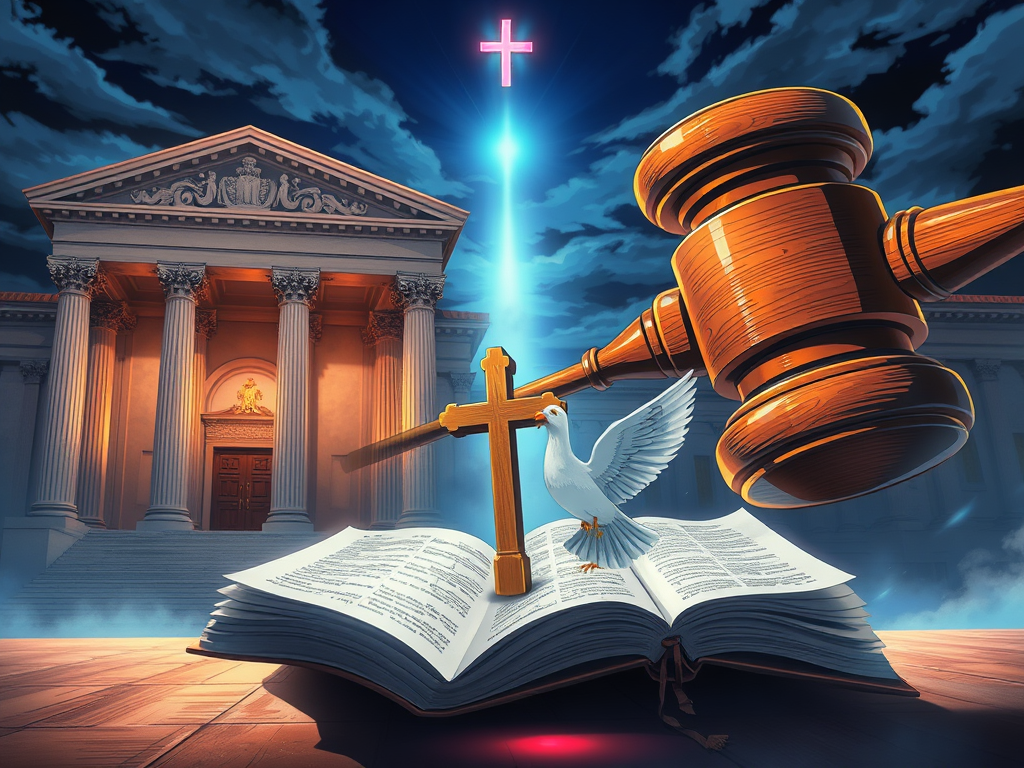

Principles of Providence
What does it mean to bring Christianity into politics?
This question has weighed on my mind for years, especially as I see so many people around me fiercely advocating for a government built on Christian values. It seems noble at first—who wouldn’t want laws and leaders to reflect what is good, just, and righteous?
And yet, something within me resists …
When Christians try to legislate morality, believing they can force godliness through law, they end up pushing Christ out of what they are trying to build. Faith cannot be mandated by government—it must be a transformation of the heart, not a system of control.
Jesus never called His followers to seize power or enforce righteousness through politics but to be a light that changes the world from the inside out. The more we push for earthly rule, the more we replace God’s kingdom with man’s authority—trading grace for governance and the Spirit’s work for state power.
If the church truly wants to bring God’s presence into a nation, it won’t be through laws alone, but through genuine hearts surrendered to Christ.
Church and State
C.S. Lewis and John Wesley both spoke to the complex relationship between Christianity and the state, offering insights that strengthen my conviction that the kingdoms of this world are not ours to rule as if we were sent to establish a theocracy.
C.S. Lewis, in Mere Christianity, wrote:
“The State exists simply to promote and to protect the ordinary happiness of human beings in this life. A Church exists to draw men into Christ, to make them little Christs. If they are doing their jobs, their functions do not overlap.”
Lewis was addressing a broad audience of believers and skeptics alike, presenting Christianity in a rational and accessible way. His argument here is profound: the purpose of government is to manage societal order, ensuring justice and stability, whereas the purpose of Christianity is to transform individual lives into the likeness of Christ.
These are two distinct missions, and when the Church seeks to wield the power of the State to accomplish its spiritual aims, it risks losing the very essence of what makes faith voluntary and transformative. Likewise, when the State adopts religious authority, it ceases to serve all people equitably, favoring one doctrine over others in a way that history has repeatedly shown to be dangerous.
John Wesley, in A Letter to the Reverend Dr. Free, wrote:
“The Church is properly and directly designed to influence men’s hearts and lives. The State is designed to regulate only their outward actions.”
Wesley was responding to concerns about religious influence in governance during his time. His words carry weight even today—reminding me while faith should undoubtedly inspire individual actions and public virtue, the work of governing belongs to an entirely different realm.
Laws can shape behavior, but they cannot transform hearts; they can enforce justice, but they cannot produce genuine righteousness. Christianity does not advance by the sword of legislation but by the power of conviction, love, and personal transformation.
So I stand firmly in this middle space—not rejecting Christian influence in society but resisting the urge to claim dominion over it. I believe in a higher sovereignty that does not require the machinery of government to fulfill its purposes.
“Two cities have been formed by two loves: the earthly by the love of self, even to the contempt of God; the heavenly by the love of God, even to the contempt of self.”
— Augustine, The City of God
The kingdoms of this world will rise and fall, but Christ’s kingdom operates on an entirely different plane—one that does not depend on ballots, laws, or policies to accomplish its work in the human soul.
“For our citizenship is in heaven, and we eagerly await a Savior from there, the Lord Jesus Christ.”
— Philippians 3:20 (NIV)
Scriptural Interpretation
This struggle has never truly ended. Even today, with countless Christian denominations interpreting the Bible in different ways, the idea of a “Christian nation” becomes impossible.
Here are some quotations from various Christian denominations critiquing one another’s doctrines and practices, illustrating the divisions that make the idea of a unified “Christian nation” impossible.
Catholic View
“If anyone says that man is justified by faith alone, meaning that no other cooperation is required in order to obtain the grace of justification, let him be anathema.”
— Council of Trent (1545-1563), Canon 9 on Justification (Catholic Doctrine Rejecting Sola Fide)
The Catholic Church has historically condemned the Protestant doctrine of justification by faith alone (sola fide), which remains a fundamental dividing line.
Protestant Reform
“I believe that the Pope is the masked and incarnate devil because he is the Antichrist.”
— Martin Luther, Against the Roman Papacy, an Institution of the Devil (1545)
Luther saw the papacy not as a spiritual guide, but as a corrupt institution.
Calvinist Predestination
“Such blasphemy this doctrine of predestination is… you represent God as worse than the devil, more false, more cruel, and more unjust.”
— John Wesley, Free Grace (1739)
Methodist founder John Wesley outright rejected the Calvinist doctrine of predestination, which teaches that God elects some for salvation and others for damnation.
Anabaptists
“For who ever saw, in any period of history, an example of [Anabaptist] frenzy and madness?”
— John Calvin, Institutes of the Christian Religion (1536)
Calvin had no patience for Anabaptists, who rejected infant baptism and advocated for a believer’s baptism instead.
Infant Baptism
“Baptism is not to be administered to infants. It is contrary to the institution of Christ.”
— London Baptist Confession of Faith (1689)
Baptists reject infant baptism, a practice upheld by Catholics, Lutherans, Anglicans, and Presbyterians.
Evangelical Critique
“The so-called churches of Christendom have erected a system of rites and rituals… replacing the simplicity of the Gospel with man-made tradition.”
— A.W. Tozer, The Root of the Righteous
Many Evangelicals reject high-church traditions and liturgical worship as empty formalism, contrasting their “Spirit-led” approach to faith with what they see as dead ritualism in Catholicism, Orthodoxy, and even some Protestant traditions.
Orthodox Christian
“Western theology is rationalistic, legalistic, and at times, sentimental. It has lost the fullness of the mystical, spiritual life which is essential to true Christianity.”
— Vladimir Lossky, The Mystical Theology of the Eastern Church
The Eastern Orthodox Church sees both Protestantism and Catholicism as distortions of the original apostolic faith, accusing them of excessive rationalism and legalism.
Christianity Cannot Agree
The history of Christianity is one of deep theological division, where even those who claim to follow the same Christ cannot agree on foundational doctrines. From salvation to baptism, from church authority to worship styles, every major branch of Christianity has argued—often bitterly—over what it means to be Christian.
These are not minor disputes—they are centuries-old debates that have shaped nations, caused wars, and divided churches. Any attempt to enforce one interpretation of Christianity through law would inevitably result in oppression, exclusion, and conflict.
The idea of a “Christian nation” is not just impractical—it is a contradiction of Christianity itself.
The deeper one looks, the clearer it becomes that no human government could ever enforce a single, unified Christian doctrine without silencing large portions of believers who see Scripture differently.
Theocracy Example
The Puritan colonies of early America sought to build a “City upon a Hill,” a society governed by strict Christian law. Yet, in their pursuit of religious purity, they did not unite under faith—they divided under it.
Their vision of a godly society became a battleground of interpretations, where disputes over doctrine led not to discussion, but to persecution. They sanctioned executions for dissenters, burned so-called witches at the stake, and exiled those who dared to interpret Scripture differently. The very faith that preached grace and redemption was used as a weapon to control and condemn.
If this level of division existed among the first settlers, who shared a common cultural and theological background, how much more fragmented would it be in a modern, diverse nation with centuries of doctrinal disagreement behind it?
The Puritan experiment showed that when religious authority is wielded as political power, it does not create unity—it creates factions, exclusion, and ultimately, oppression. This is the unavoidable flaw in any attempt to establish a so-called Christian nation.
Roger Williams, one of the first to reject theocratic rule in America, warned:
“Forced worship stinks in God’s nostrils.”
— Roger Williams, The Bloudy Tenent of Persecution (1644)
He recognized that faith imposed by law is no faith at all.
James Madison later echoed this concern, writing:
“Who does not see that the same authority which can establish Christianity, in exclusion of all other Religions, may establish with the same ease any particular sect of Christianity, in exclusion of all other Sects?”
— James Madison, Memorial and Remonstrance Against Religious Assessments (1785)
The Puritans themselves proved this, turning their society into a battleground of interpretations where those with differing beliefs were exiled or executed.
Faith has never been, and never will be, a singular, undivided ideology under human rule. John Milton wrote:
“No man can be forced to be virtuous.”
— John Milton, Areopagitica (1644)
History has already shown the consequences of trying to force unity through governance. True faith thrives in conviction, not coercion, and any attempt to enforce it through political power will always end in division rather than devotion.
Enforcing Christian Principles
The reason I cannot support the idea of a government enforcing Christian principles by law is not because I reject those principles, but because Christianity itself has never been, and never will be, a single, undivided ideology under human rule.
Jesus never sought political power, nor did He command His followers to establish a government in His name. When questioned about earthly authority, He made it clear:
“My kingdom is not of this world. If it were, my servants would fight to prevent my arrest by the Jewish leaders. But now my kingdom is from another place.”
— John 18:36 (NIV)
Faith is lived, not legislated. The teachings of Christ call people to follow Him willingly, not by force or compulsion. Paul reinforces this idea, emphasizing that righteousness comes through faith, not law:
“For sin shall no longer be your master, because you are not under the law, but under grace.”
— Romans 6:14 (NIV)
Jesus never gave His disciples instructions to create a theocratic rule; instead, He warned against seeking power and control over others:
“You know that the rulers of the Gentiles lord it over them, and their high officials exercise authority over them. Not so with you. Instead, whoever wants to become great among you must be your servant.”
— Matthew 20:25-26 (NIV)
Faith thrives in conviction, not coercion.
The moment a government enforces one interpretation of God’s will through the power of the state, it ceases to reflect the true nature of Christ’s message. The Apostle Paul further warned against imposing religious burdens on others, stating:
“Now the Lord is the Spirit, and where the Spirit of the Lord is, there is freedom.”
— 2 Corinthians 3:17 (NIV)
History has already shown us what happens when men try to force faith through governance. Jesus’ call was never to build a kingdom through law and political rule but to transform hearts through grace, love, and personal conviction.
A Haunting Question
These examples raise a haunting question: If a government enforces religious law but rules with violence, oppression, and corruption, is it truly serving God—or is it serving its own lust for power?
History does not whisper this warning; it cries out for us to listen.
This is why I hesitate when people call for a “Christian nation.” Not because I doubt the power of Christ’s teachings, but because I have seen what happens when men claim divine authority over others.
Faith is meant to transform hearts, not control laws. If we truly believe in the power of Christ, then we should trust that His kingdom does not need the power of the state to endure.
Entangled Truths
I do not argue that Christian principles should be abandoned in public life—far from it. In fact, the values Jesus taught are so deeply ingrained in the fabric of human decency that they transcend religious identity.
Justice, mercy, humility, compassion—these are not just Christian ideals, they are universal truths that have shaped every great moral society.
And this is the tragic reality, the moment we attach a religious Christian label to these virtues, the battle lines are drawn. Suddenly, kindness becomes controversial, justice becomes political, and mercy is mistaken for weakness.
Do we really want to drag our Savior, God, and King into the filth of politics, how we have reduced the Most Holy, Most Beautiful, Most Righteous One to nothing more than a banner for causes, a weapon for divisions, a tool for power struggles?
Have we turned the Prince of Peace into a warrior for ideologies? Have we desecrated His mercy in pursuit of control?
We have sullied His name in our earthly disputes, clothed His holiness in self-righteousness, and nailed Him once again to the cross of our ambitions. Do we not tremble at the thought?
Read and see now the shame we bring upon our Beautiful Savior
- Immigration & Refugees: When some Christian leaders advocate for welcoming refugees and immigrants, citing Jesus’ command to care for the stranger (Matthew 25:35), they are accused of promoting open borders, socialism, or ignoring national security. The very act of showing mercy to displaced people—once considered a fundamental Christian value—has become a political flashpoint.
- Religious Freedom vs. Discrimination: Many Christians argue for religious freedom, particularly regarding businesses, schools, and organizations that wish to operate according to their biblical convictions. However, opponents often see this as a cover for discrimination, particularly in cases involving LGBTQ+ rights, abortion, and marriage. Christian bakers, florists, and wedding venues refusing to serve same-sex weddings based on their faith have been sued or boycotted. To some, this is a matter of religious liberty; to others, it is denying equal rights under the law.
- The debate over whether Christian adoption agencies can refuse to place children with same-sex couples has led to legal battles, with some seeing it as a right to operate by biblical values and others as state-supported discrimination.
- Racial Justice & Equality: Many Christians who supported movements like Black Lives Matter or racial reconciliation efforts have been met with backlash from within their own faith communities. Despite the Bible’s consistent calls for justice (Isaiah 1:17, Micah 6:8), these efforts were seen by some as aligning with secular political agendas rather than being genuine acts of Christian love.
- Caring for the Poor & Social Justice: Some churches that prioritize helping the homeless, advocating for healthcare, or pushing for economic justice are labeled as promoting socialism, even though these actions align with Christ’s teachings (Luke 4:18, Acts 2:44-45). What was once seen as a Christian duty to care for the marginalized is now tangled in ideological warfare.
- Biblical Marriage vs. “Hate Speech”: Christians who believe in traditional marriage as between a man and a woman have increasingly faced censorship or backlash, with their views being labeled as bigotry, intolerance, or hate speech rather than theological conviction. Public figures, pastors, and Christian businesses who affirm a biblical definition of marriage often face cancellation, de-platforming, or employment consequences.
- Some Christian colleges and universities risk losing their tax-exempt status for upholding traditional views on sexuality. Pastors in some countries, like Canada and parts of Europe, have faced legal action for preaching against same-sex marriage, raising concerns about whether religious convictions can be openly expressed.
- Forgiveness & Nonviolence: When high-profile Christian figures preach forgiveness—such as after mass shootings or racial violence—some celebrate it as Christ-like, while others criticize it as a way to excuse injustice. The call to “love your enemies” (Matthew 5:44) has become, in many circles, a sign of weakness rather than a spiritual command.
- Christian Patriotism vs. Christian Nationalism: Many conservative Christians believe in America’s biblical foundations and advocate for keeping faith in public spaces (like schools and government). However, this belief is often criticized as Christian Nationalism, an attempt to merge Christianity with state power. Saying “America is a Christian nation” can be seen as a statement of historical fact or a call for religious supremacy, depending on the perspective.
- Christian prayers and symbols in public schools have been removed due to legal challenges, while other religious expressions (such as Islamic prayers in schools) are defended under religious freedom. This leads some Christians to feel their faith is being uniquely erased. The phrase “In God We Trust” on money or government buildings is seen by some as a heritage of faith and by others as a violation of church and state separation.
- LGBTQ+ Inclusion vs. Exclusion: Churches are deeply divided over how to approach LGBTQ+ individuals. Some Christian communities emphasize love and inclusion, while others focus on doctrine and boundaries. As a result, both sides accuse each other—either of abandoning biblical truth or of lacking Christ’s compassion.
- Christian Views on Gender vs. Gender Identity Politics: Many Christians believe that male and female are distinct, God-given categories based on Scripture (Genesis 1:27). However, this view is increasingly framed as harmful, intolerant, or even abusive by secular progressives. Christian parents or teachers who refuse to use a student’s preferred pronouns may face disciplinary action or job loss, even if their stance is based on deeply held biblical beliefs. Christian athletes and organizations opposing biological males competing in women’s sports are accused of bigotry, even though their concerns center on fairness and biological differences.
These are not abstract debates. They are happening in pulpits, workplaces, social media, and even around family dinner tables.
What were once universally recognized Christian values—compassion, justice, and mercy—now come with political baggage the moment they are openly labeled as “Christian.” Rather than drawing people together, these discussions have become battlegrounds, showing just how divided even Christianity itself is in today’s world.
Intertwined Missions
Perhaps the problem isn’t Christianity itself, but what happens when religion and political power intertwine. History is not kind to those who tried to legislate faith. And yet, even knowing this, the struggle continues.
What frightens me most—not a secular government, but one so convinced of its divine right that it sees no room for dissent, no room for mercy, no room for humility.
I also understand the desire to shape the world in accordance with what we believe to be true. Is it not a natural response to want justice and righteousness to flourish?
The question then becomes, how do we intertwine with politics as Christians without becoming the very thing we claim to oppose?
If we truly believe in the power of Christ’s kingdom, then we must also recognize that any attempt to force faith into politics risks corrupting that very kingdom. That is why my answer has always been found in Christ Himself.
Christ Alone
For me, the answer has always been Christ Himself.
Jesus had every right to take the throne, to establish an earthly kingdom, to command armies and enforce His will. But He didn’t. He walked among the people, healed the sick, comforted the outcasts, rebuked the religious elite, and when offered power, He turned it down. “My kingdom is not of this world,” He said, and I believe Him.
If He refused to take up the sword for the sake of His message, why should I believe that my faith requires me to wield political power to accomplish what He did through love and sacrifice?
I do not advocate for silence or passivity.
We are called to be salt and light, to influence the world for good, but not through force, not through legal mandates, not through nationalism disguised as faith. The good we bring to society should not be because we forced the laws to change—it should be because we, as individuals, lived out the love and truth of Christ so undeniably that society could not help but be changed.
If a law promotes justice, mercy, and equity, then it is good—regardless of whether it is labeled “Christian” or not.
If a policy stands against oppression and lifts the downtrodden, then it is in line with the heart of God, no matter which political party authored it.
And so, I find myself in the middle—not endorsing a “Christian nation” but not advocating for a world void of God’s influence either. I believe in a higher sovereignty, one that does not need elections or policies to accomplish His will.
The rise and fall of kings, the shifting of borders, the shaping of nations—all of it is in His hands. Does that mean I am complacent? No. It means I trust that even when the world seems chaotic, even when politics becomes a battleground of ideologies, even when governments rise and fall, I will always stand for what is good and equal, not because it is Christian, but because it is Godlike.
Godliness Over Christianity
Jesus Himself made it clear that God’s grace is extended to all—both the righteous and the unrighteous, the good and the evil. His love does not discriminate, nor does His mercy belong only to those who claim to follow Him.
“He causes His sun to rise on the evil and the good, and sends rain on the righteous and the unrighteous.”
— Matthew 5:45 (NIV)
If God provides for all, regardless of their moral standing, then who are we to limit goodness only to those we deem worthy? Christ emphasized this truth again when He rebuked those who only loved those who loved them back:
“If you love those who love you, what reward do you have? Do not even the tax collectors do the same?”
— Matthew 5:46 (ESV)
The call to be Godlike is not a call to exclusivity but to radical grace—the kind that embraces the undeserving, the broken, the lost, and even the rebellious. The Apostle Paul reinforces this when he reminds us that none of us were righteous when God extended His grace to us:
“But God demonstrates His own love for us in this: While we were still sinners, Christ died for us.”
— Romans 5:8 (NIV)
Jesus consistently taught that God’s kingdom is not reserved for the religious elite, nor does it belong only to those who follow the rules most perfectly. Instead, He welcomed tax collectors, prostitutes, and sinners into His presence, making it clear that His love is for everyone.
“It is not the healthy who need a doctor, but the sick. I have not come to call the righteous, but sinners.”
— Mark 2:17 (NIV)
If Christ spent His time among the rejected, the hated, and the lost, then His goodness cannot be confined to any one group. It extends beyond religious labels, beyond political lines, beyond human institutions.
I cannot reduce goodness to just Christianity. Goodness belongs to God, and His grace belongs to all.
Whether someone recognizes Christ in it or not does not change the fact that the love of God moves in ways far beyond our comprehension. And if people see His kingdom in that goodness, then perhaps they will finally understand—it was never about power, laws, or control.
In Luke 17:20-21, Jesus firmly asserts,
“The kingdom of God does not come with your careful observation, nor will people say, ‘Here it is,’ or ‘There it is,’ because the kingdom of God is in your midst.”
Source Appendix
Scriptural References (Canonical)
- Matthew 5:44 (NIV)
“But I tell you, love your enemies and pray for those who persecute you.” - Matthew 5:45 (NIV)
“He causes His sun to rise on the evil and the good, and sends rain on the righteous and the unrighteous.” - Matthew 5:46 (ESV)
“If you love those who love you, what reward do you have? Do not even the tax collectors do the same?” - Matthew 20:25–26 (NIV)
“You know that the rulers of the Gentiles lord it over them, and their high officials exercise authority over them. Not so with you. Instead, whoever wants to become great among you must be your servant.” - Mark 2:17 (NIV)
“It is not the healthy who need a doctor, but the sick. I have not come to call the righteous, but sinners.” - Luke 4:18 (NIV)
“The Spirit of the Lord is on me, because he has anointed me to proclaim good news to the poor. He has sent me to proclaim freedom for the prisoners and recovery of sight for the blind, to set the oppressed free.” - Luke 17:20–21 (NIV)
“The kingdom of God does not come with your careful observation, nor will people say, ‘Here it is,’ or ‘There it is,’ because the kingdom of God is in your midst.” - John 18:36 (NIV)
“My kingdom is not of this world. If it were, my servants would fight to prevent my arrest by the Jewish leaders. But now my kingdom is from another place.” - Romans 5:8 (NIV)
“But God demonstrates His own love for us in this: While we were still sinners, Christ died for us.” - Romans 6:14 (NIV)
“For sin shall no longer be your master, because you are not under the law, but under grace.” - 2 Corinthians 3:17 (NIV)
“Now the Lord is the Spirit, and where the Spirit of the Lord is, there is freedom.” - Philippians 3:20 (NIV)
“But our citizenship is in heaven. And we eagerly await a Savior from there, the Lord Jesus Christ.” - Isaiah 1:17 (NIV)
“Learn to do right; seek justice. Defend the oppressed. Take up the cause of the fatherless; plead the case of the widow.” - Micah 6:8 (NIV)
“He has shown you, O mortal, what is good. And what does the Lord require of you? To act justly and to love mercy and to walk humbly with your God.” - Acts 2:44–45 (NIV)
“All the believers were together and had everything in common. They sold property and possessions to give to anyone who had need.” - Genesis 1:27 (NIV)
“So God created mankind in his own image, in the image of God he created them; male and female he created them.”
Early Christian & Theological Writings
- Augustine, The City of God
“Two cities have been formed by two loves: the earthly by the love of self, even to the contempt of God; the heavenly by the love of God, even to the contempt of self.” - Council of Trent (1545–1563), Canon 9 on Justification
“If anyone says that man is justified by faith alone, meaning that no other cooperation is required in order to obtain the grace of justification, let him be anathema.” - Martin Luther, Against the Roman Papacy, an Institution of the Devil (1545)
“I believe that the Pope is the masked and incarnate devil because he is the Antichrist.” - John Calvin, Institutes of the Christian Religion (1536)
“For who ever saw, in any period of history, an example of [Anabaptist] frenzy and madness?” - London Baptist Confession of Faith (1689)
“Baptism is not to be administered to infants. It is contrary to the institution of Christ.” - John Wesley, Free Grace (1739)
“Such blasphemy this doctrine of predestination is… you represent God as worse than the devil, more false, more cruel, and more unjust.” - John Wesley, A Letter to the Reverend Dr. Free
“The Church is properly and directly designed to influence men’s hearts and lives. The State is designed to regulate only their outward actions.” - A.W. Tozer, The Root of the Righteous
“The so-called churches of Christendom have erected a system of rites and rituals… replacing the simplicity of the Gospel with man-made tradition.” - Vladimir Lossky, The Mystical Theology of the Eastern Church
“Western theology is rationalistic, legalistic, and at times, sentimental. It has lost the fullness of the mystical, spiritual life which is essential to true Christianity.” - C.S. Lewis, Mere Christianity
“The State exists simply to promote and to protect the ordinary happiness of human beings in this life. A Church exists to draw men into Christ, to make them little Christs. If they are doing their jobs, their functions do not overlap.”
Historical & Political Writings
- Roger Williams, The Bloudy Tenent of Persecution (1644)
“Forced worship stinks in God’s nostrils.” - James Madison, Memorial and Remonstrance Against Religious Assessments (1785)
“Who does not see that the same authority which can establish Christianity, in exclusion of all other Religions, may establish with the same ease any particular sect of Christianity, in exclusion of all other Sects?” - John Milton, Areopagitica (1644)
“No man can be forced to be virtuous.”




Leave a comment