

Give God the Glory
I used to think that when we “gave God glory,” it meant we were somehow adding to His honor, as if my words of praise made Him greater. I assumed glory was something like a divine award—an acknowledgment of His status, something that we, as creation, offered back to Him. Let me share some other misconceptions I had before I was so humbled under His Glory I understood.
Praises
I thought that by singing louder, lifting my hands higher, or expressing my devotion with more intensity, I was somehow feeding something in God—as if He was waiting for humanity to give Him His due recognition.
God does not need our praise to be complete—we are the ones who need worship, because it reminds us of what is already true. Worship does not sustain Him; it sustains us. It realigns our hearts, not His. It lifts our eyes to see the glory that has always been there.
Jesus made this clear when He entered Jerusalem, and the people shouted praises, calling out, “Blessed is the King who comes in the name of the Lord!” The religious leaders, offended by the noise, told Jesus to rebuke His disciples. But Jesus responded with a statement that shattered the idea that human worship was the only acknowledgment of His glory:
“I tell you,” he replied, “if they keep quiet, the stones will cry out.” (Luke 19:40)
Creation itself bears witness to God’s majesty. The mountains do not need a choir to declare His greatness. The oceans do not require a congregation to sing of His power. The stars do not wait for human approval to shine forth His splendor. If every human voice fell silent, the rocks, the trees, the rivers, the winds—all creation—would still proclaim Him.
The psalmist understood this when he wrote:
“The heavens declare the glory of God; the skies proclaim the work of his hands. Day after day they pour forth speech; night after night they reveal knowledge.” (Psalm 19:1-2)
There is a constant song of praise rising from all that exists. Even the living creatures around His throne never stop crying out:
“Holy, holy, holy is the Lord God Almighty, who was, and is, and is to come!” (Revelation 4:8)
For all eternity, God is glorified, whether we acknowledge it or not. Worship does not increase His greatness; it increases our awareness of it.
Worship
My worship had been too small. I had confined it to songs, services, and moments of emotional intensity—but worship is far bigger than that. Worship is when I see the majesty of a sunrise and stand in awe. Worship is when I recognize His hand in my life and bow in gratitude. Worship is when I surrender my will to His and obey.
Paul said it best:
“Therefore, I urge you, brothers and sisters, in view of God’s mercy, to offer your bodies as a living sacrifice, holy and pleasing to God—this is your true and proper worship.” (Romans 12:1)
Worship is not just a song—it is a life laid down.
I had once thought that I was giving God something He lacked. Now I know that I was simply joining the chorus that had been singing long before I existed, and will continue long after I am gone.
There is a song that has never ceased. Before humanity was created, before the first worshipper lifted their voice, all of creation was already proclaiming His glory. The sound of waves crashing, wind moving, stars burning, and angels crying out—it all declares Him.
Bethel Music’s Be Enthroned puts it beautifully:
“We’ve come to join the song / Sung long before our lives / To raise our voice along / Heaven and Earth alike.”
Worship isn’t about us starting something—it’s about us stepping into something. Heaven’s anthem has never stopped. The angels have never grown tired of declaring “Holy, Holy, Holy.” Creation has never ceased to bear witness to His glory. Even when we are silent, the rocks cry out.
Praying
I used to think that prayer was about informing God of my needs, as if He wasn’t already aware. I thought that if I phrased my words correctly, or prayed with enough passion, I could convince Him to act, as if I was pleading with a distant ruler to notice me. But when I truly understood His presence, I realized: prayer is not about informing God—it is about aligning myself with Him.
Jesus Himself made this clear when He taught about prayer:
“And when you pray, do not keep on babbling like pagans, for they think they will be heard because of their many words. Do not be like them, for your Father knows what you need before you ask Him.” (Matthew 6:7-8)
God is not waiting to be persuaded. He is not counting the length of our prayers or measuring our level of emotion. Before we ever speak, before we even form a request in our minds, He already knows.
Yet, even though He knows, Jesus still instructs us to pray. Why? Because prayer is not about transferring information to God—it is about transformation in us.
Jesus tells us:
“But seek first the kingdom of God and His righteousness, and all these things will be given to you as well.” (Matthew 6:33)
We do not pray to make God aware; we pray to remind ourselves of who He is and to seek His will above our own. Prayer is not a tool of manipulation—it is a place of surrender. It is where our hearts are reoriented toward the reality that He is our Provider, our Sustainer, and the One who holds all things together.
I once thought that my prayers were about changing God’s mind. Now I know that prayer changes me.
Faith
I used to think that God’s power depended on my faith, as if my level of belief controlled how much He could or would do. I saw faith as some kind of currency—the more of it I had, the more God would act. If I just believed hard enough, prayed with enough intensity, or avoided doubt, then God would be obligated to move.
God is not bound by human limitations. He does not need my faith to be powerful; I need faith to see His power. The Bible does not show a God whose hands are tied by human doubt—it shows a God who moves when and how He wills, whether man believes it or not.
And yet, faith is still necessary. Not because it unlocks God’s power, but because it aligns us with Him.
Hebrews 11:6 states it plainly:
“And without faith it is impossible to please God, because anyone who comes to Him must believe that He exists and that He rewards those who earnestly seek Him.” (Hebrews 11:6)
Faith is not about manipulating God into action—faith is the posture of trust and surrender that pleases Him. It is the acknowledgment that He is God, and we are not.
Jesus emphasized the necessity of faith. He told people, “Your faith has made you well”, not because faith itself had power, but because their faith was the means by which they received what God had already willed to give them.
In Mark 9, a father brought his demon-possessed son to Jesus and said,
“If you can do anything, take pity on us and help us.” (Mark 9:22)
Jesus responded,
“‘If you can’? Everything is possible for one who believes.” (Mark 9:23)
The father’s next words were some of the most honest and powerful words of faith in Scripture:
“I do believe; help me overcome my unbelief!” (Mark 9:24)
This moment changed how I viewed faith. The father did not have perfect, unshakable faith—he had a weak, struggling faith that still reached for Jesus. And Jesus responded.
Faith does not control God; faith pleases God because it is an act of trust in who He already is. Faith does not make God powerful—it makes us able to see His power.
When I think of faith, I don’t see it as a way to get what I want from God. I see it as the way I approach Him at all. Without faith, I cannot please Him, because without faith, I do not seek Him. And if I do not seek Him, I cannot know Him.
Faith is not about having enough belief for God to act—faith is about having enough trust to know that He already is.
Service
It is easy to think that because we have been faithful longer or worked harder, we somehow deserve more from God. But the truth is, His kingdom does not operate on human effort or merit—it operates on His grace. It is not based on seniority, endurance, or the weight of our sacrifices. The workers in the vineyard all received the same wage, not because they all worked the same amount, but because the master had the right to be generous.
But he answered one of them,
“I am not being unfair to you, friend. Didn’t you agree to work for a denarius? Take your pay and go. I want to give the one who was hired last the same as I gave you. Don’t I have the right to do what I want with my own money? Or are you envious because I am generous?”
“So the last will be first, and the first will be last.” (Matthew 20:13-16)
This parable shattered my thinking. It showed me that God’s work is not about who does the most or who serves the longest—it is about God’s generosity and His will.
God does not need me—I need Him. His plans are not fragile, and His work is not dependent on my effort. He allows me to take part in His work, not because He requires my help, but because He is shaping me in the process.
My service to Him is not about earning but about receiving. I am not laboring for a greater reward—I am working because I have already received the greatest reward: Him.
Holiness
I used to think that holiness was about behavior, about what I did or didn’t do. I believed that if I could just avoid sin well enough, I would become holy. If I could pray enough, give enough, resist temptation enough, then somehow, I would achieve righteousness.
But holiness is not a checklist of moral achievements—it is the presence of God within a person. Holiness is not something I create in myself; it is something I receive from Him.
The prophet Isaiah makes this clear when he says:
“All of us have become like one who is unclean, and all our righteous acts are like filthy rags; we all shrivel up like a leaf, and like the wind our sins sweep us away.” (Isaiah 64:6)
The phrase “filthy rags” in this passage is translated from the Hebrew words “בֶּגֶד עִדִּים” (beged iddim), which refers to a garment so defiled that it is considered unclean and worthless. The term “iddim” specifically describes a cloth that has been stained with menstrual impurity, rendering it ceremonially unclean under Jewish law (Leviticus 15:19-23). This is not just a metaphor for something slightly dirty—it is a striking image of complete impurity and unworthiness before a holy God.
Isaiah is making a radical statement here: even our best, most righteous acts are not just insufficient—they are repulsive when compared to God’s holiness. No amount of human effort, religious discipline, or moral striving can ever make a person truly righteous in God’s sight.
Even my best efforts at righteousness, my most disciplined acts of holiness, my strictest avoidance of sin—are still like filthy rags compared to God’s holiness. No matter how much I try to clean myself up, my righteousness on its own is worthless in the presence of the Only One who is truly holy.
Paul reinforces this truth in Romans:
“As it is written: ‘There is no one righteous, not even one; there is no one who understands; there is no one who seeks God. All have turned away; they have together become worthless; there is no one who does good, not even one.’” (Romans 3:10-12)
The stark reality is that true holiness is not something we can manufacture. It is not the result of human willpower, but of divine presence. Only God Himself is holy, and only when He dwells within a person can they be made righteous.
Paul echoes this truth when he writes:
“For by grace you have been saved through faith, and that not of yourselves; it is the gift of God, not of works, so that no one can boast.” (Ephesians 2:8-9)
Righteousness is not something I work toward—it is a gift given to me. Holiness is not a product of human effort; it is the result of being in the presence of God.
When Moses encountered the burning bush, God told him:
“Take off your sandals, for the place where you are standing is holy ground.” (Exodus 3:5)
The ground was not holy because of anything Moses had done—it was holy because God was there. Holiness is not about perfecting my actions; it is about dwelling in His presence.
Jesus reinforced this truth when He said:
“Remain in me, as I also remain in you. No branch can bear fruit by itself; it must remain in the vine. Neither can you bear fruit unless you remain in me.” (John 15:4)
Holiness is not about avoiding sin—it is about remaining in Him. If I try to create holiness by my own actions, I will always fall short. But if I abide in Him, then His holiness becomes mine.
For so long, I thought that righteousness was something I built—now I know it is something I surrender to. I do not become holy by trying harder; I become holy by staying near Him.
Salvation
I used to think that salvation was a transaction, where I gave God my belief, and in return, He gave me eternal life. I saw it as a deal—one that benefited both of us. If I believed hard enough, repented correctly, and followed the right steps, then God would fulfill His end of the agreement by granting me salvation.
But salvation is not a trade—it is a rescue. I was not a person negotiating terms with God; I was a drowning man being pulled from the depths. He was not offering me a contract; He was giving me life.
Paul makes this clear in his letter to the Ephesians:
“As for you, you were dead in your transgressions and sins, in which you used to live when you followed the ways of this world and of the ruler of the kingdom of the air, the spirit who is now at work in those who are disobedient.” (Ephesians 2:1-2)
This verse reveals the true state of humanity before salvation—not drowning, struggling, or in need of assistance, but dead. A dead man cannot bargain, negotiate, or contribute to his own rescue. The only way he can live is if someone else intervenes and breathes life into him.
Paul continues:
“But because of His great love for us, God, who is rich in mercy, made us alive with Christ even when we were dead in transgressions—it is by grace you have been saved.” (Ephesians 2:4-5)
Salvation is not an exchange—it is resurrection. God is not making a fair trade with us; He is calling dead people to life.
Jesus Himself confirmed this when He said:
“Very truly I tell you, no one can see the kingdom of God unless they are born again.” (John 3:3)
Being born again is not a transaction—it is a miracle. Just as no baby negotiates its own birth, so too does no person contribute to their own salvation. It is a work of God alone.
Paul drives this point home in Romans:
“At just the right time, when we were still powerless, Christ died for the ungodly.” (Romans 5:6)
We were not strong people looking for direction; we were powerless sinners with no way out. The Greek word used here for “powerless” is ἀσθενῶν (asthenōn), which means utterly weak, without strength, incapable of action. Salvation is not about us doing something—it is about what Christ has already done.
Titus 3:5 explains it even further:
“He saved us, not because of righteous things we had done, but because of His mercy. He saved us through the washing of rebirth and renewal by the Holy Spirit.” (Titus 3:5)
This means that even our faith is not a “work” that earns us salvation—it is a response to what God has already accomplished. The Bible is clear that God is the one who initiates, God is the one who rescues, and God is the one who sustains.
Jesus compared salvation to a shepherd rescuing a lost sheep:
“Suppose one of you has a hundred sheep and loses one of them. Doesn’t he leave the ninety-nine in the open country and go after the lost sheep until he finds it? And when he finds it, he joyfully puts it on his shoulders and goes home.” (Luke 15:4-6)
The sheep does not find its way back. The shepherd does all the work. In the same way, I was not a seeker who made the right choice—I was lost, wandering, and helpless until Christ carried me home.
For a long time, I believed that I brought something to the table in my salvation. I thought that my decision, my faith, my commitment sealed the deal. But now I know: I was dead, and He made me alive. I was lost, and He found me. I was drowning, and He rescued me.
Salvation is not something I achieve—it is something I receive.
Emotion
I used to think that God’s presence was a feeling, something that could be measured by emotion. If the music was right, if the atmosphere was right, if my heart was stirred, then I thought, “God is here.” I believed that His presence could be amplified—that the right song, the right preacher, the right moment of collective intensity could somehow pull Him in closer.
But I have since learned that God’s presence is not dependent on my senses. It is as real in the silence as it is in the shouting, as present in the ordinary as it is in the extraordinary.
This is where our generation struggles. We have been conditioned to believe that God must be “felt” to be real. Many churches build their entire experience around emotional engagement, crafting an environment that is designed to stir, move, and energize. We have mistaken volume for validation and stimulation for spiritual depth.
But what happens when the music fades?
What happens when the voices stop?
Elijah learned this lesson when he sought God on Mount Horeb. He had just experienced one of the most powerful moves of God in history—calling down fire on Mount Carmel—yet when he fled in despair, God did not meet him in another loud and dramatic display. Instead, He revealed Himself in the stillness:
“Then He said, ‘Go out and stand on the mountain before the Lord.’ And behold, the Lord passed by, and a great and strong wind tore into the mountains and broke the rocks in pieces before the Lord, but the Lord was not in the wind; and after the wind an earthquake, but the Lord was not in the earthquake; and after the earthquake a fire, but the Lord was not in the fire; and after the fire a still small voice.” (1 Kings 19:11-12)
God was not in the wind, not in the earthquake, not in the fire. These were the big, dramatic displays—the kind of manifestations people expect from God. But He was not there. Instead, He was in the stillness.
This passage convicts me because it exposes the way I used to search for God. I expected Him to be where the excitement was. I assumed that if I wasn’t feeling something, then God wasn’t moving. But He is just as much in the silence as He is in the sound.
Jesus Himself often withdrew from the crowds and the noise to be alone with the Father.
“But Jesus often withdrew to lonely places and prayed.” (Luke 5:16)
If God’s presence was only found in high-energy, high-emotion experiences, why would Jesus seek solitude? If volume and excitement were the measure of His nearness, then the quiet moments of prayer would be meaningless. And yet, Jesus found the Father there.
This is the problem I see today: we have mistaken stimulation for spiritual depth. Churches have become places where if it doesn’t move you, it must not be anointed. But the presence of God is not something that we manufacture—it is something we learn to recognize.
God is not more real when the music swells, and He is not absent when the room is still. If I can only sense Him when my emotions are engaged, then I have not yet learned what it means to truly abide in His presence.
David understood this when he wrote:
“Be still, and know that I am God.” (Psalm 46:10)
To be still is to recognize that God does not need to be conjured up. His presence is constant, unshaken by the noise or the silence. He does not come when we feel Him—He is already here.
I have learned to stop searching for God in the feeling and start trusting Him in the quiet. Now, I no longer say, “God is here because I feel Him.”
Instead, I say, “God is here because He said He is.”
And then …
These misunderstandings shaped so much of how I approached God. When I encountered His true presence, everything changed. I was undone. I saw how small I was, how dependent I was, how much of my thinking had been centered on myself rather than on Him.
Not some moment of elevation or recognition—it was a moment of absolute breaking. Something unbearably heavy settled upon my soul, pressing into me, exposing me. I wept, not because I was emotional, but because I couldn’t do anything else. The weight of it was too real, too overwhelming. It silenced me. I had nothing to say in His presence.
And when I searched the Scriptures, I realized I was not alone in this experience. No one in the Bible encountered God’s glory and walked away feeling important or proud. They fell to the ground, they lost their strength, they were terrified, they wept. Glory wasn’t a title or an honor—it was an inescapable force that unraveled them.
Undoes a Man
The first time I really saw this pattern in Scripture, it shattered my assumptions. When Isaiah saw the Lord, he didn’t lift his hands in praise—he collapsed.
“Woe is me! For I am undone; because I am a man of unclean lips, and I dwell in the midst of a people of unclean lips: for mine eyes have seen the King, the LORD of hosts.” (Isaiah 6:5)
That word “undone” in Hebrew means to be destroyed, to be silenced, to cease. Isaiah wasn’t just saying, “Wow, God is big!” He was saying, “I am coming apart at the seams. I shouldn’t even exist in front of this!”
Daniel had a similar experience when he encountered a vision of the Lord.
“I had no strength left, my face turned deathly pale, and I was helpless. Then I heard him speaking, and as I listened to him, I fell into a deep sleep, my face to the ground.” (Daniel 10:8-9)
The first time I saw this pattern—this overwhelming fear, collapse, and silence—I realized something: God’s glory is not about making us feel important; it’s about making us see reality. And the reality is this: we are nothing without Him.
Even John, the beloved disciple who leaned against Jesus at the Last Supper, could not stand when he saw Him in His glorified state.
“When I saw him, I fell at his feet as though dead.” (Revelation 1:17)
This is not the response of a man feeling honored—this is the response of a man who has just come into contact with the unbearable weight of divine presence.
Overwhelmed
The more I searched, the more I saw the same reaction happening over and over again.
When God descended upon Mount Sinai, His presence came with fire, smoke, and earthquake. The Israelites, though chosen as His people, begged not to hear His voice again.
“Speak to us yourself and we will listen. But do not have God speak to us or we will die.” (Exodus 20:19)
Moses himself had to be shielded from the fullness of God’s glory because God told him,
“You cannot see my face, for no one may see me and live.” (Exodus 33:20)
I used to think that encounters with God were about spiritual excitement, but what I saw in Scripture was physical incapacity. Paul, when confronted by the risen Christ on the road to Damascus, was struck blind.
“As he journeyed, he came near Damascus, and suddenly a light shone around him from heaven. Then he fell to the ground and heard a voice saying to him, ‘Saul, Saul, why are you persecuting me?’” (Acts 9:3-4)
I can’t tell you how many times I thought of God’s presence as a feeling, a moment of heightened worship, a deep emotional stirring. But these passages made me realize: when God’s true presence manifests, it is not something we control.
It overcomes us.
It changes us.
It leaves a permanent mark.
Cannot Be Contained
God’s glory exists independent of me. It is woven into creation itself. The heavens already declare His glory. The earth is already full of it.
“The heavens declare the glory of God; the skies proclaim the work of his hands.” (Psalm 19:1)
“Holy, holy, holy is the Lord of Hosts; the whole earth is full of His glory!” (Isaiah 6:3)
There is no place where His presence is not. His glory is not waiting to be acknowledged by man—it is already saturating existence itself. Even those who do not believe in Him live within His glory, sustained by it, without knowing what it is.
The apostle Paul explained it perfectly:
“For in Him all things were created: things in heaven and on earth, visible and invisible, whether thrones or powers or rulers or authorities; all things have been created through Him and for Him. He is before all things, and in Him all things hold together.” (Colossians 1:16-17)
The reality is, we do not give God glory—we recognize what is already there.
I Met God’s Glory
I will never forget the day when I first encountered the weight of His presence. It wasn’t in a church. It wasn’t in a moment of singing. It was the day I truly surrendered my life to Him.
It came as an overwhelming heaviness, something that pressed upon my soul so deeply that I couldn’t stand under it. I wept—not because I was emotional, but because I had no choice. I saw my sin, my weakness, my utter inability to stand before Him, and it broke me.
Even after that moment, there have been times when I have felt a presence near me—and every time, my body’s response is the same. I fall to my knees, I weep, I hush myself in silence because words are too small. During worship, when I feel that unseen weight pressing upon me, all I can do is let the tears flow.
It is not something I control. It is something so much greater than me that my body, my emotions, and my soul respond involuntarily.
Breaks and Transforms
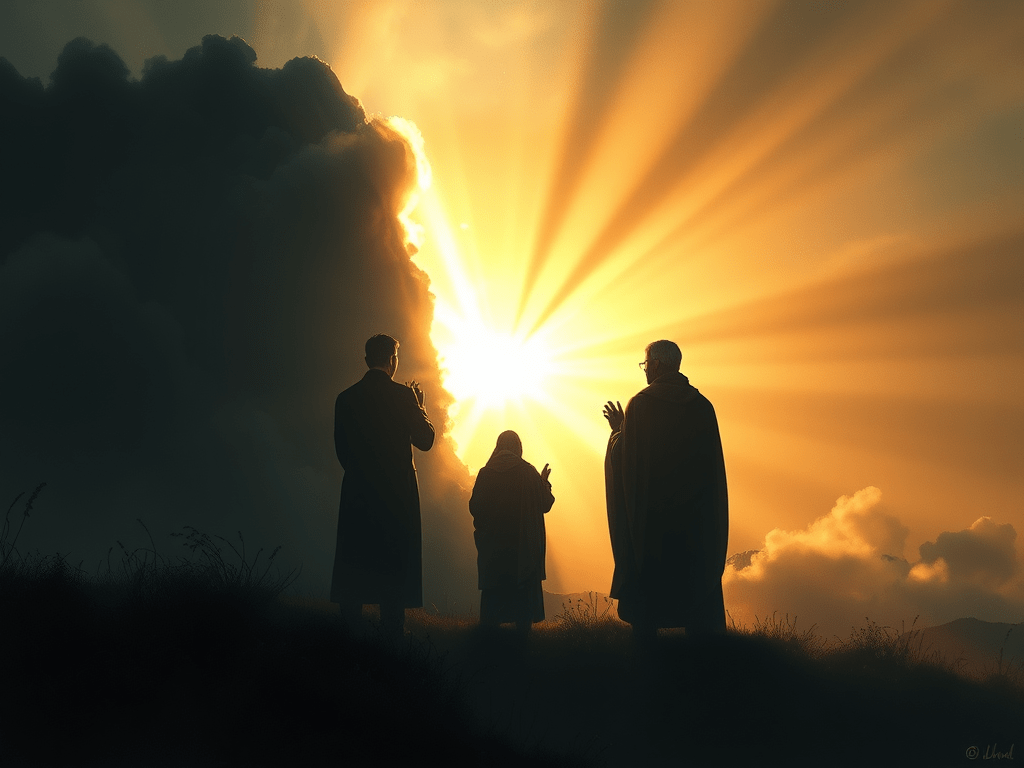
I no longer think of glory as something I give to God. I now know that His glory is the essence of His being, the very presence that sustains the universe, the uncontainable fire that either consumes or transforms.
If we truly understand what it means to encounter Him, we will stop seeing glory as a human contribution and start seeing it for what it really is:
The inescapable, eternal presence of God that either undoes us or remakes us.
I can never be the same after encountering Him.
What About You?
Have you ever felt the weight of His presence? Have you ever experienced a moment where you couldn’t stand, couldn’t speak, couldn’t do anything but weep or fall?
Because if you have, you know. You know that God’s glory is not just a theological idea—it is something that breaks a person and changes them forever.
Appendix of References
Exodus 3:5 – “Take off your sandals, for the place where you are standing is holy ground.”
Exodus 20:19 – “Speak to us yourself and we will listen. But do not have God speak to us or we will die.”
Exodus 33:20 – “You cannot see my face, for no one may see me and live.”
Isaiah 6:3 – “Holy, holy, holy is the Lord of Hosts; the whole earth is full of His glory!”
Isaiah 6:5 – “Woe is me! For I am undone; because I am a man of unclean lips…”
Isaiah 64:6 – “All of us have become like one who is unclean, and all our righteous acts are like filthy rags…”
Psalm 14:1 – “The fool says in his heart, ‘There is no God.’”
Psalm 19:1–2 – “The heavens declare the glory of God; the skies proclaim the work of His hands. Day after day they pour forth speech; night after night they reveal knowledge.”
Psalm 46:10 – “Be still, and know that I am God.”
Matthew 6:7–8 – “And when you pray, do not keep on babbling like pagans… for your Father knows what you need before you ask Him.”
Matthew 6:33 – “But seek first the kingdom of God and His righteousness…”
Matthew 20:13–16 – “‘I am not being unfair to you, friend… Or are you envious because I am generous?’ So the last will be first, and the first will be last.”
Luke 5:16 – “But Jesus often withdrew to lonely places and prayed.”
Luke 15:4–6 – “Suppose one of you has a hundred sheep and loses one of them… And when he finds it, he joyfully puts it on his shoulders and goes home.”
Luke 19:40 – “‘I tell you,’ he replied, ‘if they keep quiet, the stones will cry out.’”
John 3:3 – “Very truly I tell you, no one can see the kingdom of God unless they are born again.”
John 15:4 – “Remain in me, as I also remain in you…”
Acts 9:3–4 – “As he journeyed… a light shone around him… Then he fell to the ground and heard a voice…”
Romans 3:10–12 – “There is no one righteous, not even one; there is no one who understands…”
Romans 5:6 – “At just the right time, when we were still powerless, Christ died for the ungodly.”
Romans 12:1 – “…offer your bodies as a living sacrifice, holy and pleasing to God—this is your true and proper worship.”
Ephesians 2:1–2 – “As for you, you were dead in your transgressions and sins…”
Ephesians 2:4–5 – “But because of His great love for us, God… made us alive with Christ…”
Ephesians 2:8–9 – “For by grace you have been saved through faith… not of works, so that no one can boast.”
Colossians 1:16–17 – “For in Him all things were created… and in Him all things hold together.”
Hebrews 11:6 – “And without faith it is impossible to please God…”
Titus 3:5 – “He saved us, not because of righteous things we had done, but because of His mercy…”
1 Kings 19:11–12 – “…but the Lord was not in the wind… the earthquake… the fire… but in a still small voice.”
Revelation 1:17 – “When I saw him, I fell at his feet as though dead.”
Revelation 4:8 – “Holy, holy, holy is the Lord God Almighty, who was, and is, and is to come!”
Other References
Bethel Music – “Be Enthroned”
Lyrics referenced: “We’ve come to join the song / Sung long before our lives…”
Hebrew Term – בֶּגֶד עִדִּים (Beged Iddim)
Translated as “filthy rags” in Isaiah 64:6, referring to garments ceremonially unclean by Levitical law.
Greek Term – ἀσθενῶν (Asthenōn)
Used in Romans 5:6, translated as “powerless,” meaning utterly weak, incapable of action.



Leave a comment