
Rome Transformed Christianity
I’ve been mulling over some wild ironies in history—a journey that leaves me both perplexed and profoundly moved.
As I reflect on the period from 100 AD to the Edict of Milan, I find myself questioning how a faith, so deeply rooted in the humble traditions of Judaism, was eventually remolded into an institutional tool of the state.
Now, don’t get me wrong—I remain steadfast in my faith in Christ and God.
Yet, I can’t help but wonder about the transformation that took place. How did a vibrant, grassroots movement, born out of genuine devotion and community, end up being repurposed by an empire for its own political ends?
This isn’t a rejection of the true message of Christ; rather, it’s a heartfelt, apologetic inquiry into the ways history has reshaped what was once an organic, communal expression of faith into something far more structured and, at times, manipulated. I wonder if anyone else feels that mix of shock and outrage at the sheer scale of this transformation.
Let’s dive deeper into this conundrum and see if we can unravel some of these perplexing threads together.
Re-purposing Temples and Festivals
I’ve dug into some archaeological findings and historical records that back up how Rome repurposed its pagan temples for Christian use. Here are a couple of examples that really illustrate the transformation:
The Pantheon
One of the most iconic examples is the Pantheon in Rome. Originally built as a temple dedicated to all the gods under Emperor Hadrian around 126 AD, the Pantheon was a marvel of Roman religious architecture. Fast forward a few centuries, and in 609 AD, it was consecrated as a Christian church—now known as Santa Maria ad Martyres.
Archaeologists and historians have noted that during its conversion, pagan altars and symbols were removed or reinterpreted. The grand columns and the oculus, once meant to inspire awe for a pantheon of deities, now served to elevate the Christian liturgy. Written records from later periods even hint at how the building’s transformation was part of a broader strategy to integrate and appropriate familiar sites for Christian worship, making the new faith feel more acceptable to the populace.
The Basilica of San Clemente
Another fascinating example is the Basilica of San Clemente in Rome. This site is like an archaeological palimpsest, showing layers of religious history built atop one another. Excavations have revealed that the current Christian basilica was constructed over earlier structures that once served pagan functions. In these lower layers, evidence of pagan altars, inscriptions, and mosaic decorations with symbols that hark back to the old gods have been found.
Over time, these elements were either removed or subtly integrated into the Christian narrative—sometimes reinterpreted as symbols of a divine truth that prefigured the coming of Christ. This blending of traditions helped ease the transition for a society steeped in long-established rituals, even if it meant that the authentic, grassroots elements of early Judaism and Christianity became overshadowed by an institutionalized faith.
The Integration of Festivals
Even more surprising is the way old festivals were absorbed into the Christian calendar. For example, the popular midwinter festival, known as Saturnalia, gradually influenced the celebration of Christmas. This shift wasn’t about erasing the past, but rather about making the conversion process smoother for the masses. By keeping familiar celebrations in a new guise, Constantine and his successors made the big leap to monotheism seem less abrupt and more acceptable to everyday Romans.
These examples show that the transformation wasn’t about erasing the past altogether—it was more about reinterpreting and repackaging the familiar for a new religious context. The Pantheon and San Clemente are tangible proofs of how the Roman Empire, in its push for unity under Christianity, integrated its rich tapestry of pagan heritage into a new monotheistic framework. This approach made the shift more palatable for the masses, even as it diluted some of the original, deeply rooted traditions.
It’s pretty wild to think about how symbols and sacred spaces can be redefined and given new life, all in the name of political and cultural unity.
Overlooking the Jewish Roots
Let’s dive a bit deeper into how Roman influence reshaped key Jewish festivals and practices as Christianity evolved. There are a few more examples that show this process in action:
Reconfiguring the Weekly Rhythm
One of the clearest changes was the shift from the traditional Jewish Sabbath (Saturday) to Sunday worship. The Jewish Sabbath was a day of rest, reflection, and community, deeply embedded in Jewish law and practice. However, as Christianity came under the sway of Roman influence, the focus shifted to Sunday—a day that not only honored the resurrection of Christ but also dovetailed with the Roman celebration of Sol Invictus, the “Sun” God.
This change wasn’t accidental; it was a strategic move to make the new faith more appealing and familiar to the Roman populace, who were accustomed to their own cultural rhythms.
A Shift in Meaning
Passover Reimagined
Another significant example is how the meanings of key Jewish festivals were reinterpreted. Take Passover, for instance. Originally, Passover celebrated the Israelites’ liberation from Egypt—a deeply rooted Jewish tradition. In early Christianity, however, the Passover meal was transformed into the Last Supper, which later became the basis for the Eucharist. Over time, the focus shifted from the historical exodus to commemorating Christ’s sacrifice. This reinterpretation not only created a distinct Christian identity but also forged a path that both borrowed from and diverged from its Jewish origins.
Pentecost Transformed
Similarly, Pentecost offers another clear example. In Judaism, Pentecost (or Shavuot) originally marked the giving of the Torah at Mount Sinai—a celebration of divine law and legal tradition. In the new Christian calendar, however, Pentecost was repurposed to celebrate the descent of the Holy Spirit on the apostles, a moment seen as the birth of the Church. This transformation reoriented the festival from a celebration of legal tradition to one of spiritual empowerment, making it resonate more with a Roman audience in search of a unified religious experience.
It’s fascinating to see how these redefinition of festivals not only facilitated the integration of Jewish traditions into early Christianity but also helped shape a new, cohesive religious identity that appealed to the broader, diverse populace of the Roman Empire.
Reshaping Faith
These examples show that while early Christianity was deeply rooted in Jewish tradition, the Roman transformation of the faith involved a deliberate reshaping of its practices. By shifting the Sabbath, reinterpreting Passover, and repurposing Pentecost, Roman authorities made it easier for a predominantly non-Jewish population to adopt this new form of worship.
- Shifting the Sabbath: The move from the traditional Jewish Sabbath (Saturday) to Sunday worship wasn’t random. It tied into the Roman celebration of the sun god, Sol Invictus, and helped frame the resurrection of Christ in a context familiar to Roman citizens.
- Reinterpreting Passover: Originally, Passover commemorated the Israelites’ liberation from Egypt—a foundational Jewish narrative. Over time, its symbolism was reimagined in Christian theology as a prefiguration of Christ’s sacrifice, turning a historic celebration into a ritual that underscored the Eucharist.
- Repurposing Pentecost: In Judaism, Pentecost (or Shavuot) celebrated the giving of the Torah at Mount Sinai. Under Roman influence, it became a day to honor the descent of the Holy Spirit on the apostles, thus marking the birth of the Church and shifting the focus from law to divine inspiration.
Essentially, the authentic, grassroots elements of the original faith were systematically supplanted by an institutional structure designed to mesh with the broader cultural and political landscape of the Roman Empire.
It is also crucial to note that by the time these changes took hold, the population of Jews and Jewish Christians had dwindled dramatically due to relentless persecution and widespread attacks. With so few remaining adherents, reshaping the narrative around the Jewish Messiah became far easier for the Roman authorities—there were simply not enough voices left to resist or challenge the new order.
Isn’t it wild to see how these changes helped bridge the gap between two very different worlds—even if it meant leaving some of the original Jewish traditions behind?
It feels like the very soul of the original movement was hidden behind layers of political strategy and adaptation, a subtle yet profound transformation that continues to spark debate and reflection to this day.
The Mockery of the Cross
A Symbol Reborn
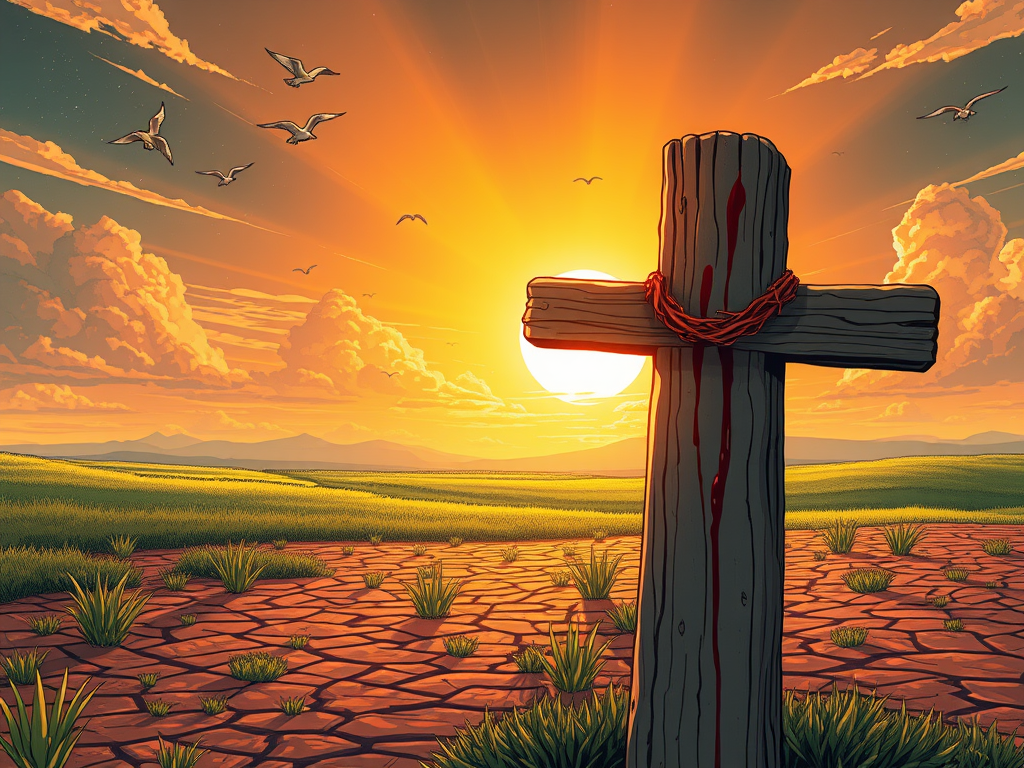
Then there’s the ultimate twist: the rise of the cross as the symbol of Christianity. For early Jews and Christians, the cross was not a mark of honor—it was an instrument of death, a brutal tool used by the Romans to execute rebels and criminals, including the very Messiah they revered. To imagine venerating a symbol that represented such unmitigated cruelty is nothing short of staggering. It’s as if the empire’s brutal methods were twisted into a mark of divine salvation, a transformation that turns agony into adoration.
I can’t help but imagine the shock and disbelief among those original believers. The cross, once a symbol of humiliation and suffering, was suddenly elevated to the centerpiece of Christian worship. This radical shift was more than a mere change of symbols—it was a profound reimagining of what that symbol represented. As Constantine famously declared,
“In this sign, conquer.”
This simple yet powerful statement encapsulates a deep irony: the very tool of Roman conquest became the emblem of a faith that now served the empire’s agenda.
For many true worshipers, it must have felt like a mockery—a stark reminder that the message of salvation had been repackaged by those in power, transforming the pain of crucifixion into a symbol of hope and redemption.
Pondering the Threads of History
I’m left with deep questions about what it means to be a Christian when history has been so thoroughly rewritten by political forces. How did a movement, once rooted in the humble and sincere traditions of Judaism, become an institutional façade designed to support an empire’s ambitions?
It’s a striking and thought-provoking revelation, knowing that the sacred message of a grassroots community was, in many ways, redirected to serve the interests of power.
Am I the only one who sees these hidden threads of irony?
It’s enough to make anyone wonder whether we’re truly honoring the original spirit of faith or simply following a narrative shaped by conquerors. The transformation of temples, festivals, and even the cross itself tells a story of profound change—a story that leaves me both deeply amazed and contemplative. I continue to ponder these fascinating intersections of faith, power, and history, eager to uncover more about the layers beneath our inherited traditions.



Leave a comment